Engineering
Fit-for-purpose solutions that meet project objectives and comply with international codes and standards.
Explore discipline →
Who we are
Teknik Engineering Practice (TEP) is dedicated to delivering world-class Engineering, Procurement, and Construction solutions through systematic engineering principles, international standards, proven procedures, and industry best practices.
Our approach combines engineering excellence, technical integrity, innovation, and professional competency to achieve the highest standards of safety, quality, reliability, efficiency, and sustainability.
Read our overview →Core disciplines
From concept to handover, TEP brings disciplined engineering, assured procurement, and safe construction together.
Fit-for-purpose solutions that meet project objectives and comply with international codes and standards.
Explore discipline →Timely and cost-effective acquisition of quality materials, equipment, and professional services.
Explore discipline →Safe, efficient execution aligned with design intent, quality standards, and operational readiness.
Explore discipline →How we work
People, assets, and environment.
Quality in every process and deliverable.
Best practices and continuous improvement.
Responsible practice for a better future.
Featured Ebooks
Explore digital handbooks, templates, and toolkits that help EPC work become more systematic, safe, and measurable.
Go to Product Page →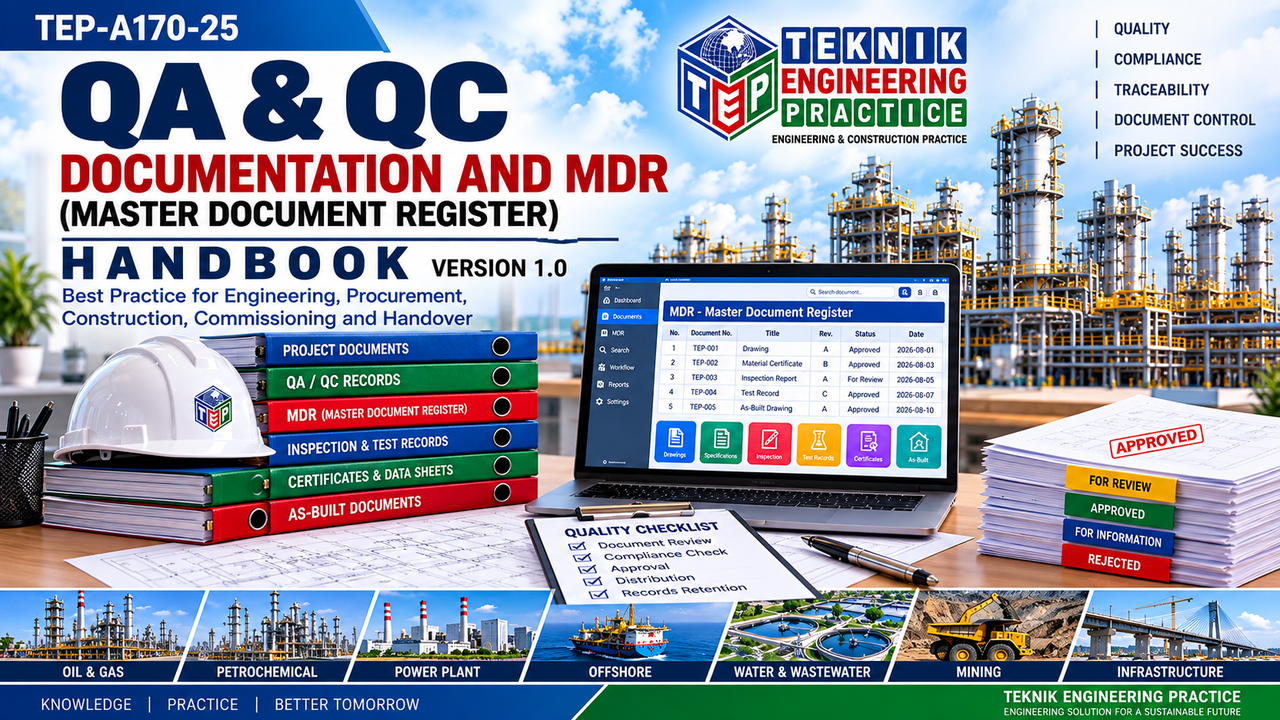
QA & QC DOCUMENTATION AND MDR HANDBOOK VERSION 1.0 presents an end-to-end methodology for planning, controlling, measuring, compiling, and handing over project quality documentation across the complete EPC lifecycle. The handbook defines the architecture and governance of the Master Document Register (MDR), including document numbering, metadata, revision control, status coding, review workflows, approval responsibilities, and interfaces between engineering, procurement, vendor data, fabrication, construction, inspection, testing, pre-commissioning, commissioning, and final turnover. The methodology emphasizes traceability, document completeness, controlled access, timely review, and auditable status management. Practical controls cover Vendor Data Requirement Lists, material certificates, fabrication data books, welding and NDT dossiers, civil and structural records, mechanical equipment files, piping test packs, electrical and instrumentation test records, Requests for Inspection, Inspection and Test Plans, NCR and CAR systems, calibration records, mechanical completion dossiers, commissioning records, as-built drawings, and electronic document-management workflows. The handbook also addresses data quality, document integrity, access control, backup, audit trails, retention periods, archive strategy, digital handover, and long-term retrievability. Quantitative methods are provided for MDR completeness, weighted document progress, on-time submission, first-pass acceptance, review cycle time, overdue aging, traceability coverage, and turnover readiness. Worked examples demonstrate how documentation metrics can be converted into reliable management information for prioritization, escalation, forecasting, and closeout decisions. Reusable templates support document registers, transmittals, review logs, status reports, dossier indexes, turnover checklists, and final archive records. Sector-specific guidance covers Oil & Gas, Petrochemical, Chemical, Power Plant, Water & Wastewater, Mining, Manufacturing, Offshore, Infrastructure, and Marine projects. The intended outcome is a consistent, auditable, and practical documentation-control system that ensures quality evidence remains complete, current, traceable, and retrievable. By linking physical completion with approved records, the handbook supports reliable turnover, regulatory compliance, contractual closeout, commissioning readiness, asset information integrity, and efficient transfer of project knowledge into operations and maintenance. It further strengthens coordination among quality, document control, engineering, suppliers, construction, commissioning, operations, and owners through defined responsibilities, measurable workflows, controlled approvals, structured escalation, and disciplined management of outstanding documentation.

NCR CORRECTIVE ACTION QA & QC HANDBOOK VERSION 1.0 defines a closed-loop methodology for controlling nonconforming outputs and corrective actions across EPC, industrial, construction, commissioning, and maintenance activities. The handbook begins with requirement-based detection and objective evidence, then establishes containment, classification, technical disposition, controlled correction, re-inspection, root-cause analysis, corrective action, completion verification, effectiveness confirmation, and formal closure. The methodology emphasizes traceability, timely escalation, risk-based prioritization, authorized disposition, and evidence-driven decision making. Nonconformities may arise from products, processes, documents, suppliers, fabrication, construction, commissioning, operations, or maintenance, and each case is linked to the applicable requirement, responsible function, corrective action, verification record, and closure status. Technical content includes severity classification, risk prioritization, 5 Why analysis, Ishikawa diagrams, Risk Priority Number calculations, trend analysis, cost of poor quality, acceptance and disposition logic, data integrity, supplier corrective action requests, discipline-specific examples, construction controls, commissioning re-test requirements, industrial-sector tailoring, and reliability follow-up. Worked examples demonstrate how recurring issues can be converted into measurable trends and management actions. Practical guidance addresses containment, use-as-is, repair, rework, reject, concession, deviation control, root-cause verification, action ownership, due dates, effectiveness checks, and prevention of recurrence. Forms and appendices provide reusable templates for NCRs, CAPA, RCA, ITP interfaces, field release, supplier responses, commissioning re-tests, audit tracking, lessons learned, and KPI monitoring. The handbook is intended for QA/QC engineers, inspectors, discipline engineers, project managers, construction managers, supplier-quality personnel, commissioning teams, maintenance and reliability engineers, and auditors working across Oil & Gas, Petrochemical, Chemical, Power, Water & Wastewater, Mining, Manufacturing, Offshore, Infrastructure, and Marine industries. The intended outcome is a consistent, auditable, and practical nonconformance-management system that reduces repeat defects, strengthens accountability, improves supplier and contractor performance, protects quality and reliability, and converts corrective-action data into continuous improvement throughout the project and asset lifecycle. Additional guidance addresses escalation thresholds, aging analysis, recurring-defect alerts, workflow controls, approval authority, closure dashboards, audit readiness, management review, knowledge capture, and feedback into engineering standards, procurement specifications, inspection planning, maintenance strategies, and projects.
NDT INSPECTION HANDBOOK VERSION 1.0 provides a comprehensive Quality Assurance and Quality Control framework for non-destructive testing across Oil & Gas, Petrochemical, Chemical, Power Generation, Water & Wastewater, Mining, Manufacturing, Offshore, Marine, and Infrastructure projects. The handbook covers visual testing, penetrant testing, magnetic particle testing, ultrasonic testing, phased array, TOFD, radiographic testing, digital radiography, eddy current, ACFM/ECA, magnetic flux leakage, guided wave, leak testing, acoustic emission, infrared thermography, PMI, portable hardness, coating and wall-thickness measurement, and civil NDT techniques. Each technical chapter addresses testing principles, limitations, equipment requirements, procurement control, calibration, written procedures, Inspection and Test Plan points, field workflow, HSE, indication evaluation, acceptance logic, reporting, maintenance frequency, reliability applications, and representative calculations. Application guidance extends these methods to welds, pressure vessels, heat exchangers, piping, pipelines, storage tanks, structural steel, rotating equipment, boilers, HRSG units, power assets, and offshore or subsea systems. The methodology emphasizes qualified personnel, calibrated equipment, approved procedures, traceable consumables, controlled hold and witness points, objective interpretation, and complete digital records. Lifecycle inspection planning connects fabrication, construction, commissioning, baseline inspection, in-service monitoring, integrity assessment, repair verification, and reliability management. Practical content includes indication review, equipment-control logs, consumable records, calibration forms, inspection checklists, commissioning baselines, trend analysis, reporting templates, method-selection matrices, and worked examples. Examples are intentionally transparent and conservative, supporting engineering review without replacing project-specific acceptance calculations or approved code requirements. The intended outcome is a consistent, auditable, and technically defensible NDT system that improves defect detection, inspection reliability, traceability, and asset integrity. Project engineers shall substitute actual geometry, material properties, code limits, service conditions, and risk assumptions before final acceptance decisions. The handbook also supports coordinated decision-making among engineering, procurement, fabrication, construction, commissioning, operations, maintenance, vendors, inspectors, and owners, ensuring that NDT evidence remains available for quality release, root-cause investigation, lifecycle reliability, maintenance planning, and long-term asset management. It also strengthens inspection governance, digital traceability, repair control, technical reporting, lessons learned, and continuous improvement across complex industrial facilities and projects worldwide.
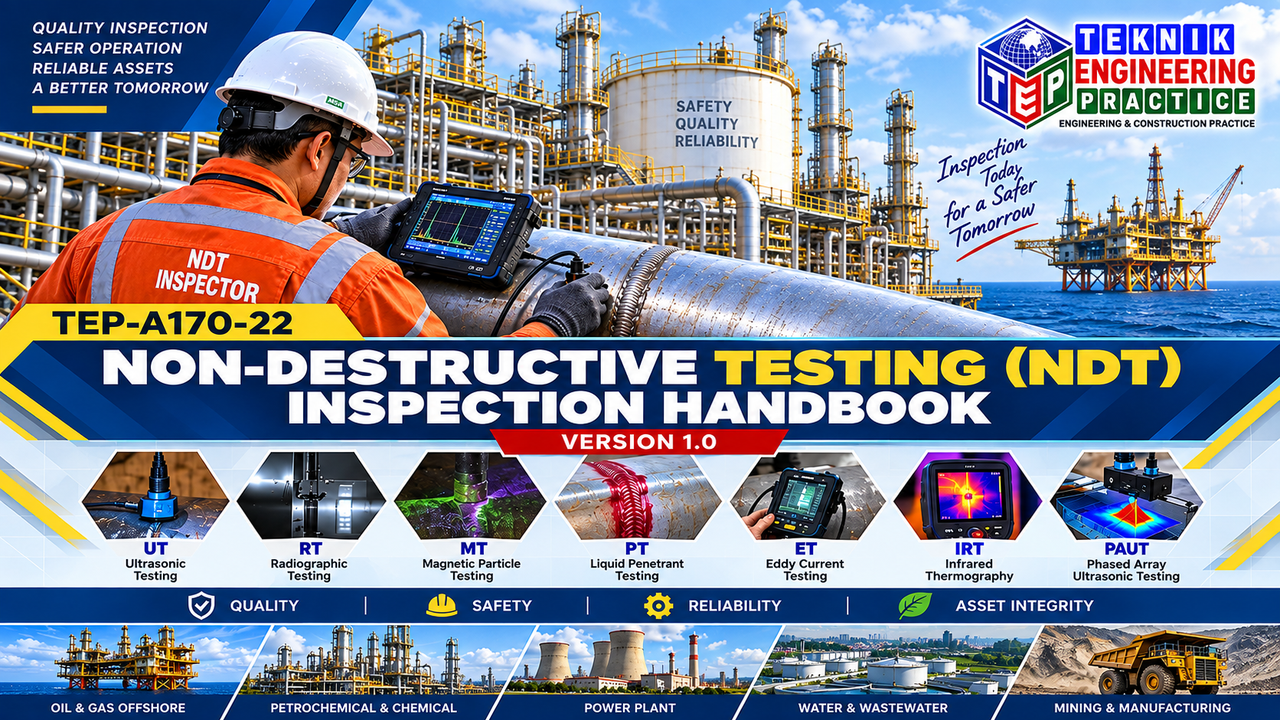
NDT INSPECTION HANDBOOK VERSION 1.0 provides a comprehensive Quality Assurance and Quality Control framework for non-destructive testing across Oil & Gas, Petrochemical, Chemical, Power Generation, Water & Wastewater, Mining, Manufacturing, Offshore, Marine, and Infrastructure projects. The handbook covers visual testing, penetrant testing, magnetic particle testing, ultrasonic testing, phased array, TOFD, radiographic testing, digital radiography, eddy current, ACFM/ECA, magnetic flux leakage, guided wave, leak testing, acoustic emission, infrared thermography, PMI, portable hardness, coating and wall-thickness measurement, and civil NDT techniques. Each technical chapter addresses testing principles, limitations, equipment requirements, procurement control, calibration, written procedures, Inspection and Test Plan points, field workflow, HSE, indication evaluation, acceptance logic, reporting, maintenance frequency, reliability applications, and representative calculations. Application guidance extends these methods to welds, pressure vessels, heat exchangers, piping, pipelines, storage tanks, structural steel, rotating equipment, boilers, HRSG units, power assets, and offshore or subsea systems. The methodology emphasizes qualified personnel, calibrated equipment, approved procedures, traceable consumables, controlled hold and witness points, objective interpretation, and complete digital records. Lifecycle inspection planning connects fabrication, construction, commissioning, baseline inspection, in-service monitoring, integrity assessment, repair verification, and reliability management. Practical content includes indication review, equipment-control logs, consumable records, calibration forms, inspection checklists, commissioning baselines, trend analysis, reporting templates, method-selection matrices, and worked examples. Examples are intentionally transparent and conservative, supporting engineering review without replacing project-specific acceptance calculations or approved code requirements. The intended outcome is a consistent, auditable, and technically defensible NDT system that improves defect detection, inspection reliability, traceability, and asset integrity. Project engineers shall substitute actual geometry, material properties, code limits, service conditions, and risk assumptions before final acceptance decisions. The handbook also supports coordinated decision-making among engineering, procurement, fabrication, construction, commissioning, operations, maintenance, vendors, inspectors, and owners, ensuring that NDT evidence remains available for quality release, root-cause investigation, lifecycle reliability, maintenance planning, and long-term asset management. It also strengthens inspection governance, digital traceability, repair control, technical reporting, lessons learned, and continuous improvement across complex industrial facilities and projects worldwide.

INSULATION, REFRACTORY AND FIREPROOFING QA & QC HANDBOOK VERSION 1.0 provides a structured quality assurance and quality control framework for thermal and acoustic insulation, corrosion-under-insulation prevention, refractory linings, spray-applied and intumescent passive fire protection, and firestopping across EPC and industrial projects. The handbook covers engineering design basis, material specification, procurement surveillance, receiving inspection, storage, substrate release, installation control, testing, field release, commissioning, maintenance, and digital traceability. The methodology emphasizes verified design requirements, compatible materials, controlled storage, approved installation procedures, qualified personnel, calibrated inspection equipment, environmental monitoring, traceable records, and objective acceptance evidence. Practical guidance addresses insulation thickness, jacketing, vapor barriers, weatherproofing, CUI prevention, refractory anchors, joints, mixing, placement, curing, dry-out, passive fire-protection preparation, thickness control, density, adhesion, firestopping interfaces, defect management, repair, and final release. Technical content includes heat-transfer fundamentals, cylindrical thermal resistance, condensation and dew-point checks, refractory lining design considerations, anchor spacing and joint control, curing and dry-out requirements, passive fire-protection system selection, section-factor concepts, fireproofing thickness, density and adhesion testing, inspection frequencies, maintenance planning, and worked examples. These examples support engineering review and inspection judgment while final acceptance remains governed by approved project specifications, manufacturer requirements, contractual obligations, and applicable standards. The handbook also provides guidance for Inspection and Test Plans, material receiving, preservation, substrate inspection, installation checklists, test records, NCR control, punch closure, commissioning handover, maintenance frequencies, and digital quality records. Sector application guidance covers Oil & Gas, Petrochemical, Chemical, Power, Water & Wastewater, Mining, Manufacturing, Offshore, Marine, and Infrastructure projects. The intended outcome is a consistent, auditable, and practical QA/QC system that reduces heat loss, condensation, CUI risk, refractory failure, passive fire-protection defects, rework, and premature deterioration. By connecting engineering requirements with field inspection, traceability, testing, and lifecycle maintenance, the handbook supports safer facilities, improved reliability, complete turnover records, and sustained asset protection throughout operation. Reusable templates for inspection requests, environmental records, material controls, repair logs, release certificates, maintenance schedules, and reliability feedback further support standardized implementation and continuous improvement programs.
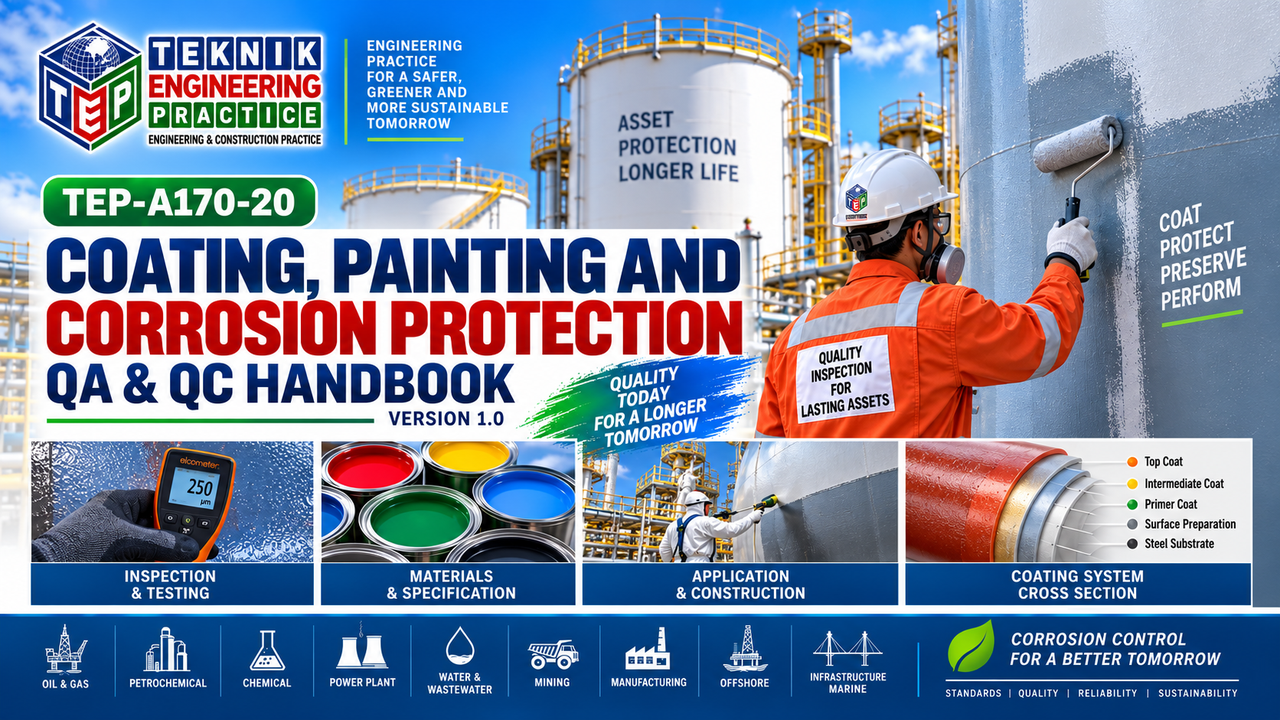
COATING PAINTING CORROSION QA & QC HANDBOOK VERSION 1.0 provides an integrated quality assurance and quality control framework for protective coating, painting, and corrosion-protection activities on steel structures, piping, equipment, tanks, and industrial assets. The handbook covers corrosion mechanisms, coating-system selection, surface preparation, environmental monitoring, material receiving and storage, mixing and application control, wet and dry film thickness, holiday detection, adhesion testing, defect assessment, repair, Inspection and Test Plans, field release, commissioning, maintenance, and industrial-sector adaptations. The methodology emphasizes surface condition, environmental control, material traceability, qualified personnel, calibrated inspection equipment, approved procedures, controlled application stages, and objective acceptance evidence. Practical guidance addresses abrasive blasting, cleanliness, surface profile, soluble salts, dust contamination, dew point, relative humidity, coating pot life, induction time, recoat intervals, stripe coating, application methods, curing, DFT measurement, discontinuity testing, adhesion verification, and final inspection. Each chapter integrates technical theory, practical inspection points, representative material requirements, checklists, calculation notes, quality records, maintenance considerations, and unique engineering illustrations. Worked examples address paint quantity, theoretical spreading rate, dry-film-thickness acceptance, dew-point margin, abrasive consumption, inspection sampling, coating loss factors, and repair-area estimation. These examples support inspection judgment and planning while final acceptance remains governed by approved project specifications, manufacturer instructions, contractual requirements, and applicable standards. The handbook also provides guidance for NCR management, coating defects, repair procedures, preservation, field release, punch closure, commissioning interfaces, maintenance frequencies, corrosion monitoring, and lifecycle reliability. Reusable templates support material receiving, environmental records, blasting inspection, coating application, DFT measurement, holiday testing, adhesion testing, NCR control, release documentation, and final handover. The intended outcome is a consistent, auditable, and practical coating QA/QC system that reduces corrosion risk, coating failures, rework, and premature degradation. It supports Oil & Gas, Petrochemical, Chemical, Power, Water & Wastewater, Mining, Manufacturing, Offshore, Infrastructure, and Marine projects while enabling adaptation into project-specific procedures, ITPs, inspection forms, and maintenance programs.
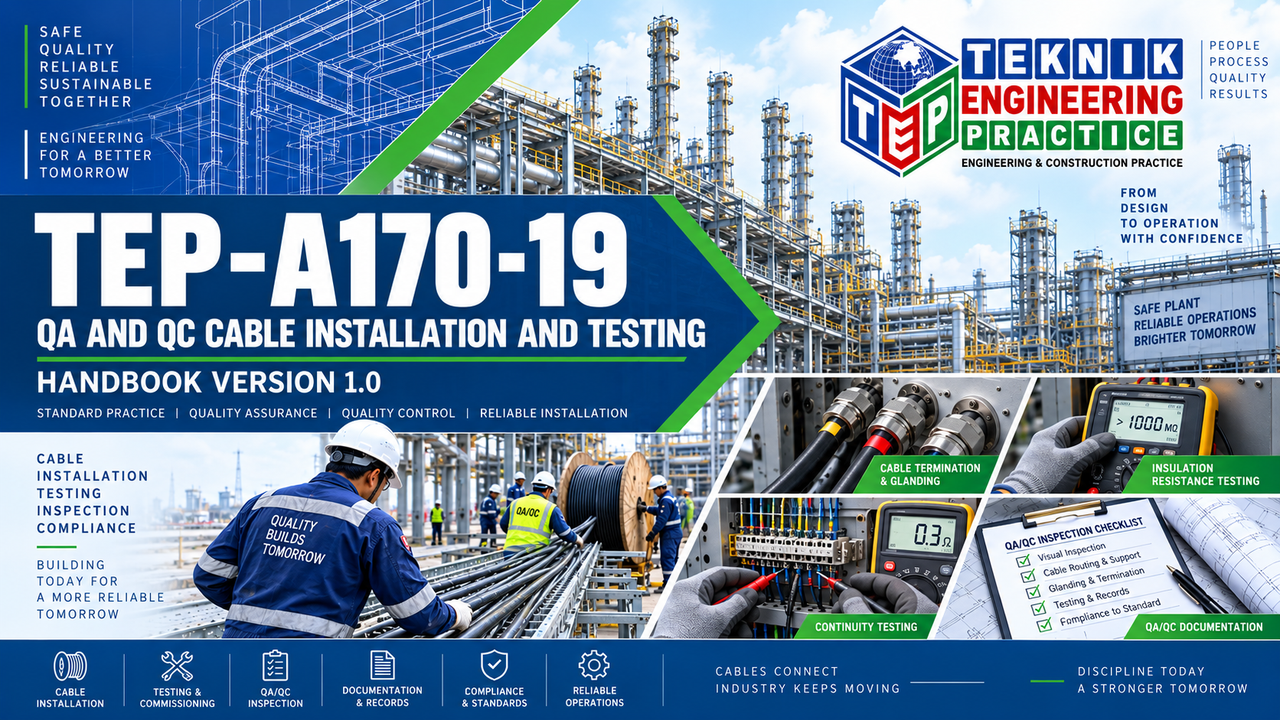
QA & QC CABLE INSTALLATION AND TESTING HANDBOOK VERSION 1.0 provides an end-to-end quality assurance and quality control framework for power, control, instrumentation, and communication cable systems across EPC and industrial projects. The handbook covers quality management, applicable standards, cable construction, procurement, receiving inspection, storage, drum management, route readiness, cable trays, conduits, underground installation, cable pulling, LV, MV and HV systems, fiber optics, glands, firestopping, terminations, earthing and bonding, tagging, field inspection, testing, commissioning, maintenance, sector applications, and engineering calculations. Each chapter is structured as a field-ready package comprising an overview, design and material basis, applicable standards, Inspection and Test Plan requirements, calculation or engineering notes, installation procedures, inspection checklists, test methods, acceptance records, maintenance guidance, reliability considerations, and sector-specific applications. Unique 3D engineering schematics and field-style visualizations support understanding of installation sequences, interfaces, inspection points, and common field conditions. The methodology emphasizes traceability, approved procedures, qualified personnel, calibrated test equipment, controlled installation stages, and objective acceptance evidence. Practical guidance addresses drum handling, cable identification, bend radius, pulling tension, segregation, support spacing, gland selection, termination quality, torque control, insulation resistance, continuity, sheath testing, fiber testing, earthing, fire sealing, punch management, and final release. Appendices provide reusable master ITPs, material receiving forms, drum, cutting and pulling records, installation checklists, termination and torque sheets, electrical test forms, formula sheets, procurement matrices, maintenance schedules, sector matrices, NCR, punch and release forms, standards references, and abbreviations. The intended outcome is a consistent, auditable, and practical cable QA/QC system that reduces installation defects, prevents damage, strengthens traceability, improves testing quality, supports safe energization, and enables reliable handover. The handbook can be tailored into project-specific procedures and work packs by replacing generic acceptance statements with approved project criteria, controlled drawings, photographs, and document numbers for each project. Application guidance supports Oil & Gas, Petrochemical, Chemical, Power Generation, Water & Wastewater, Mining, Manufacturing, Offshore, Infrastructure, and Marine projects, while lifecycle controls connect procurement, construction, commissioning, operations, maintenance, reliability feedback, and continuous improvement.
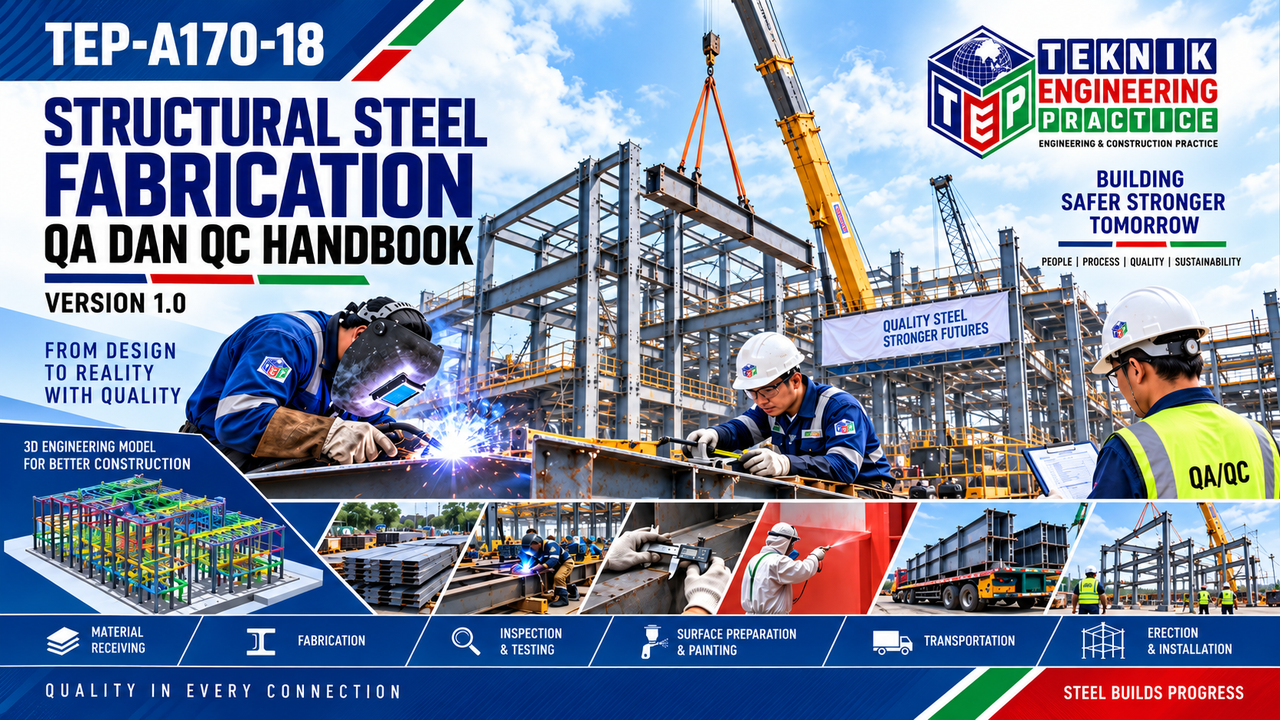
STRUCTURAL STEEL FABRICATION QA & QC HANDBOOK VERSION 1.0 presents an integrated framework for Quality Assurance and Quality Control of structural steel fabrication across the complete project lifecycle. It covers design review, procurement, material receiving, identification and traceability, cutting, drilling, forming, fit-up, welding, nondestructive testing, bolting, dimensional inspection, surface preparation, protective coating, packing, transportation, site receiving, erection, commissioning interfaces, maintenance, and reliability. The methodology emphasizes traceability, approved procedures, qualified personnel, calibrated equipment, controlled inspection stages, and objective acceptance evidence. Material certificates, heat numbers, weld maps, inspection records, NDT results, bolt records, coating data, dimensional reports, and release status are linked so that fabricated components remain traceable from raw material receipt through erection and final handover. Technical content includes material and welding control guidance, Inspection and Test Plan concepts, technical tables, inspection checklists, calculation notes, worked examples, maintenance frequencies, quality metrics, NCR workflows, document control, and Manufacturing Data Record requirements. Practical topics include member identification, fit-up tolerances, welding surveillance, repair control, bolt installation, alignment, dimensional surveys, surface cleanliness, coating thickness, packing, preservation, and transport damage prevention. Worked examples support engineering review and inspection judgment while final acceptance remains governed by approved project specifications, drawings, contractual requirements, and applicable code editions. Reusable forms and registers support material receiving, welding, NDT, dimensional inspection, bolting, coating, NCR management, release, erection, and final dossier compilation. Industry application matrices address Oil & Gas, Petrochemical, Chemical, Power Plant, Water & Wastewater, Mining, Manufacturing, Offshore, Infrastructure, and Marine projects. The intended outcome is a consistent, auditable, and practical structural-steel QA/QC system that prevents defects, detects deviations early, reduces rework, preserves material and fabrication traceability, and provides defensible evidence that steelwork has been fabricated, delivered, erected, and accepted in accordance with approved project requirements. The framework also supports reliability, maintainability, lessons learned, and continuous improvement throughout the asset lifecycle. It further supports coordination among engineering, procurement, fabrication, construction, quality, logistics, commissioning, vendors, and owners through standardized responsibilities, inspection points, records, and defined release criteria.