Engineering & Construction PracticeSafety • Quality • Integrity • Sustainability

Knowledge & competency

Engineering Resources

Practical references, templates, and learning materials designed to strengthen professional engineering competency.

Thumbnail for TEP-A350-03 FLARE STACK HANDBOOK VERSION 1.0
Digital Resource

TEP-A350-03 FLARE STACK HANDBOOK VERSION 1.0

This handbook presents a systematic approach to flare-stack systems used for the controlled disposal and combustion of relief and depressurization gases. It covers system selection, relief-load definition, flare-header hydraulics, knockout drums, seal systems, stack configuration, radiation, dispersion, pilot and ignition systems, flare tips, assist utilities, smoke control, noise, materials, structural design, piping stress, instrumentation, electrical interfaces, hazardous-area requirements and functional safety. Project execution topics include design deliverables, technical bid evaluation, vendor data, material traceability, welding, NDE, fabrication, transport, erection, construction inspection, pre-commissioning, start-up and performance acceptance. Operating topics include monitoring, troubleshooting, emissions reporting, inspection, maintenance, reliability and management of change. The handbook contains worked screening calculations and controlled templates for datasheets, material specifications, vendor document registers, inspection and test plans, shop inspection, construction, commissioning, operation, maintenance, HAZOP and industrial-sector applications. The objective is to improve technical consistency, interdisciplinary coordination, traceability and safe decision-making across the flare-system lifecycle.  

Rp499.000
Thumbnail for TEP-A350-02 FURNACE HANDBOOK VERSION 1.0
Digital Resource

TEP-A350-02 FURNACE HANDBOOK VERSION 1.0

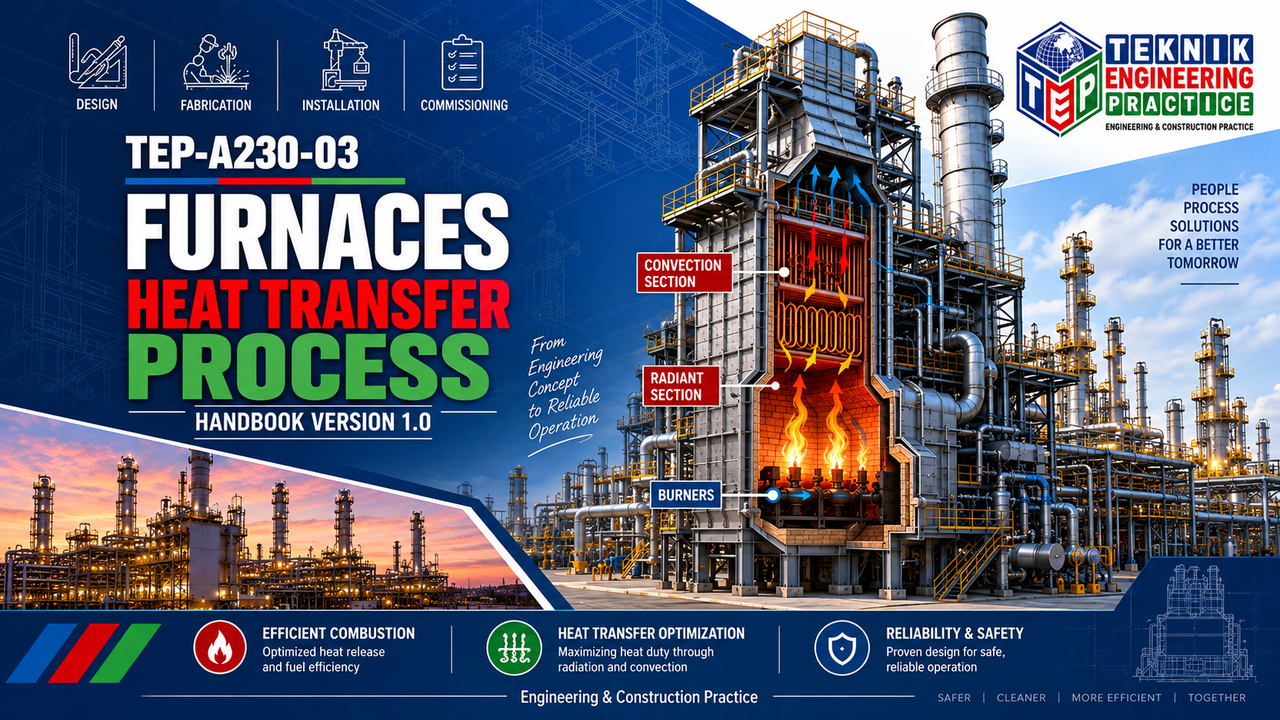
This handbook provides a comprehensive professional reference for the engineering and lifecycle management of industrial furnaces and fired heaters. Coverage includes heat-duty definition, fuel and combustion balance, radiant and convection design, burners, draft systems, refractory, coils, materials, structures, instrumentation, protective interlocks, environmental control, fabrication, inspection, construction, commissioning, operation and maintenance. The document includes practical calculation notes, technical control tables, inspection checklists, common-defect guidance, material and procurement controls, ITP concepts, commissioning forms and maintenance templates. It is applicable to oil and gas, refinery, petrochemical, chemical, power, water and wastewater, mining, manufacturing, offshore, infrastructure and marine project environments, subject to project-specific engineering review. The expanded lifecycle chapter provides deeper equipment- and material-specific controls for design, shop fabrication, packing and transportation, site installation, commissioning, handover and reliability baselining. Chapters 1-6 include dedicated field visual reference pages that connect the design basis, thermal calculations, equipment geometry and radiant-section controls to recognizable installation and operating conditions. The central objective is to support safe, efficient and maintainable furnace systems by connecting design assumptions to fabrication evidence, field installation, operating limits, inspection records and reliability decisions throughout the asset lifecycle.

Rp499.000
Thumbnail for TEP-A330-03 TOWER ENGINEERING HANDBOOK VERSION 1.0
Digital Resource

TEP-A330-03 TOWER ENGINEERING HANDBOOK VERSION 1.0

This handbook provides an integrated reference for industrial tower engineering from concept selection through decommissioning. It addresses phase equilibrium, balances, distillation, absorption, stripping, trays, packing, distributors, hydraulics, diameter and height, feed devices, demisters, pressure-vessel design, wind and seismic response, materials, corrosion, fabrication, NDE, instrumentation, process safety, relief and vacuum protection, procurement, transportation, erection, commissioning, operation, inspection, maintenance and industrial applications. Industrial towers are among the most integrated items in a process facility. Their performance depends on thermodynamics, phase equilibrium, internal vapor and liquid traffic, trays or packing, heat exchange, pressure control, mechanical integrity, materials, fabrication quality, construction discipline and operating competence. This handbook is structured as a lifecycle reference. It begins with separation fundamentals and technology selection, develops process and hydraulic design, then addresses mechanical configuration, materials, fabrication, inspection, automation, process safety, procurement, transportation, installation, commissioning, operation, maintenance and sector applications. The intended readers include process, mechanical, piping, civil, electrical and instrumentation engineers; project and construction teams; QA/QC inspectors; commissioning engineers; operators; maintenance personnel; technical trainers and engineering students. Each chapter combines engineering context, workflow, critical checks, deliverables and a technical reference table.

Rp499.000
Thumbnail for TEP-A227-01 ENGINEERING PROCEDURE FOR FIRE PROTECTION HANDBOOK VERSION 1.0
Digital Resource

TEP-A227-01 ENGINEERING PROCEDURE FOR FIRE PROTECTION HANDBOOK VERSION 1.0

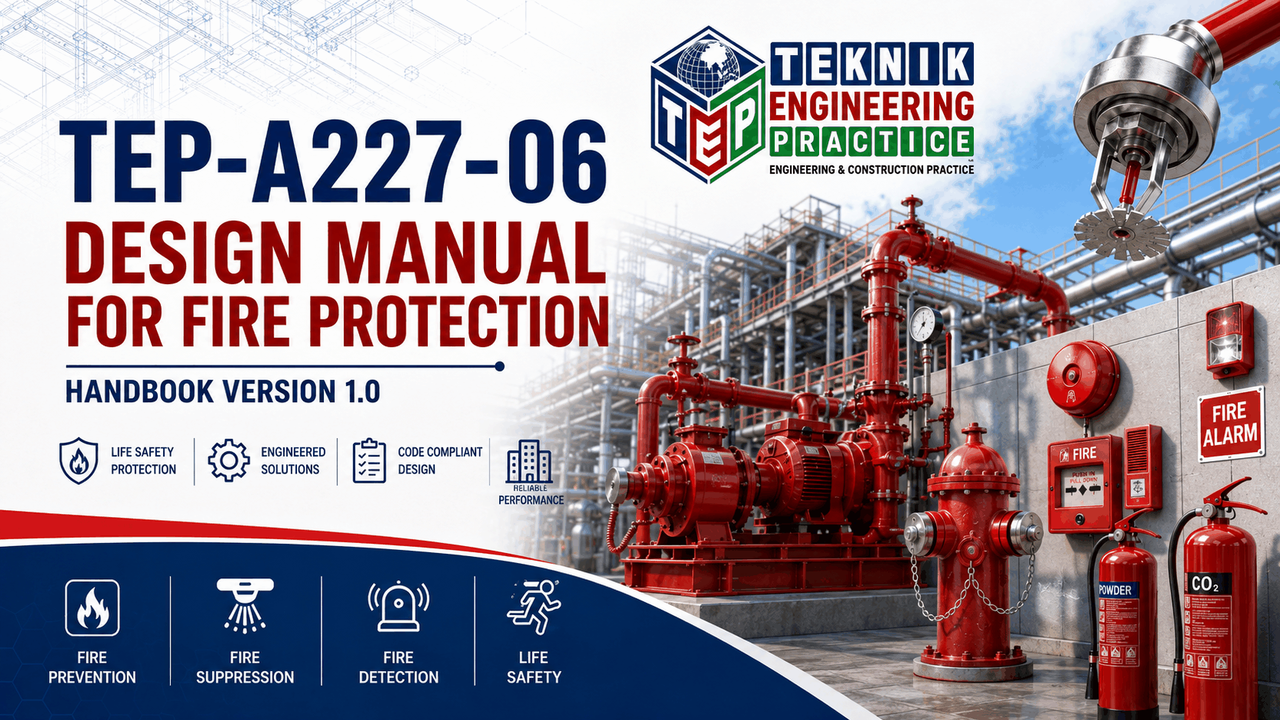
This handbook provides an integrated engineering procedure for active and passive fire protection. It covers fire hazard assessment, fire-water demand, storage, pumps, distribution mains, hydrants, monitors, sprinklers, deluge, foam, water mist, clean agents, carbon dioxide, chemical suppression, portable extinguishers, detection and alarm, fire and gas logic, passive fire protection, smoke control, electrical and instrumentation interfaces, 3D coordination, fabrication, installation, commissioning, maintenance and reliability. The technical approach is based on four principles: protection shall be matched to credible fire scenarios; system capacity shall be demonstrated by calculation; installation shall preserve the approved design and listed or certified equipment requirements; and operational readiness shall be demonstrated by documented inspection, testing, commissioning and maintenance. Worked examples illustrate hydraulic head, water storage, pump power, nozzle or sprinkler discharge, foam concentrate quantity and inspection planning. The examples are deliberately transparent so that assumptions, unit consistency and safety margins can be checked. Final project values remain subject to the governing code, manufacturer data and AHJ acceptance. The handbook also addresses procurement and vendor document control, material traceability, factory acceptance, preservation and shipping, construction quality, field release, functional testing, turnover dossiers, impairment control, preventive maintenance and sector-specific application. It is structured as a professional A4 master suitable for project adaptation and printing.

Rp499.000
Thumbnail for TEP-A225-05 PREPARATION OF PROCESS OPERATION DIAGRAM HANDBOOK VERSION 1.0
Digital Resource

TEP-A225-05 PREPARATION OF PROCESS OPERATION DIAGRAM HANDBOOK VERSION 1.0

This handbook defines a practical framework for preparing Process Operation Diagrams from approved process design inputs. It explains the role of PODs in the document hierarchy; establishes requirements for source-data validation, symbols, equipment, streams, instrumentation, operating modes, alarms, trips, relief and drain systems; and demonstrates typical applications for separation, storage, heat transfer, gas handling, water treatment, mining and offshore facilities. Technical content includes basic equations, worked examples, material and procurement controls, ITP and inspection concepts, commissioning and handover forms, maintenance frequencies, reliability methods, management of change and industrial application matrices. The examples are intentionally generic and must be adapted to the specific project design basis and safety requirements. The expected result is a controlled, operator-oriented diagram that is technically traceable, visually clear, consistent with the PFD and P&ID, aligned with control and safeguarding documents, and maintained through construction, commissioning and operations.

Rp499.000
Thumbnail for TEP-A224-03 WINTERIZATION CONDENSATE RECOVERY SYSTEM HANDBOOK VERSION 1.0
Digital Resource

TEP-A224-03 WINTERIZATION CONDENSATE RECOVERY SYSTEM HANDBOOK VERSION 1.0

WINTERIZATION CONDENSATE RECOVERY SYSTEM provides a professional framework for the design and implementation of winterization and condensate recovery systems across Oil & Gas, Petrochemical, Chemical, Power Plant, Water & Wastewater, Mining, Manufacturing, Offshore, Infrastructure and Marine facilities. The handbook covers ambient design cases, freezing and hydrate risks, insulation, electric and steam heat tracing, glycol heating, instrument protection, vessels, tanks, rotating equipment, flare and drain systems, steam condensate collection, flash steam recovery, receivers, pumps, polishing, materials, fabrication, shipping, construction, commissioning, control, operation, reliability, HSE and industrial applications. Calculation notes address heat loss, tracing output, glycol flow, flash fraction, receiver and pump sizing, warm-up energy, availability and recovery efficiency. A consistent quality pathway is applied from design basis through procurement, ITP, inspection forms, field release, commissioning and maintenance. The goal is a winter-ready installation with clear evidence that thermal protection, drainage, control and condensate recovery perform as intended.

Rp499.000
Thumbnail for TEP-A222-03 PROCESS ENGINEERING TECHNICAL DESIGN HANDBOOK VERSION 1.0
Digital Resource

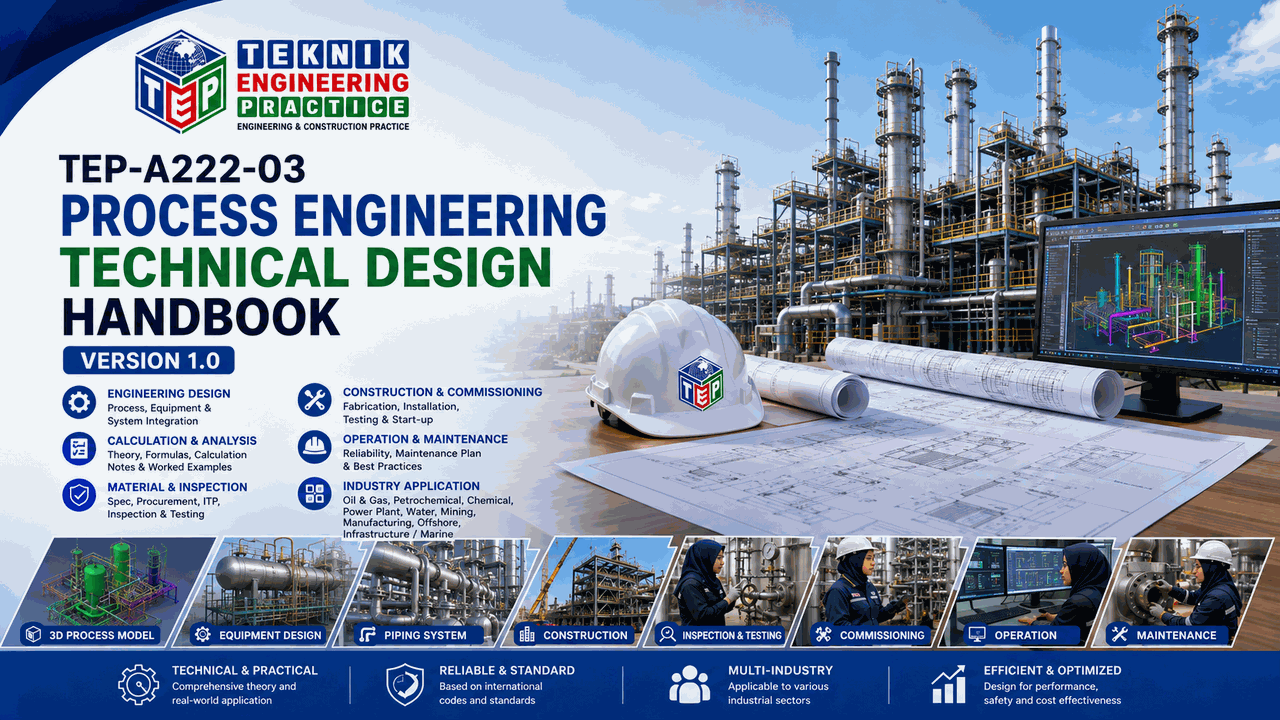
TEP-A222-03 PROCESS ENGINEERING TECHNICAL DESIGN HANDBOOK VERSION 1.0

Process Engineering Technical Design Handbook provides a comprehensive and practical technical reference for the development, review, implementation, and lifecycle management of process engineering designs for industrial facilities. The handbook establishes an integrated engineering framework covering the progression from the initial Basis of Design and design criteria through detailed process engineering, procurement support, fabrication, construction, commissioning, start-up, operation, maintenance, and continuous performance improvement. The handbook addresses the fundamental process engineering activities required to develop safe, reliable, operable, maintainable, and technically sound facilities. Major subjects include process design data and deliverables, Process Flow Diagrams (PFD), Piping and Instrumentation Diagrams (P&ID), material and energy balances, thermodynamics and phase equilibrium, process simulation and optimization, hydraulic calculations, line sizing, equipment sizing, separation systems, distillation, absorption, reactors, heat-transfer systems, rotating equipment, piping interfaces, instrumentation, control, and automation. Particular emphasis is placed on process safety and safeguarding. Relief and depressuring systems, flare and vent systems, HAZID, HAZOP, LOPA, SIL, material compatibility, corrosion control, utility systems, offsite facilities, layout development, 3D model review, and constructability are incorporated as integral elements of the engineering lifecycle rather than isolated design activities. The handbook also extends process engineering responsibilities into procurement, vendor data review, quality control, fabrication, installation, inspection, field release, pre-commissioning, commissioning, start-up, operation, maintenance, reliability, and performance improvement. Supporting appendices provide worked calculation examples, material specifications and datasheets, Inspection and Test Plans (ITP), field-release and punch-list forms, commissioning checklists, maintenance guidance, standard drawings, engineering deliverable registers, design review gates, Management of Change (MOC), digital engineering requirements, vendor inspection, FAT/SAT, logistics, preservation, performance guarantees, acceptance criteria, and lessons learned. Through this lifecycle-based approach, the handbook is intended to support process engineers, multidisciplinary engineering teams, project personnel, construction and commissioning teams, operators, inspectors, and technical reviewers in achieving consistent engineering quality and disciplined technical decision-making throughout a project.

Rp499.000
Thumbnail for TEP-A223-05 PERFORMANCE GUARANTEE PROCESS ENGINEERING HANDBOOK VERSION 1.0
Digital Resource

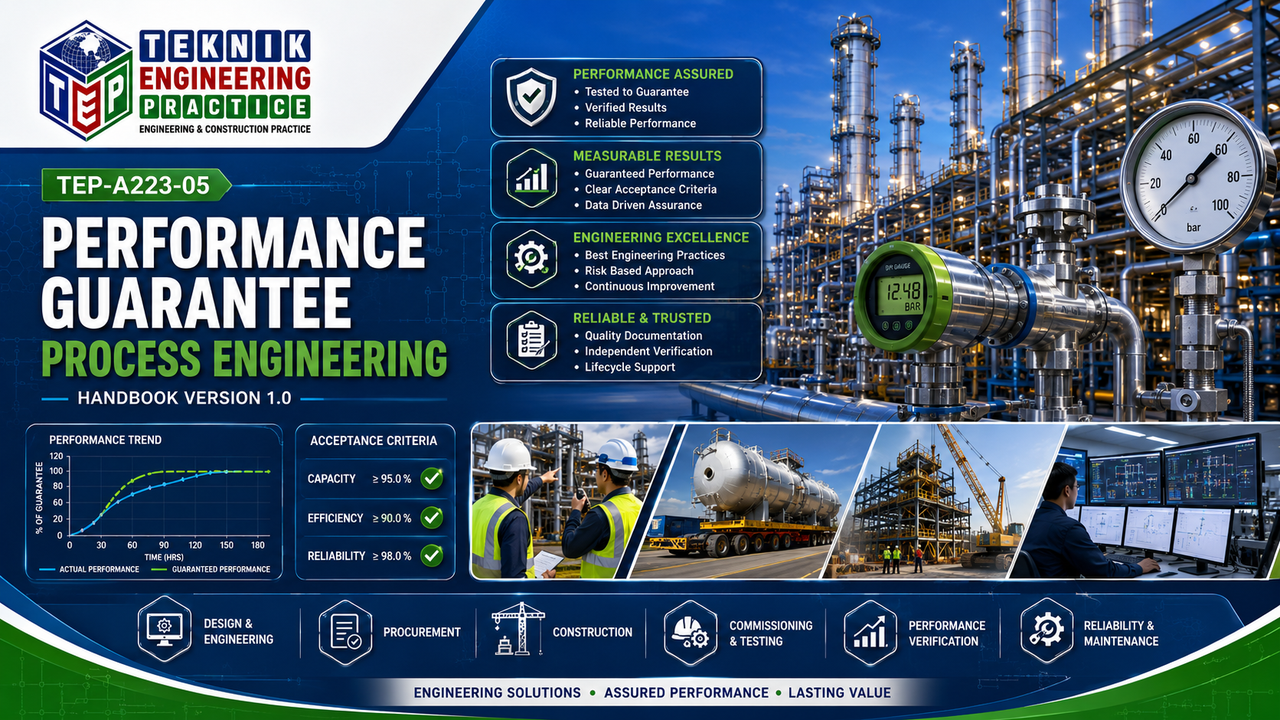
TEP-A223-05 PERFORMANCE GUARANTEE PROCESS ENGINEERING HANDBOOK VERSION 1.0

This handbook presents a structured methodology for developing, executing, and closing process performance guarantees. It covers guarantee envelopes, mass and energy balance, equipment performance, instrumentation, sampling, uncertainty, data reconciliation, normalization, test execution, industrial applications, inspection records, procurement controls, maintenance, and contractual closeout. Worked examples and templates are included to support practical implementation across oil and gas, petrochemical, chemical, power, water, mining, manufacturing, offshore, infrastructure, and marine projects.

Rp499.000
Thumbnail for TEP-A224-02 GUIDE TO VALVE SELECTION HANDBOOK VERSION 1.0
Digital Resource

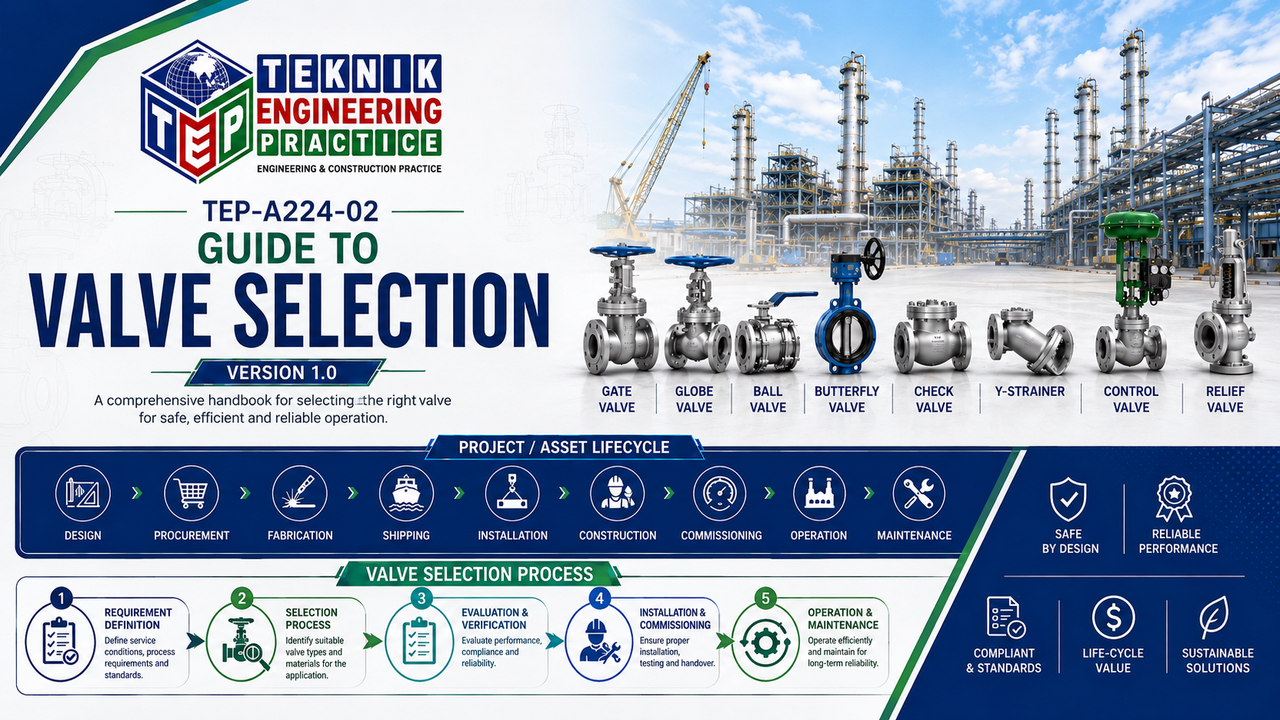
TEP-A224-02 GUIDE TO VALVE SELECTION HANDBOOK VERSION 1.0

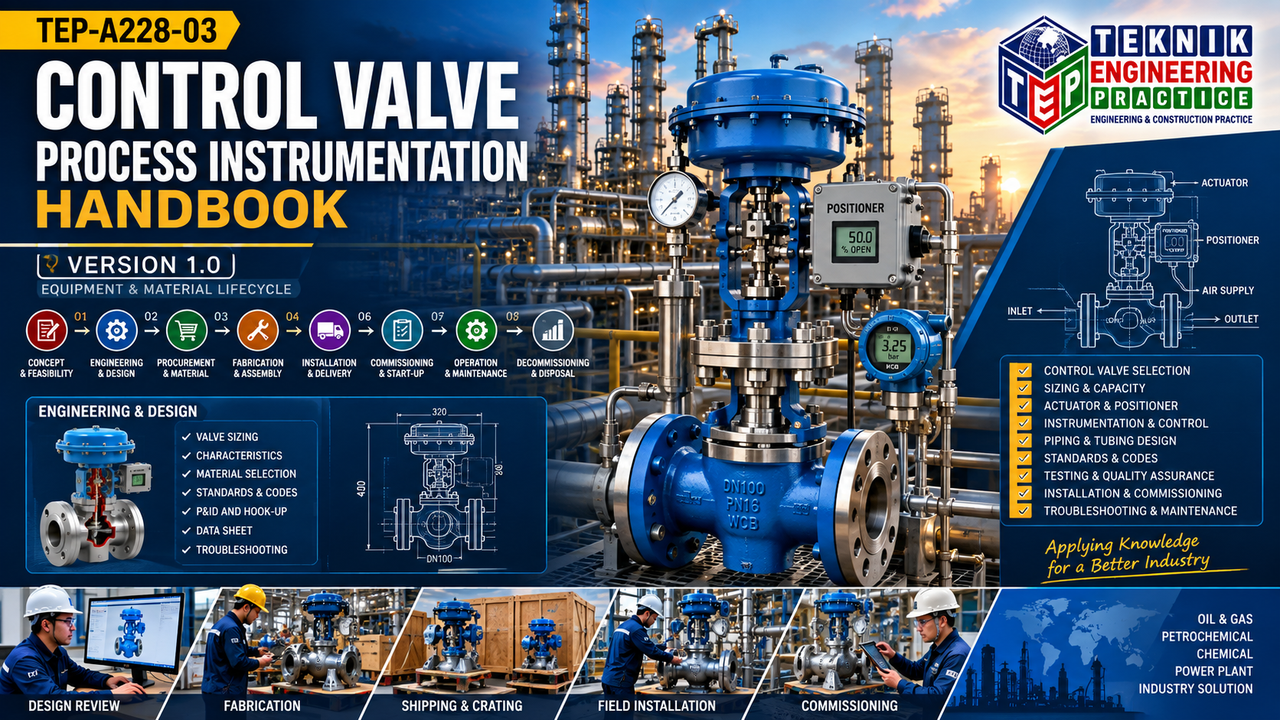
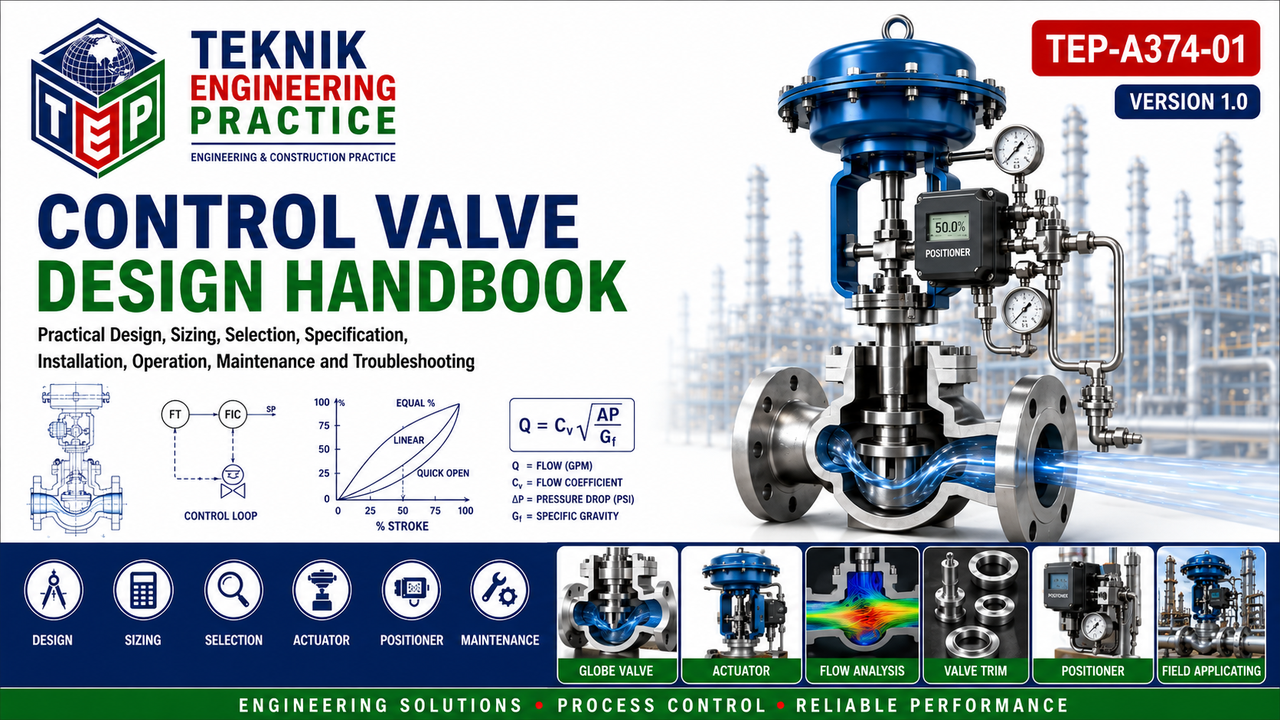
This handbook provides a comprehensive engineering reference for the systematic selection, specification, application, verification, procurement, installation, commissioning, operation, and lifecycle management of industrial valves. It establishes an integrated approach to valve engineering by considering process conditions, functional requirements, pressure–temperature ratings, flow characteristics, material compatibility, sealing performance, actuation requirements, maintainability, reliability, safety, environmental performance, and total lifecycle considerations. The handbook addresses the principal valve types used in industrial facilities, including gate, globe, ball, butterfly, plug, check, diaphragm, pinch, sanitary, knife-gate, slurry-service, control, pressure-relief, safety, emergency-shutdown, and severe-service valves. Special operating environments such as cryogenic service, corrosive service, abrasive and erosive fluids, slurry systems, sour and hydrogen-containing service, high-temperature steam, refrigeration, fugitive-emission control, fire-safe applications, cavitation, flashing, and noise are also incorporated into the selection methodology. Engineering guidance extends beyond valve type selection to include control-valve sizing fundamentals, trim and flow characteristics, positioners and instrumentation, pneumatic, hydraulic and electric actuators, motor-operated valve torque and thrust requirements, end connections, pressure classes, construction materials, soft seats, packing, gaskets, welding, overlays, hardfacing, piping integration, accessibility, fabrication, inspection, pressure testing, FAT, SAT, preservation, transportation, installation, pre-commissioning, commissioning, operation, maintenance, reliability and failure analysis. The handbook structure reflects these subjects through forty technical chapters and supporting appendices.

Rp499.000
Thumbnail for TEP-A222-01 BASIC ENGINEERING DESIGN DATA HANDBOOK VERSION 1.0
Digital Resource

TEP-A222-01 BASIC ENGINEERING DESIGN DATA HANDBOOK VERSION 1.0

BASIC ENGINEERING DESIGN DATA HANDBOOK provides a complete professional framework for preparing, reviewing and controlling Basic Engineering Design Data for industrial and infrastructure projects. The handbook addresses Oil & Gas, Petrochemical, Chemical, Power Plant, Water & Wastewater, Mining, Manufacturing, Offshore and Infrastructure / Marine applications. Core Coverage • Project definition, data governance, applicable standards, units, coordinates and site/environmental conditions. • Process design basis, operating cases, heat and material balance, PFD/P&ID data, design conditions and utility systems. • Equipment, piping, metallurgy, instrumentation, electrical, civil/structural, HSE and fire-protection design data. • Constructability, fabrication, procurement, logistics, field installation, mechanical completion, commissioning and handover. • Calculation notes, worked examples, material controls, ITPs, inspection forms, maintenance frequencies, sector matrices and final release checklists.

Rp499.000
Thumbnail for TEP-A221-04 VERIFICATION PROCEDURE FOR PROCESS HANDBOOK VERSION 1.0
Digital Resource

TEP-A221-04 VERIFICATION PROCEDURE FOR PROCESS HANDBOOK VERSION 1.0

VERIFICATION PROCEDURE FOR PROCESS defines a complete verification procedure for process engineering deliverables. The handbook covers governance, planning, design inputs, process criteria, heat and material balance, simulation, PFDs, P&IDs, equipment sizing, hydraulics, relief and flare systems, process control, HAZOP, utilities, materials, datasheets, vendor documents, interdisciplinary interfaces, 3D model review, construction, pre-commissioning, commissioning, management of change, quality closeout and lifecycle reliability. The procedure is organized around four evidence classes: verified technical basis, checked calculation or document, resolved findings, and formal approval. Technical tables, inspection and commissioning forms, procurement controls, maintenance frequencies and sector application matrices are provided in the appendices.

Rp499.000
Thumbnail for TEP-A221-03 BASIC DESIGN PACKAGE HANDBOOK VERSION 1.0
Digital Resource

TEP-A221-03 BASIC DESIGN PACKAGE HANDBOOK VERSION 1.0

BASIC DESIGN PACKAGE HANDBOOK defines a comprehensive framework for preparing, checking, coordinating, approving and handing over a multidisciplinary Basic Design Package. The handbook contains 34 technical chapters and six implementation appendices covering the full engineering and execution lifecycle. The document integrates design basis, process definition, HSE, facility layout, equipment, mechanical, piping, civil, architectural, electrical, instrumentation, telecommunications, fire protection, utilities, water, marine, digital engineering, calculations, materials, procurement, constructability, fabrication, logistics, construction, commissioning, reliability, document control and quality assurance. Every chapter includes a unique 3D engineering scene, 3D lifecycle workflow and photo-realistic field visualization; a compact calculation note and worked example; input–action–output–accountability mapping; verification checkpoints; risk controls; and an industrial-sector application note. The final package is intended to establish traceable readiness for detailed design, procurement, construction and commissioning while preserving assumptions, interfaces, residual risks, approvals and the evidence needed for audit and handover.

Rp499.000
Thumbnail for TEP-A221-02 PROCESS DESIGN PHILOSOPHY HANDBOOK VERSION 1.0
Digital Resource

TEP-A221-02 PROCESS DESIGN PHILOSOPHY HANDBOOK VERSION 1.0

Process Design Philosophy Handbook Version 1.0 defines a comprehensive and auditable framework for process engineering from design basis through operations handover. It establishes how feed and product envelopes, process cases, thermodynamics, balances, margins, equipment sizing, hydraulics, relief, control, functional safety, materials, utilities, storage, environmental performance and layout shall be developed and verified. The handbook also extends beyond calculation into procurement, vendor data, fabrication, inspection, preservation, transportation, construction, systemization, commissioning, performance testing, operability, reliability and maintenance. It includes worked examples, technical tables, checklists, material and equipment lists, inspection and release records, commissioning forms, maintenance frequencies and an industrial sector application matrix.

Rp499.000
Thumbnail for TEP-A221-01 SCOPE OF BASIC ENGINEERING HANDBOOK VERSION 1.0
Digital Resource

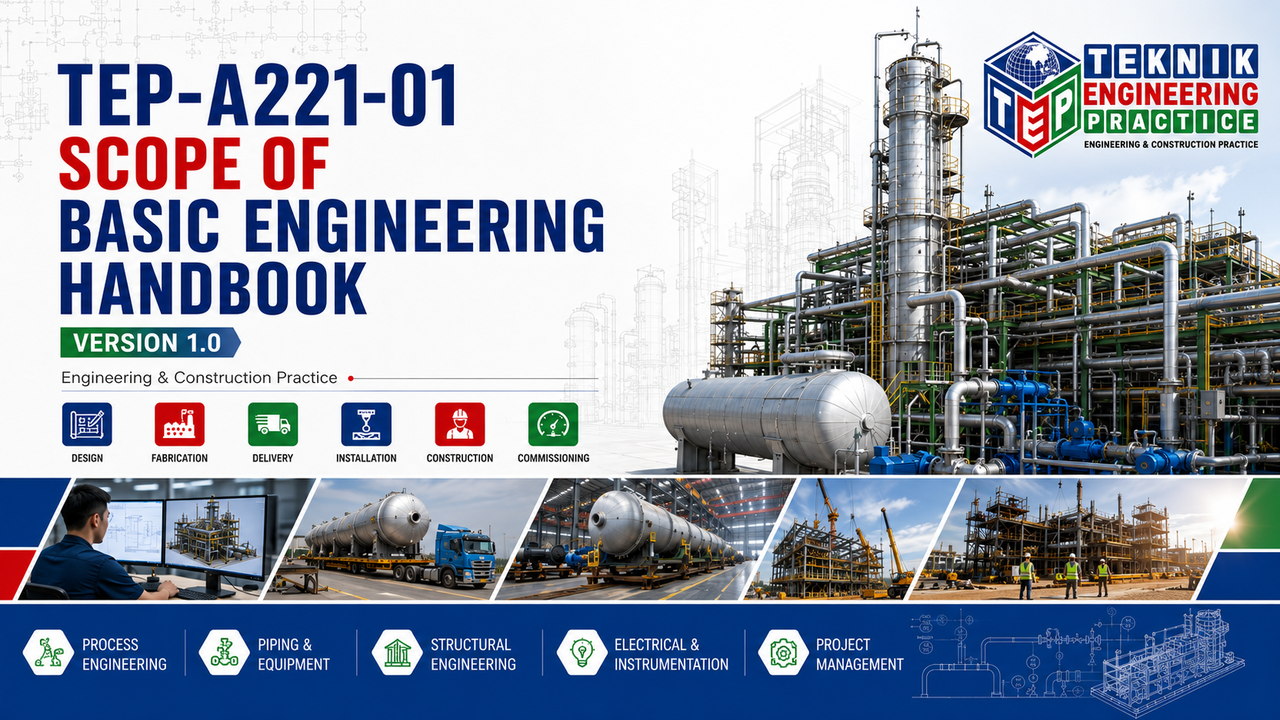
TEP-A221-01 SCOPE OF BASIC ENGINEERING HANDBOOK VERSION 1.0

This handbook defines a comprehensive scope of basic engineering for industrial and infrastructure projects. The scope begins with the approved concept and design basis, then develops coordinated discipline deliverables, engineering calculations, specifications, project controls, assurance activities, procurement support, construction interfaces, commissioning requirements, and lifecycle data. The objective is to create a design definition that is sufficiently mature for investment decisions, detailed engineering, long-lead procurement, permitting, cost and schedule control, and safe execution.

Rp499.000
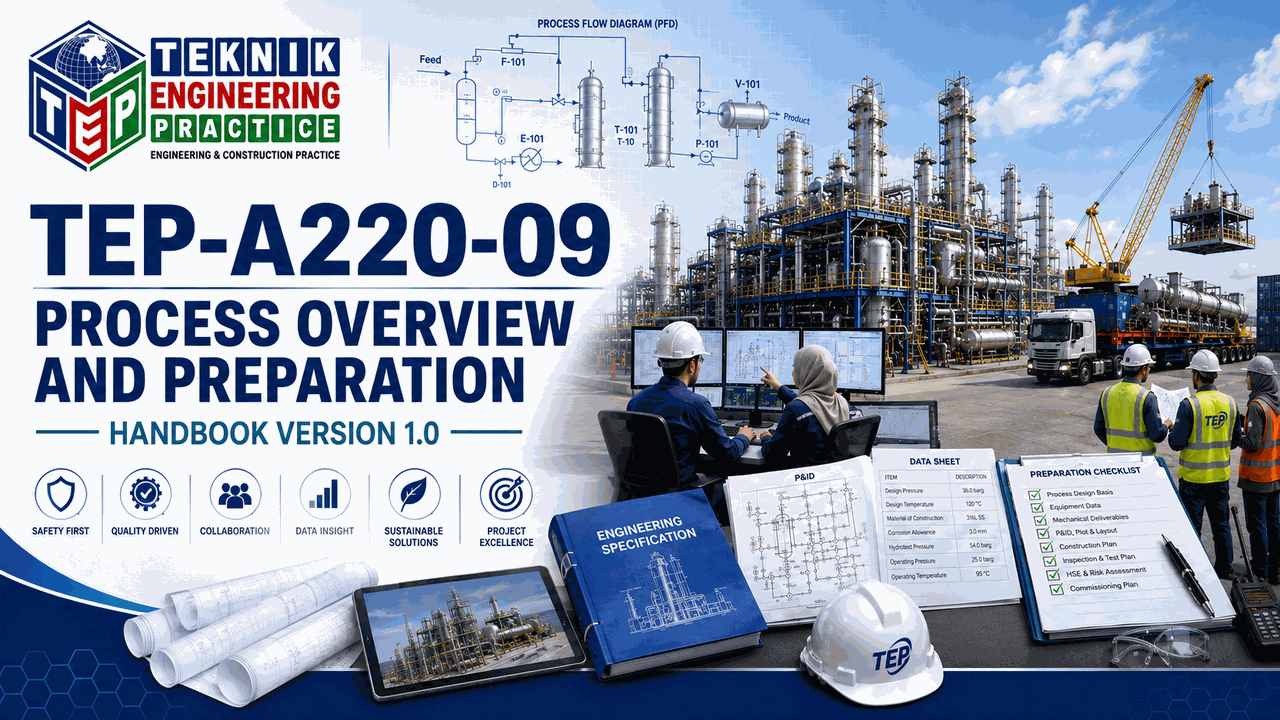
Thumbnail for TEP-A220-09 PROCESS OVERVIEW AND PREPARATION HANDBOOK VERSION 1.0
Digital Resource

TEP-A220-09 PROCESS OVERVIEW AND PREPARATION HANDBOOK VERSION 1.0

This handbook defines a professional method for Process Overview and Preparation across the complete EPC and operating lifecycle. It establishes requirements for project objectives, battery limits, data collection, field verification, feed/product/utility definition, site and environmental inputs, design basis development, simulation, heat and material balance, BFD/PFD/P&ID preparation, equipment and piping process data, utilities, relief/flare/drain systems, control, process safety, materials, layout, procurement, fabrication, logistics, construction, commissioning and reliability preparation. Attribute Handbook Requirement Document type Controlled engineering handbook, execution procedure and training reference Lifecycle Concept selection through operating support and modification Primary controls Design basis, verified calculations, interface review, change control and handover Safety focus Containment, safeguarding, relief, operating limits, construction and startup readiness Quality evidence Check records, ITPs, inspection forms, release documents and commissioning records Industries Oil & Gas, Petrochemical, Chemical, Power, Water, Mining, Manufacturing, Offshore and Marine

Rp499.000
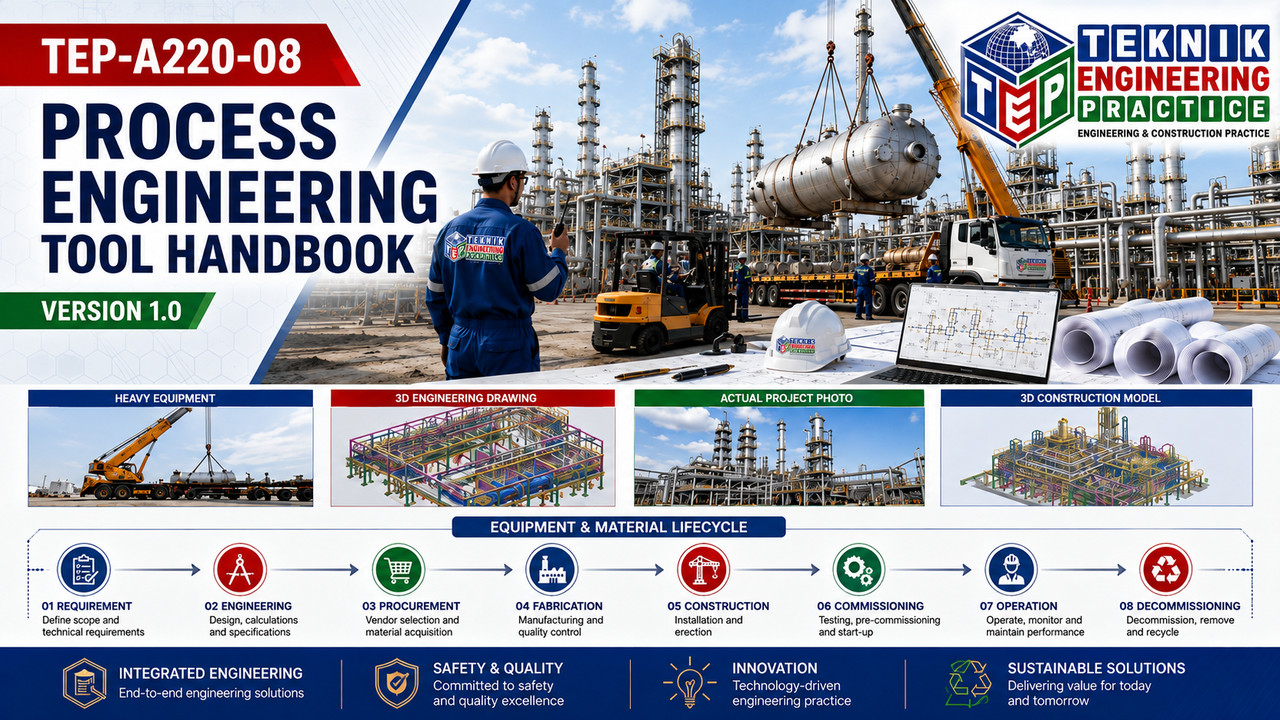
Thumbnail for TEP-A220-08 PROCESS ENGINEERING TOOL HANDBOOK VERSION 1.0
Digital Resource

TEP-A220-08 PROCESS ENGINEERING TOOL HANDBOOK VERSION 1.0

This handbook presents an integrated framework for selecting and applying process engineering tools throughout the project lifecycle. It covers design basis management, thermodynamics, simulation, heat and material balance, PFD and P&ID development, hydraulic calculations, heat exchanger design, relief and flare systems, equipment sizing, dynamic simulation, process safety, consequence modeling, flow assurance, energy optimization, materials, procurement, construction, commissioning, maintenance, reliability, and quality control. Practical elements include calculation-note requirements, worked examples, material specifications, procurement controls, inspection and test plans, field release records, commissioning forms, maintenance frequencies, inspection records, technical flow diagrams, and industrial application matrices. The intended result is a consistent, auditable, and professional engineering workflow suitable for Oil & Gas, Petrochemical, Chemical, Power Plant, Water & Wastewater, Mining, Manufacturing, Offshore, and Infrastructure / Marine applications.

Rp499.000
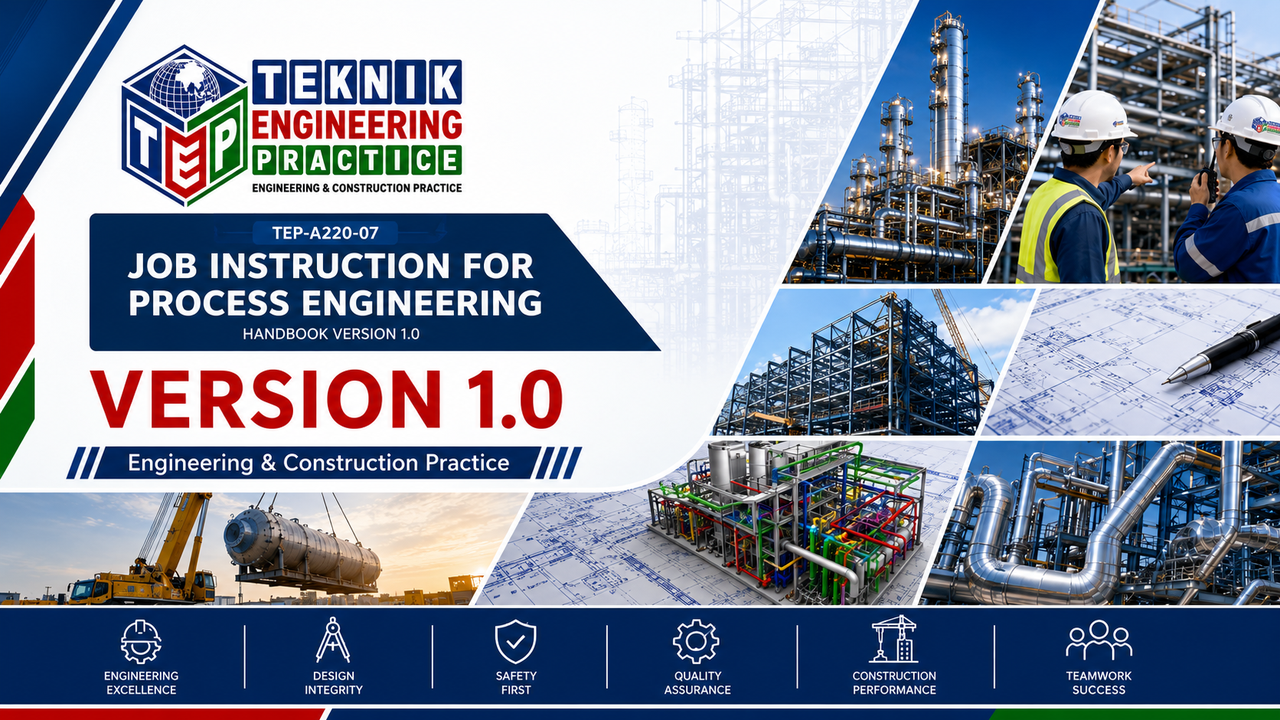
Thumbnail for TEP-A220-07 JOB INSTRUCTION FOR PROCESS ENGINEERING HANDBOOK VERSION 1.0
Digital Resource

TEP-A220-07 JOB INSTRUCTION FOR PROCESS ENGINEERING HANDBOOK VERSION 1.0

JOB INSTRUCTION FOR PROCESS ENGINEERING defines a comprehensive job-instruction system for process engineering across concept selection, basic engineering, front-end engineering design, detailed engineering, procurement support, construction, commissioning, and operations support. The handbook explains how design inputs are converted into heat and material balances, process flow diagrams, piping and instrumentation diagrams, equipment specifications, hydraulic calculations, relief-system design, process-control requirements, safety studies, technical bid evaluations, inspection records, and final handover dossiers.

Rp499.000
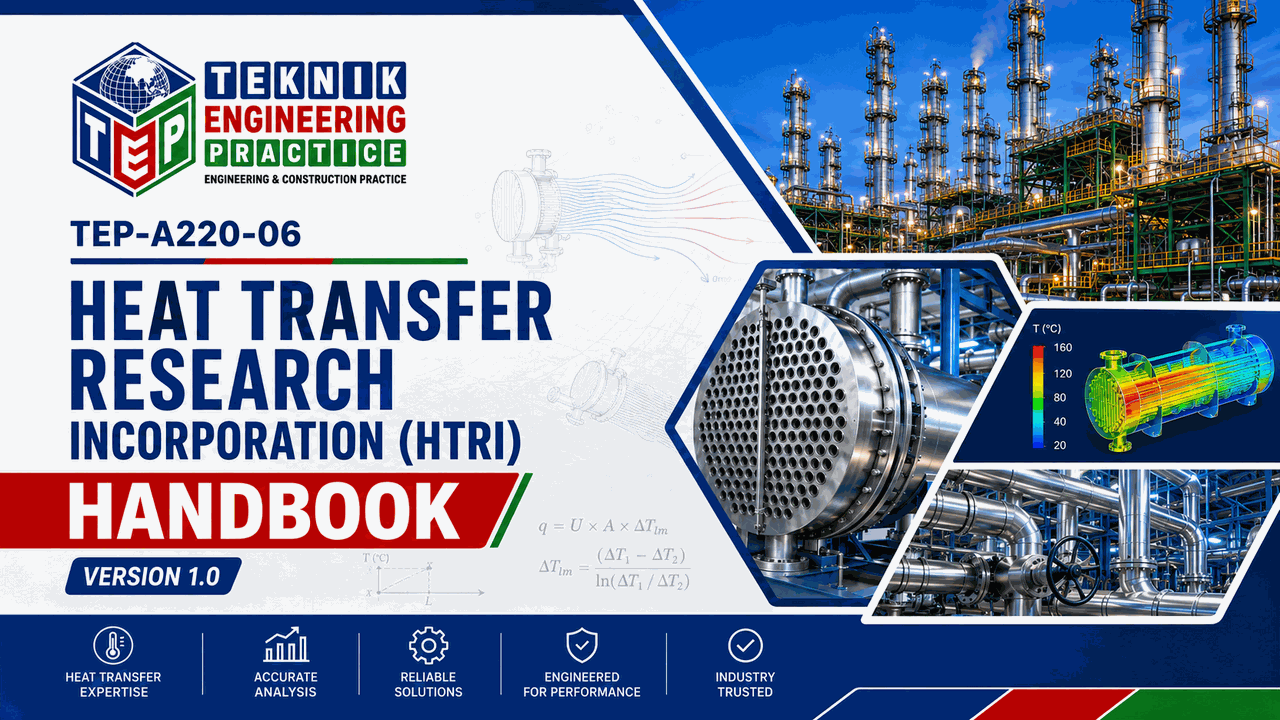
Thumbnail for TEP-A220-06 HEAT TRANSFER RESEARCH INCORPORATION (HTRI) HANDBOOK VERSION 1.0
Digital Resource

TEP-A220-06 HEAT TRANSFER RESEARCH INCORPORATION (HTRI) HANDBOOK VERSION 1.0

This handbook defines an end-to-end method for heat-transfer engineering using research-based approaches and current commercial software within a controlled workflow. It covers data preparation, properties, fundamentals, shell-and-tube rating/simulation/design, TEMA geometry, shellside/tubeside methods, condensers, reboilers, air coolers, hairpin and compact exchangers, vibration, fired heaters, networks, digital twins, procurement, inspection, commissioning and troubleshooting. Appendices provide calculation-note and input templates, worked examples, geometry/vibration checklists, monitoring registers, technical bid evaluation, ITP, commissioning forms, troubleshooting logic, industrial applications, standards framework, glossary and source/trademark register. Governing principles are traceability, applicability, proportional rigor, independent verification, controlled geometry, transparent uncertainty and lifecycle feedback.

Rp499.000
Thumbnail for TEP-A220-05 PROCESS ENGINEERING MANUAL VERSION 1.0
Digital Resource

TEP-A220-05 PROCESS ENGINEERING MANUAL VERSION 1.0

This manual defines a complete Process Engineering framework for concept selection, FEED, detailed engineering, procurement support, construction, pre-commissioning, commissioning, start-up, operating support and brownfield modification. It covers design-basis development, thermodynamics, simulation, heat and material balance, process diagrams, equipment sizing, hydraulics, heat transfer, separation, reaction engineering, utilities, relief and flare systems, control, process safety, environmental engineering, materials, energy optimization, datasheets, vendor engineering, field support, reliability and digital handover.

Rp499.000
Thumbnail for TEP-A220-04 VALUE PROCESS ENGINEERING HANDBOOK VERSION 1.0
Digital Resource

TEP-A220-04 VALUE PROCESS ENGINEERING HANDBOOK VERSION 1.0

This handbook presents a complete Value Process Engineering framework for identifying, developing, evaluating, implementing, and sustaining value-improvement opportunities across the project and asset life cycle. The approach combines function analysis, FAST modelling, cost/worth analysis, multi-criteria decision analysis, process simulation, heat and utility integration, equipment standardization, safety and environmental review, RAM analysis, constructability, life-cycle costing, procurement strategy, commissioning readiness, and benefits realization. The handbook contains twenty-two technical chapters and eleven appendices. Each chapter includes design intent, required information, technical method, calculation notes, a worked example, lifecycle controls, a unique 3D engineering schematic, a field application image, inspection and maintenance requirements, and an industrial-sector application note. The appendices provide editable-style forms and matrices for workshops, calculations, inspections, commissioning, benefits tracking, and standards management.

Rp499.000
Thumbnail for TEP-A220-01 GENERAL PROCESS STANDARD HANDBOOK VERSION 1.0
Digital Resource

TEP-A220-01 GENERAL PROCESS STANDARD HANDBOOK VERSION 1.0

This handbook defines a complete General Process Standard for opportunity framing, conceptual design, FEED, detailed engineering, procurement, construction support, pre-commissioning, commissioning, start-up, performance testing, operating support and modification. It establishes minimum requirements for the Process Design Basis, feed and product data, design cases, simulation, heat and material balance, BFD/PFD/P&ID preparation, equipment sizing, hydraulics, heat transfer, utilities, pressure relief, flare and drain systems, process control, safeguarding, process safety, materials, environmental data, datasheets, vendor review, quality control and handover. Twenty-eight chapters provide the governing requirements, execution steps, engineering criteria, review checklists, 3D technical drawings and field-implementation controls. Sixteen appendices provide reusable registers, calculation-note templates, review forms, HAZOP/LOPA worksheets, procurement checks, inspection and commissioning records, sector matrices and approval forms.

Rp499.000
Thumbnail for TEP-A215-01 HSE RISK MANAGEMENT HANDBOOK VERSION 1.0
Digital Resource

TEP-A215-01 HSE RISK MANAGEMENT HANDBOOK VERSION 1.0

This handbook presents an integrated HSE risk management system based on established risk-management principles, structured assessment techniques and verifiable field controls. It defines governance, risk criteria, hazard identification, qualitative and quantitative assessment, ALARP demonstration, hierarchy of controls, critical control management, risk registers, change management, simultaneous operations, lifecycle integration, emergency risk, occupational health, environmental risk, human factors, contractor assurance and continual improvement. The handbook includes 51 chapters and 27 appendices. Practical tools include a 5 x 5 risk matrix, HSE risk register, JSA/TRA, HAZID and HAZOP worksheets, Bow-Tie and LOPA templates, critical-control verification form, management-of-change form, SIMOPS interface matrix, environmental and occupational-health registers, emergency scenario assessment, KPI dashboard, audit checklist, competence matrix, legal register and final document-release checklist. Intended Users • Project directors, project managers, HSE managers and risk owners. • Engineering, construction, commissioning, operations and maintenance leaders. • HSE engineers, process-safety specialists, industrial hygienists and environmental professionals. • Contractors, subcontractors, vendors, supervisors, permit authorities and field work teams. • Auditors, assurance personnel, client representatives and document controllers.

Rp499.000
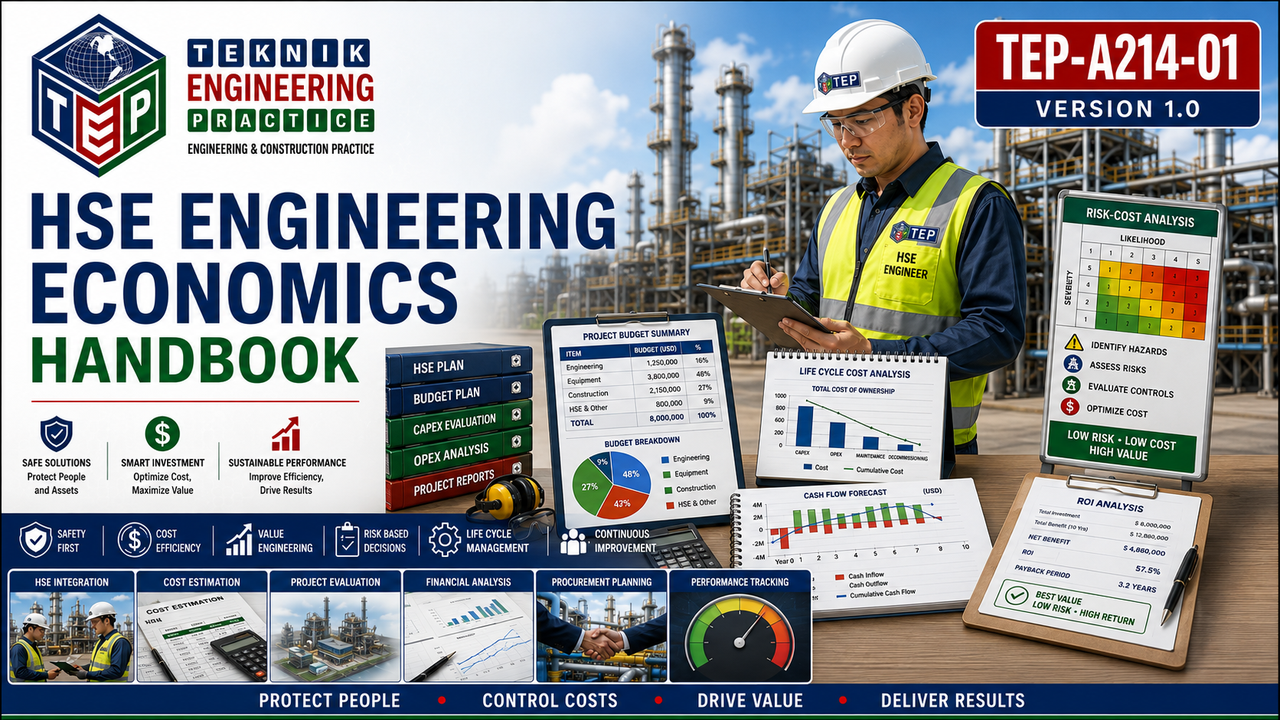
Thumbnail for TEP-A214-01 HSE ENGINEERING ECONOMICS HANDBOOK VERSION 1.0
Digital Resource

TEP-A214-01 HSE ENGINEERING ECONOMICS HANDBOOK VERSION 1.0

HSE Engineering Economics Handbook Version 1.0 presents an integrated method for evaluating HSE investments across concept development, design, procurement, fabrication, delivery, construction, installation, commissioning, operation, maintenance, modification, and decommissioning. The handbook covers CAPEX and OPEX planning, cost classification, life-cycle cost analysis, discounted cash flow, net present value, equivalent annual cost, internal rate of return, benefit-cost ratio, payback, expected annual loss, ALARP and gross-disproportion considerations, reliability economics, environmental cost, uncertainty analysis, portfolio selection, and benefit realization. Worked examples address gas detection, firewater, emergency shutdown, spill containment, machine guarding, condition monitoring, wastewater reuse, fire and gas modernization, HSE-critical procurement, governance, inspection records, and implementation programs. Appendices provide formula sheets, cost-estimate templates, ITP and inspection forms, field-release and commissioning records, maintenance procedures, an industrial application matrix, references, and a glossary. The objective is to enable decisions that protect people and assets, control total lifecycle cost, reduce risk, improve reliability, support environmental stewardship, and deliver measurable long-term value

Rp499.000
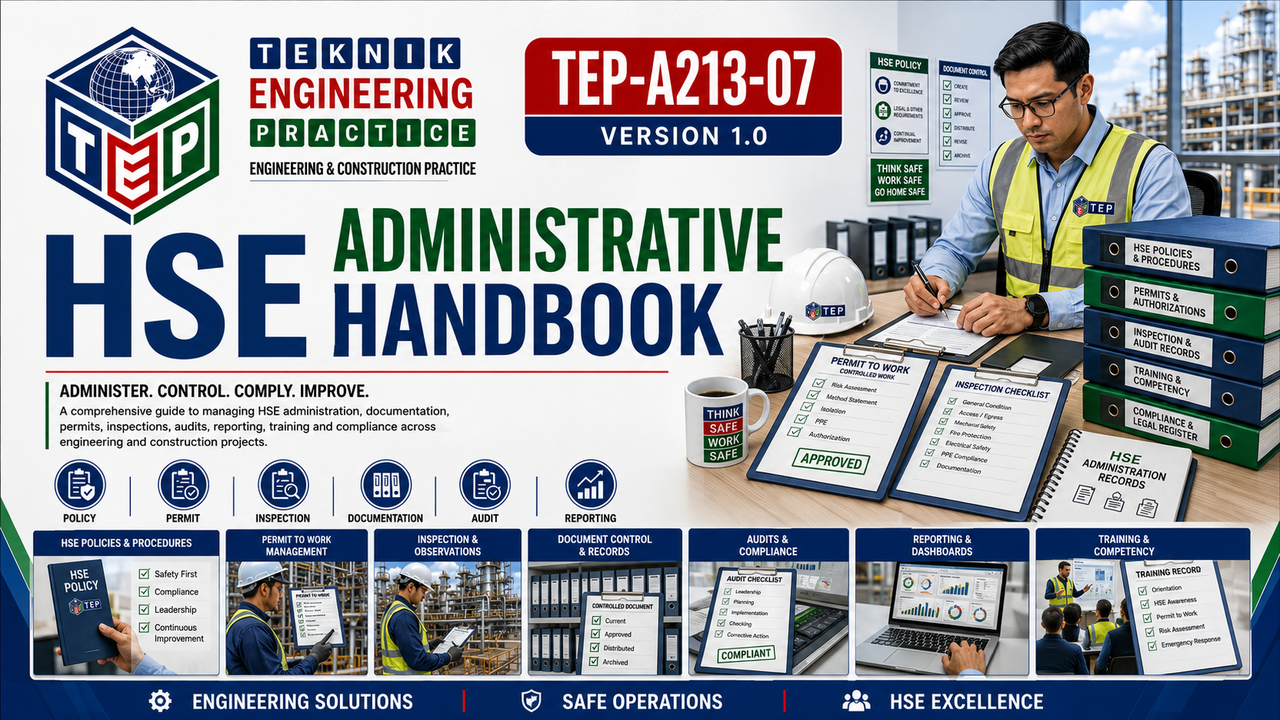
Thumbnail for TEP-A213-07 HSE ADMINISTRATIVE HANDBOOK VERSION 1.0
Digital Resource

TEP-A213-07 HSE ADMINISTRATIVE HANDBOOK VERSION 1.0

HSE Administrative Handbook Version 1.0 provides a structured framework for controlling HSE information and evidence across the full asset and project lifecycle. It integrates management-system principles with practical registers, forms, workflows, role assignments, review methods, retention rules, and performance indicators. The handbook supports organizations that need consistent HSE governance across company personnel, contractors, vendors, and multiple industrial sectors. It emphasizes traceability, risk-based approval, legal and contractual compliance, worker participation, confidentiality, digital data integrity, objective evidence, and continual improvement. Technical tools include worked KPI calculations, risk scoring guidance, inspection and test plan controls, sector application matrices, implementation roadmaps, and templates for legal registers, training, permits, incident management, audits, action tracking, environmental monitoring, emergency drills, management of change, closeout, and records retention.

Rp499.000
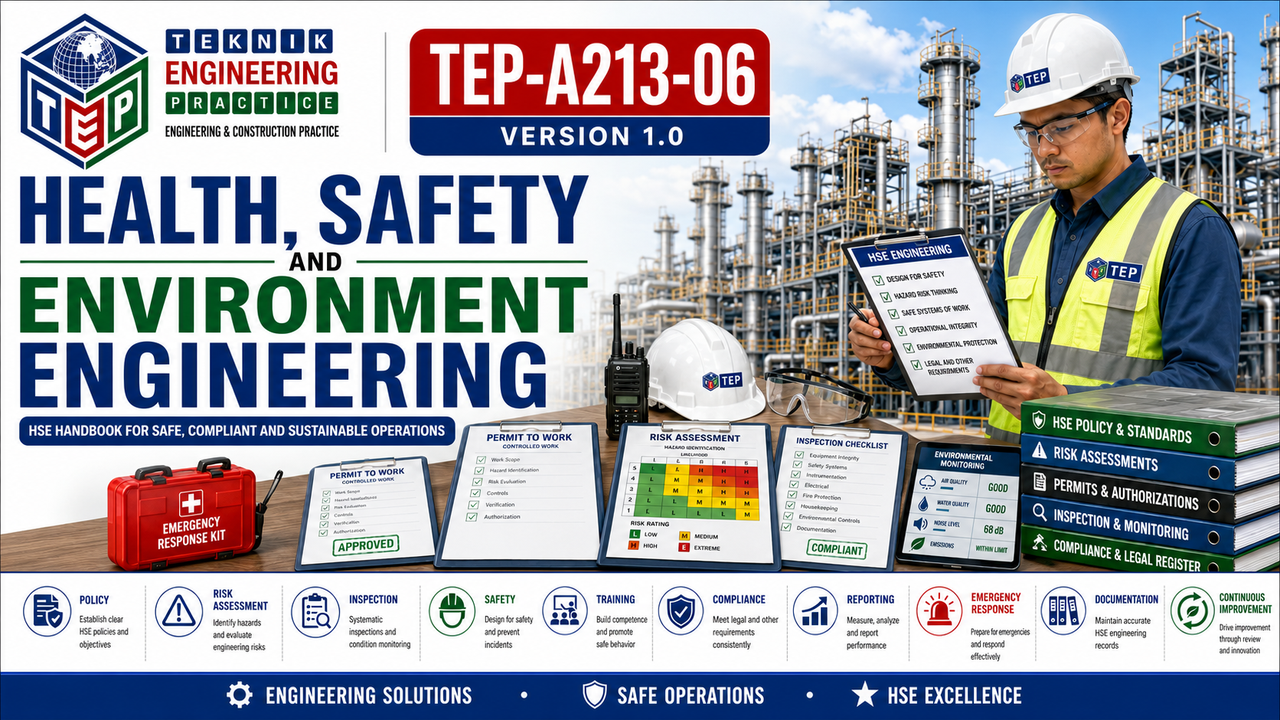
Thumbnail for TEP-A213-06 HSE ENGINEERING HANDBOOK VERSION 1.0
Digital Resource

TEP-A213-06 HSE ENGINEERING HANDBOOK VERSION 1.0

This handbook presents an integrated HSE engineering framework for oil and gas, petrochemical, refinery, chemical, power, utility, infrastructure and other industrial projects. It translates hazards, legal duties, client expectations and recognized engineering practices into controlled studies, design requirements, performance standards, procurement clauses, inspection and testing evidence, and handover records. The framework uses lifecycle risk management and the hierarchy of controls. Broad HAZID is followed, where applicable, by HAZOP, LOPA and SIL determination, QRA, ALARP demonstration, design safety reviews and verification of safety-critical elements. Occupational health and environmental engineering are treated as design disciplines rather than downstream compliance checks. Construction and commissioning hazards are anticipated through design risk transfer, temporary-works control, isolation design, SIMOPS planning and pre-startup safety review. The handbook emphasizes traceability: each control should be linked to a hazard or obligation, represented in approved design information, verified by objective evidence and transferred with its residual risk, inspection requirement and operating constraint. The 22 appendices provide practical templates for this controlled information thread.

Rp499.000
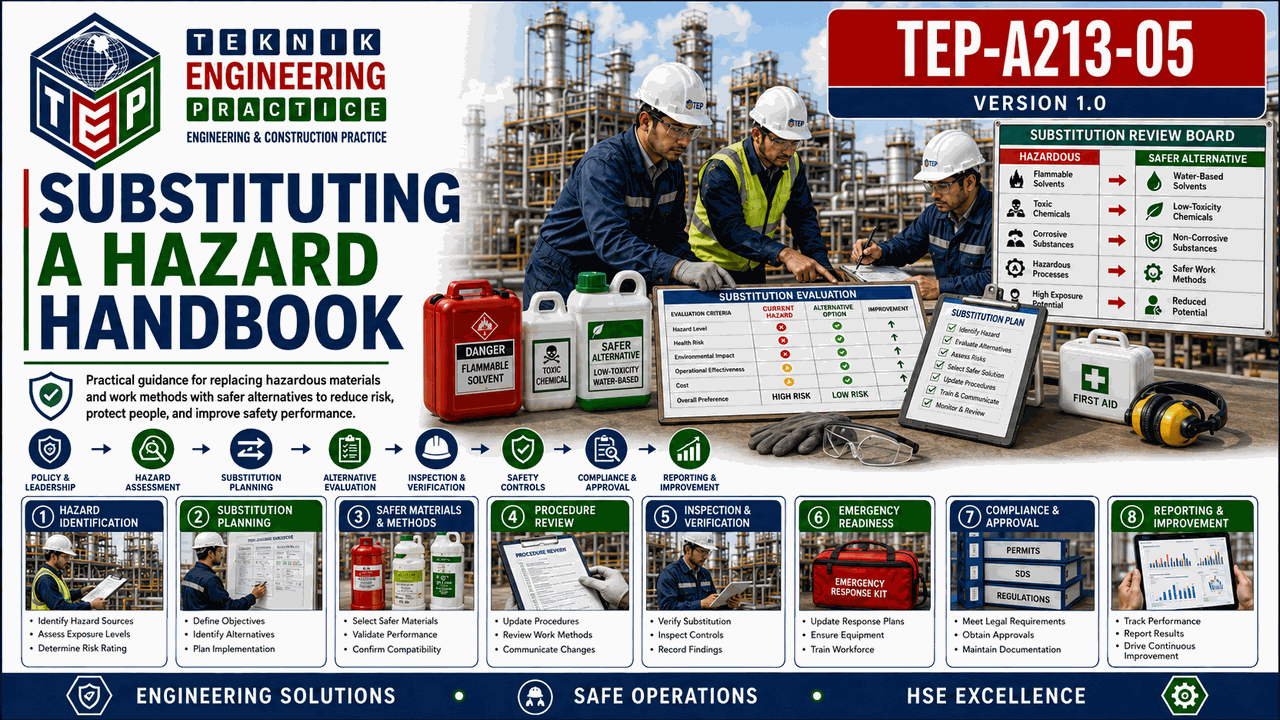
Thumbnail for TEP-A213-05 SUBSTITUTING A HAZARD HANDBOOK VERSION 1.0
Digital Resource

TEP-A213-05 SUBSTITUTING A HAZARD HANDBOOK VERSION 1.0

SUBSTITUTING A HAZARD is a lifecycle handbook for replacing hazardous materials, equipment, processes, and work methods with safer alternatives in industrial facilities. It combines occupational safety, process safety, engineering design, industrial hygiene, environmental management, quality, procurement, construction, commissioning, maintenance, reliability, and management-system controls. SCOPE METHOD OUTPUT Oil & Gas, Petrochemical, Chemical, Power Plant, Water & Wastewater, Mining, Manufacturing, Offshore, and Infrastructure / Marine. Hazard baseline, alternatives screening, technical validation, calculation, controlled change, verification, and performance monitoring. Approved safer solution supported by specifications, records, training, field release, maintenance, and measurable improvement.

Rp499.000
Thumbnail for TEP-A213-04 HAZARD ELIMINATION HANDBOOK VERSION 1.0
Digital Resource

TEP-A213-04 HAZARD ELIMINATION HANDBOOK VERSION 1.0

This handbook presents a complete hazard-elimination framework aligned with the hierarchy of controls and the principles of inherently safer design. It integrates source–path–receptor analysis, HIRA/JSA, concept selection, process safety, mechanical and electrical safety, chemical substitution, work-at-height elimination, confined-space avoidance, lifting and excavation alternatives, ergonomics, contractor control, management of change, commissioning and operational improvement. The method requires teams to identify the physical source of harm, generate alternatives that remove the source or task, assess lifecycle risk transfer, select the safest practicable design, implement through controlled engineering and procurement, and verify with objective field evidence. It includes practical checklists, forms, worked examples, KPI definitions and an industrial-sector application matrix.

Rp499.000
Thumbnail for TEP-A213-03 HSE EVALUATION HANDBOOK VERSION 1.0
Digital Resource

TEP-A213-03 HSE EVALUATION HANDBOOK VERSION 1.0

This handbook describes a complete method for evaluating HSE management-system design, implementation and effectiveness. It begins with evaluation governance, ethics, competence, program planning and legal compliance; proceeds through leadership, risk assessment, critical controls, contractor management, design HSE, occupational health, environmental performance, emergency readiness, construction, commissioning and process safety; and concludes with data analysis, corrective action, management review, industrial-sector adaptation and integrated assurance planning. Detailed appendices provide reusable models for scoring, maturity, audit planning, interviews, document review, field observation, legal compliance, contractor evaluation, emergency drill evaluation, incident investigation review, KPI calculations, corrective action, reporting and management review. The handbook is designed for multi-sector use in oil and gas, petrochemical, chemical, power generation, water and wastewater, mining, manufacturing, offshore, marine and infrastructure projects. Its central principle is that evaluation must test actual control performance and drive timely improvement rather than merely count completed forms.

Rp499.000
Thumbnail for TEP-A213-02 HSE SCOPE OF WORK HANDBOOK VERSION 1.0
Digital Resource

TEP-A213-02 HSE SCOPE OF WORK HANDBOOK VERSION 1.0

This handbook defines a complete HSE scope of work for project contracting. It establishes scope boundaries, legal and client interfaces, governance, organization, staffing, deliverables, design HSE studies, occupational health, environmental management, contractor control, procurement specifications, fabrication and logistics requirements, field high-risk work controls, emergency response, assurance, incident learning, commissioning and final closeout. Each technical chapter includes the purpose, minimum contractual controls, required deliverables, responsible parties, review and hold points, acceptance evidence, scope exclusions and records. Appendices provide reusable matrices, registers, worked examples, forms, calculation notes, KPI definitions, equipment specifications, inspection frequencies and model commercial clauses. The handbook emphasizes objective acceptance, critical-control verification, documented interface management and lifecycle transfer of residual risk. It is designed to help contracting parties avoid ambiguous HSE obligations while preserving compliance, worker participation and safe execution.

Rp499.000
Thumbnail for TEP-A213-01 HEALTH SAFETY ENVIRONMENT SPECIFICATION HANDBOOK VERSION 1.0
Digital Resource

TEP-A213-01 HEALTH SAFETY ENVIRONMENT SPECIFICATION HANDBOOK VERSION 1.0

This handbook defines a comprehensive HSE specification across twenty-six technical chapters and eighteen appendices. It covers policy and governance, hazard identification, permit-to-work, energy isolation, PPE, work at height, lifting, confined space, hot work, excavation, environmental management, emergency response, inspections, contractor management, process safety, hazardous materials, occupational health, transport, security, commissioning, electrical safety, fire protection, pressure safety, first aid, wellbeing, SIMOPS, records, management review, and full project-lifecycle implementation. Each chapter includes practical acceptance criteria and evidence requirements. Calculation notes illustrate how HSE performance and technical controls may be evaluated, while the appendices provide structured templates for HIRADC, JSA, permits, LOTO, inspections, audits, incident investigation, CAPA, environmental monitoring, training, equipment registers, emergency drills, commissioning, maintenance, KPIs, retention, and final document QA. The intended result is a consistent, auditable, and field-verifiable HSE management approach that supports safe engineering and construction delivery across multiple industrial sectors.

Rp499.000
Thumbnail for TEP-A212-03 HSE WORK PROCEDURE HANDBOOK VERSION 1.0
Digital Resource

TEP-A212-03 HSE WORK PROCEDURE HANDBOOK VERSION 1.0

This handbook provides an integrated set of safe work procedures covering planning, authorization, execution, emergency response, verification and closeout. It addresses general site controls and high-risk work including hot work, working at height, scaffolding, lifting, confined space, excavation, electrical isolation, line breaking, pressure testing, NDT, chemical handling, mobile equipment, transport, marine work, commissioning and shutdown activities. The procedure model requires task-specific risk assessment, competent roles, defined critical controls, objective evidence and stop-work response when conditions change. Appendices provide reusable permits, checklists, certificates, inspection forms, registers, KPI calculation notes and document-control records. The handbook is intended for multi-sector use in oil and gas, petrochemical, chemical, power generation, water and wastewater, mining, manufacturing, offshore, marine and infrastructure projects. It supports ISO 45001, ISO 14001, Indonesian SMK3 and project-specific HSE requirements but remains subordinate to current law, permit and approved client obligations.

Rp499.000
Thumbnail for TEP-A212-02 HSE SYSTEM PROCEDURE HANDBOOK VERSION 1.0
Digital Resource

TEP-A212-02 HSE SYSTEM PROCEDURE HANDBOOK VERSION 1.0

This handbook describes a complete HSE system procedure for managing occupational health, safety, process-safety interfaces and environmental risk. It begins with system scope, policy, legal compliance, organization, planning and risk assessment; proceeds through operational controls such as permit to work, isolation, contractor management, design HSE, occupational health, emergency response and high-risk work; and concludes with assurance, performance measurement, management review and document control. Detailed appendices provide reusable templates for HSE policy, HIRA/JSA, environmental aspect assessment, permit to work, lockout/tagout, toolbox talks, inspections, incident investigation, emergency drills, training matrices, KPI calculations, contractor evaluation and audit. Worked examples demonstrate risk scoring and performance calculations. The handbook is designed for multi-sector application in oil and gas, petrochemical, chemical, power generation, water and wastewater, mining, manufacturing, offshore, marine and infrastructure projects. It emphasizes lifecycle risk reduction, worker participation, critical-control verification and evidence-based continual improvement.

Rp499.000
Thumbnail for TEP-A211-03 ENVIRONMENT RISK MANAGEMENT IMPLEMENTATION HANDBOOK VERSION 1.0
Digital Resource

TEP-A211-03 ENVIRONMENT RISK MANAGEMENT IMPLEMENTATION HANDBOOK VERSION 1.0

This handbook defines an integrated method for implementing environmental risk management from concept selection through final closure. It describes how organizations establish context, identify environmental aspects, assess source-pathway-receptor scenarios, evaluate significance, select controls using the hierarchy of controls, assign accountable owners, verify field implementation and preserve audit-ready evidence. Technical chapters address emissions, water, stormwater, soil, groundwater, waste, hazardous materials, spills, nuisance, biodiversity, climate resilience, community interface, monitoring, environmental incidents, assurance, digital reporting, commissioning and decommissioning. Calculation notes and worked examples demonstrate significance scoring, stormwater volume screening, containment sizing, noise combination and performance indicators. Appendices provide reusable registers, matrices, inspection forms, monitoring plans, incident forms, contractor evaluations, handover checklists and sector application guidance. The framework is intended for oil and gas, petrochemical, chemical, power, water and wastewater, mining, manufacturing, offshore, marine and infrastructure projects.

Rp499.000
Thumbnail for TEP-A211-01 OFFICE HEALTH AND SAFETY PLAN HANDBOOK VERSION 1.0
Digital Resource

TEP-A211-01 OFFICE HEALTH AND SAFETY PLAN HANDBOOK VERSION 1.0

Office Health and Safety Plan Handbook Version 1.0 presents an integrated framework for managing occupational health and safety in office environments. The handbook combines management-system requirements with practical controls for office layout, ergonomics, housekeeping, manual handling, storage, electrical safety, fire prevention, emergency preparedness, first aid, indoor air quality, lighting, noise, thermal comfort, hygiene, psychosocial risks, security, pantry activities, hybrid work, technical rooms, accessibility, contractor management, training, inspection, incident management, performance measurement, and continual improvement. The method is risk-based. Hazards are identified by location and activity; risk is assessed using a 5×5 matrix; controls are selected according to the hierarchy of controls; accountable owners and due dates are assigned; and effectiveness is verified through inspections, maintenance records, worker feedback, measurements, drills, audits, and management review. The handbook includes sample registers and forms so the management framework can be converted directly into an operational office HSE plan. The principal references include ISO 45001:2018, its Amendment 1:2024, Indonesian SMK3 requirements under Government Regulation No. 50 of 2012, workplace environment requirements under Minister of Manpower Regulation No. 5 of 2018, and publicly available office-safety guidance from occupational safety authorities. All requirements must be checked against the latest applicable legal and building conditions before use. The expected result is a healthy, safe, inclusive, and resilient office where life-safety systems remain effective, workstations fit users, hazards are corrected early, emergency roles are understood, and evidence is available for assurance and continuous improvement.

Rp499.000
Thumbnail for TEP-A210-00 GENERAL HEALTH SAFETY AND ENVIRONMENT HANDBOOK VERSION 1.0
Digital Resource

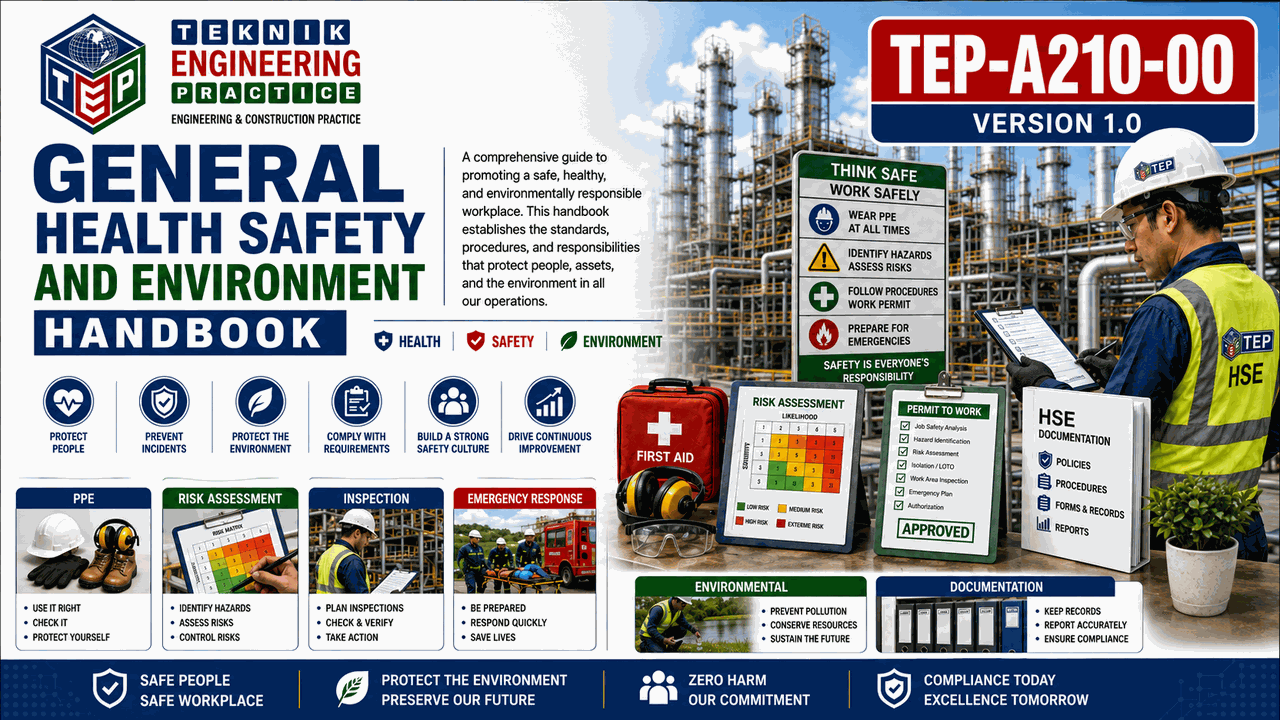
TEP-A210-00 GENERAL HEALTH SAFETY AND ENVIRONMENT HANDBOOK VERSION 1.0

The handbook defines a scalable HSE management architecture for corporate functions, EPC projects, industrial facilities and contractor organizations. It covers context and governance, legal compliance, hazard and environmental risk management, industrial hygiene, occupational safety, process safety, construction, permit-to-work, critical activities, emergency management, environmental controls, occupational health, contractors, design and procurement, transport, incidents, assurance, competence, performance measurement, management of change and lifecycle execution. Method • Plan: determine context, legal requirements, risk, environmental aspects, objectives and resources. • Do: establish controls, competence, communication, operational discipline and emergency capability. • Check: monitor exposure and performance, inspect workplaces, audit systems and investigate events. • Act: review effectiveness, manage change, correct systemic weaknesses and improve maturity

Rp499.000
Thumbnail for TEP-A150-06 COST ESTIMATION INSPECTION SERVICE COMPANY HANDBOOK VERSION 1.0
Digital Resource

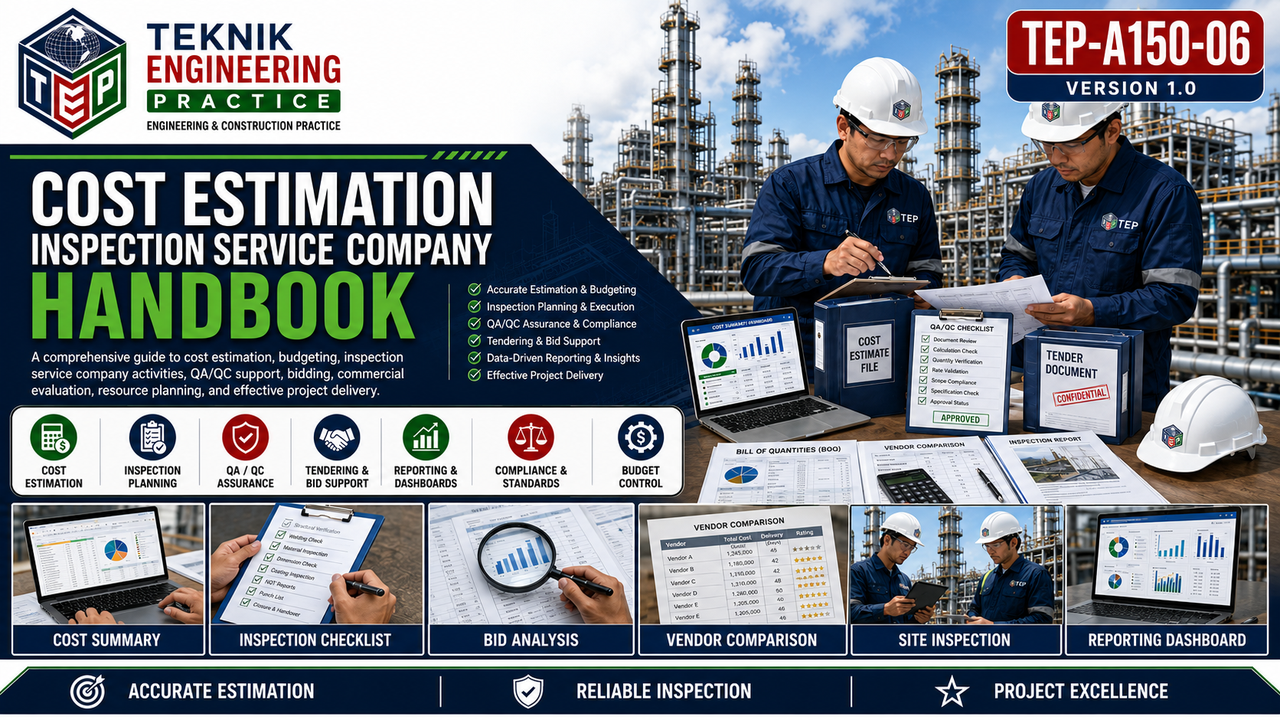
TEP-A150-06 COST ESTIMATION INSPECTION SERVICE COMPANY HANDBOOK VERSION 1.0

COST ESTIMATION INSPECTION SERVICE COMPANY HANDBOOK VERSION 1.0 establishes a professional framework for preparing and controlling inspection-service estimates. It covers tender intake, estimate classification, scope decomposition, inspection assignments, man-hours, competency categories, labor rates, payroll burden, mobilization, travel, accommodation, tools, calibration, subcontract inspection, discipline-specific estimating, project support, schedule loading, risk, taxes, pricing, review, cost control and accreditation-related assurance. The handbook contains 44 technical chapters, 26 core practical appendices and 32 supplemental technical appendices. The supplemental section adds calculation notes, worked examples, maintenance and reliability procedures, procurement controls, field-release and commissioning forms, sector adaptation guidance, and enlarged 3D and actual visual plates. Three core worked examples demonstrate offshore fabrication inspection, refinery turnaround inspection and multi-country vendor surveillance.

Rp499.000
Thumbnail for TEP-A150-08 COST ESTIMATION PROJECT MANAGEMENT TEAM HANDBOOK VERSION 1.0
Digital Resource

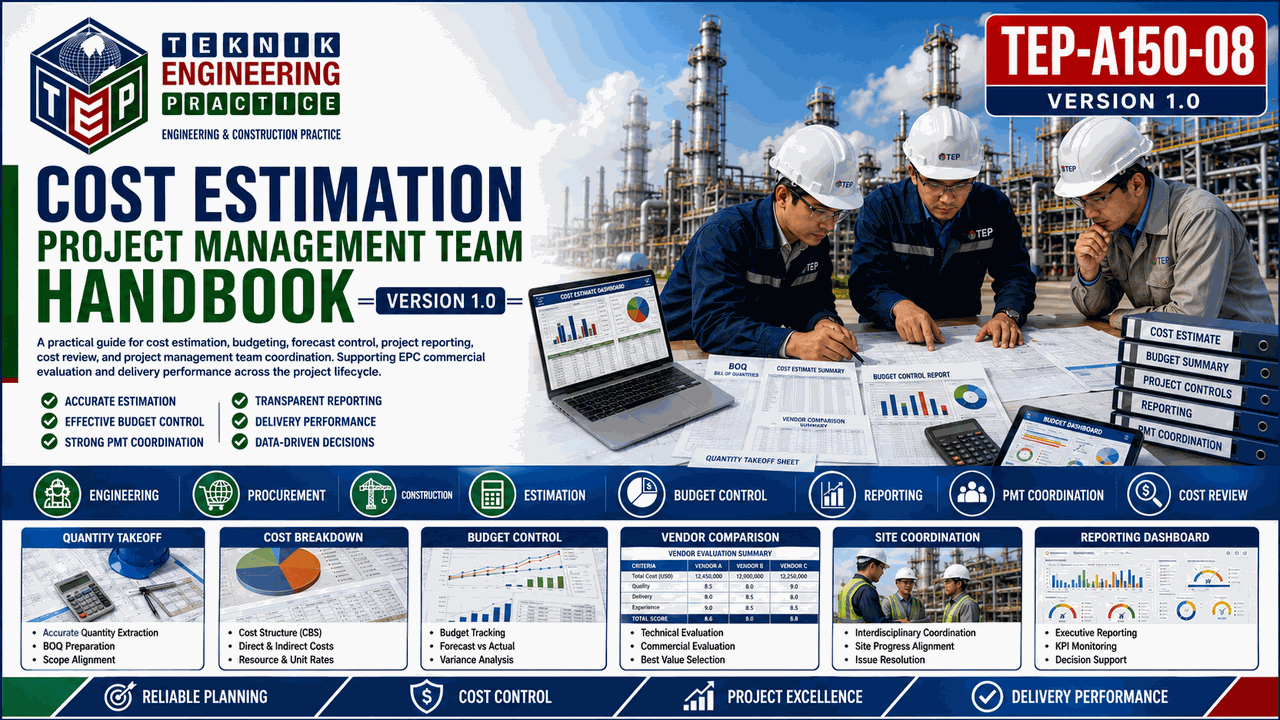
TEP-A150-08 COST ESTIMATION PROJECT MANAGEMENT TEAM HANDBOOK VERSION 1.0

Cost Estimation Project Management Team Handbook Version 1.0 presents an integrated working model for project cost estimating, cost control and management assurance. This extended issue adds detailed theory, fundamental formulas, calculation notes, worked examples, material specifications, procurement controls, ITP and inspection forms, field-release and commissioning records, maintenance and reliability procedures, 3D engineering schematics, field visualizations and an industrial-sector application matrix covering the complete project lifecycle from design through close-out.

Rp499.000
Thumbnail for TEP-A150-07 BID DOCUMENT PROJECT MANAGEMENT TEAM HANDBOOK VERSION 1.0
Digital Resource

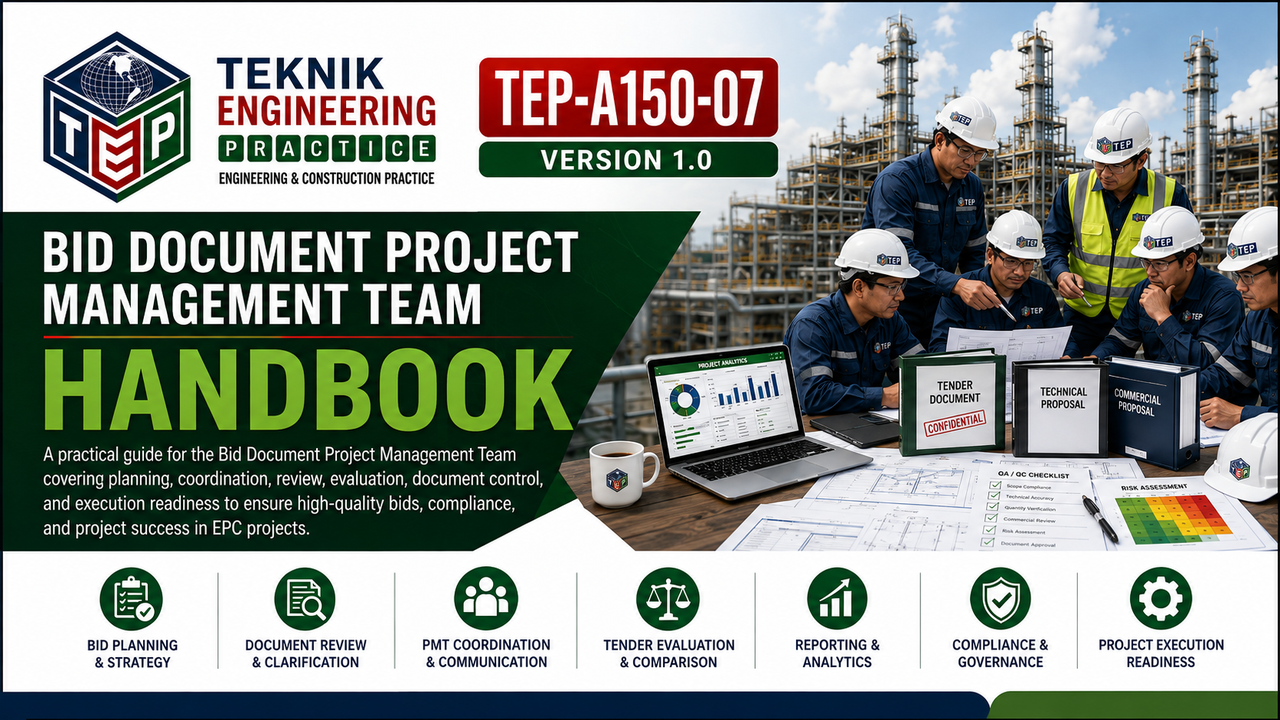
TEP-A150-07 BID DOCUMENT PROJECT MANAGEMENT TEAM HANDBOOK VERSION 1.0

BID DOCUMENT PROJECT MANAGEMENT TEAM provides a structured handbook for the preparation, integration, review, approval, submission and handover of bid documents managed by a Project Management Team. It addresses governance, bid/no-bid decisions, compliance management, PMT organization, tender scheduling, scope definition, technical integration, procurement, construction, commissioning, HSE, quality, cost, planning, project controls, risk, contracts, document control, clarification and negotiation. The handbook uses a stage-gated approach. Requirements are captured in registers, decomposed into accountable work packages, developed through coordinated technical and commercial inputs, subjected to progressive reviews and converted into an approved tender package. Control records enable auditors and project teams to reconstruct why a position was taken and who approved it.

Rp499.000
Thumbnail for TEP-A150-05 BID DOCUMENT INSPECTION SERVICE COMPANY HANDBOOK VERSION 1.0
Digital Resource

TEP-A150-05 BID DOCUMENT INSPECTION SERVICE COMPANY HANDBOOK VERSION 1.0

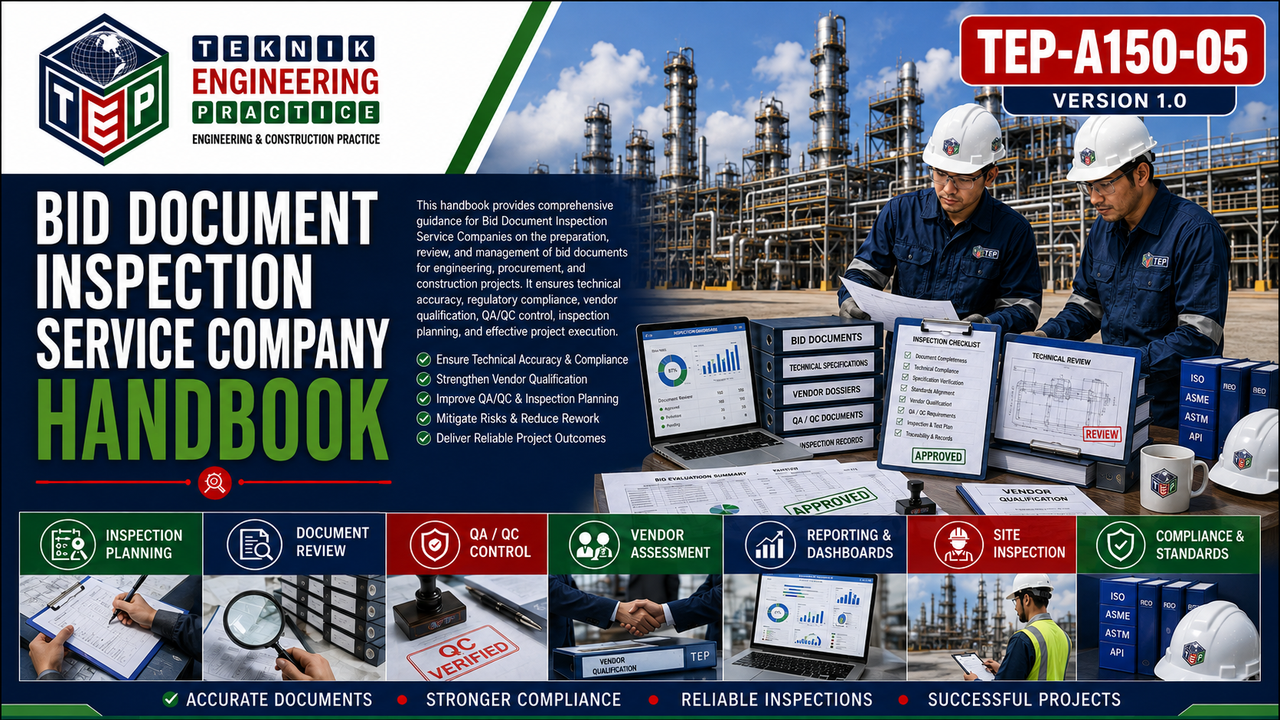
BID DOCUMENT INSPECTION SERVICE COMPANY provides a complete framework for procuring inspection service companies for EPC and industrial projects. It defines bid strategy, bidder instructions, scope, company qualification, inspector competency, discipline inspection requirements, vendor-shop workflow, material traceability, ITP and hold-point control, nonconformity management, reporting, manpower planning, mobilization, HSE, tools, calibration, commercial pricing, evaluation, contract requirements, KPIs, pre-inspection meetings, fabrication surveillance, commissioning support and final release. The handbook also supplies sample matrices, forms, worked evaluation methods and close-out controls. Its central principle is traceability: every bid requirement should connect to an execution activity, acceptance criterion, objective record and authorized decision.

Rp499.000
Thumbnail for TEP-A150-05 BID DOCUMENT INSPECTION SERVICE COMPANY HANDBOOK VERSION 1.0
Digital Resource

TEP-A150-05 BID DOCUMENT INSPECTION SERVICE COMPANY HANDBOOK VERSION 1.0

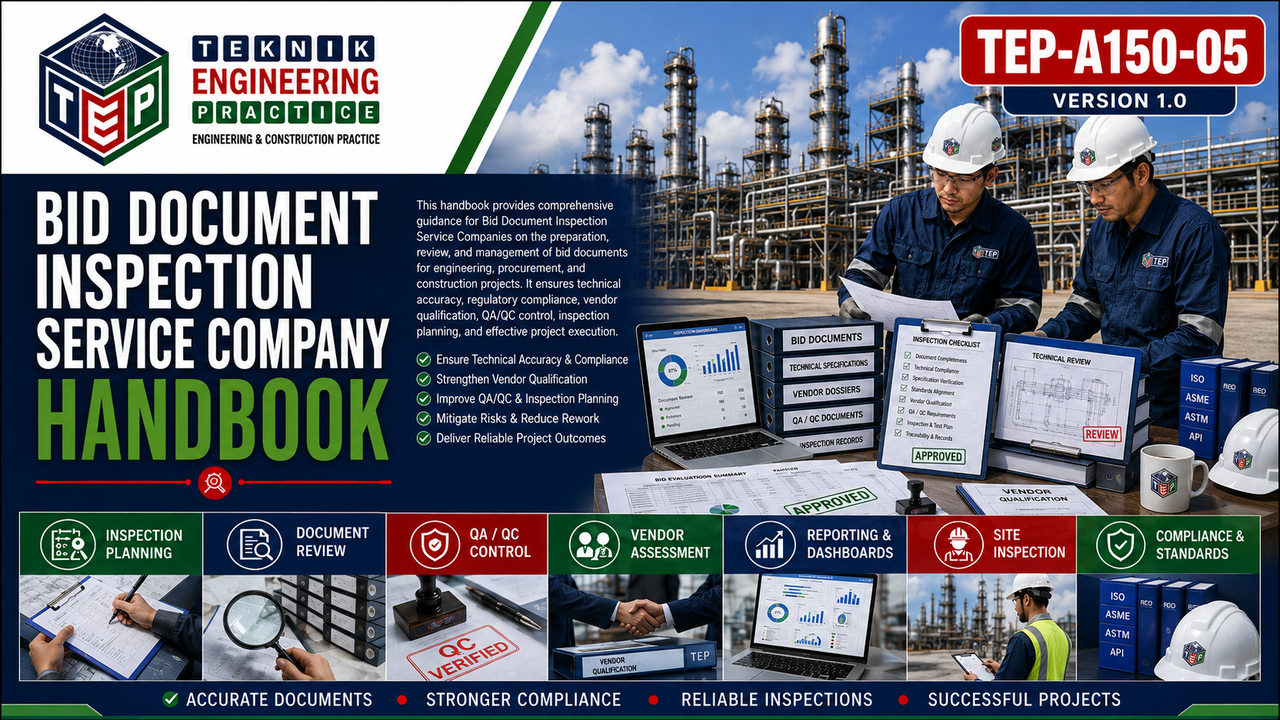
BID DOCUMENT INSPECTION SERVICE COMPANY provides a complete framework for procuring inspection service companies for EPC and industrial projects. It defines bid strategy, bidder instructions, scope, company qualification, inspector competency, discipline inspection requirements, vendor-shop workflow, material traceability, ITP and hold-point control, nonconformity management, reporting, manpower planning, mobilization, HSE, tools, calibration, commercial pricing, evaluation, contract requirements, KPIs, pre-inspection meetings, fabrication surveillance, commissioning support and final release. The handbook also supplies sample matrices, forms, worked evaluation methods and close-out controls. Its central principle is traceability: every bid requirement should connect to an execution activity, acceptance criterion, objective record and authorized decision.

Rp499.000
Thumbnail for TEP-A150-03 PROJECT SCHEDULE ENGINEERING PROCUREMENT AND CONSTRUCTION (EPC) HANDBOOK VERSION 1.0
Digital Resource

TEP-A150-03 PROJECT SCHEDULE ENGINEERING PROCUREMENT AND CONSTRUCTION (EPC) HANDBOOK VERSION 1.0

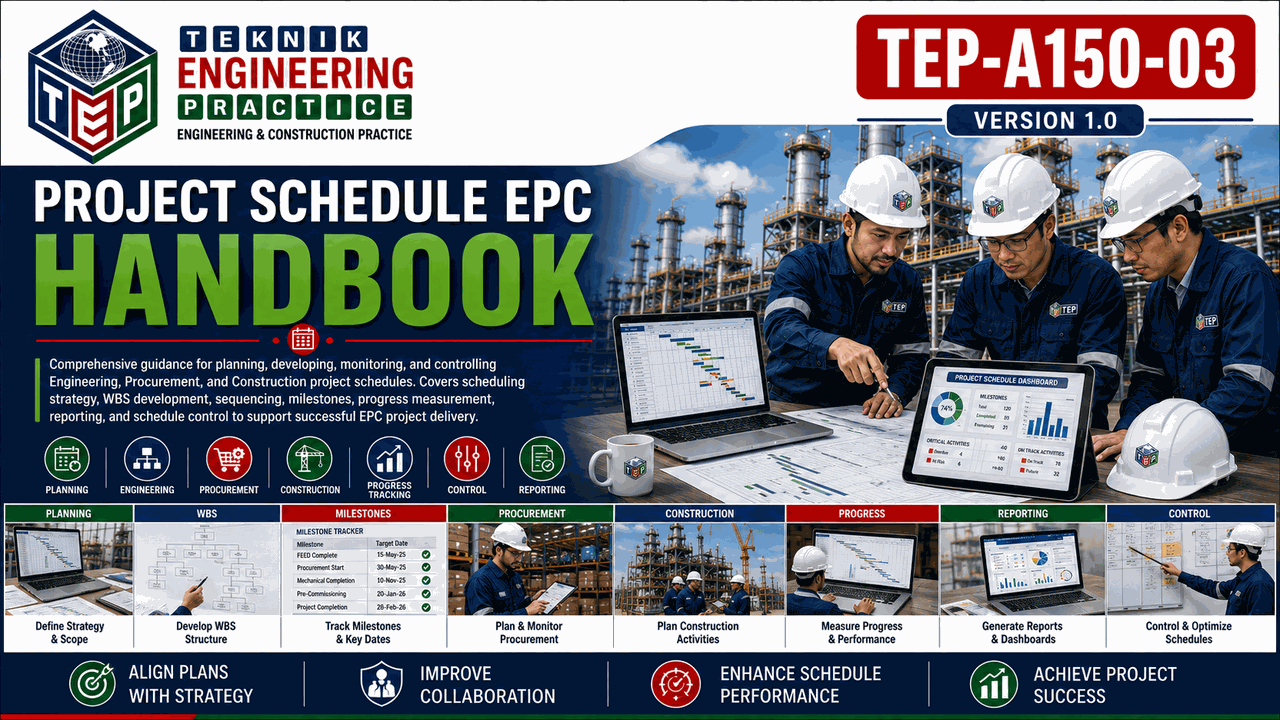
PROJECT SCHEDULE ENGINEERING PROCUREMENT AND CONSTRUCTION (EPC) defines an end-to-end EPC project schedule management system from contract review and schedule basis development through WBS design, integrated baseline preparation, progress measurement, updating, earned value, forecasting, risk, recovery, delay analysis and final as-built close-out. The handbook establishes a hierarchy from Level 1 executive milestones to Level 5 short-interval field plans. It explains engineering deliverable scheduling, procurement and vendor schedules, construction work-packaged planning, commissioning systemization, CPM logic, calendars, duration calculations, resource loading, critical-path management, baseline approval and schedule quality assurance. Worked examples demonstrate physical progress, SPI/CPI interpretation, float and path review, long-lead procurement logic, work-front readiness, P50/P80 risk dates, change fragnets and recovery scenarios. Appendices provide reusable templates, registers, checklists and data dictionaries suitable for adaptation to project procedures. The reference framework recognizes current published guidance including ISO 21502:2020, ISO 21508:2026, ISO 21511:2018, ISO 21512:2024, PMI Practice Standard for Scheduling - Third Edition, and applicable AACE International recommended practices. Users shall verify the latest published edition and contractual applicability at the time of use.

Rp499.000
Thumbnail for TEP-A150-04 COST ESTIMATION EPC HANDBOOK VERSION 1.0
Digital Resource

TEP-A150-04 COST ESTIMATION EPC HANDBOOK VERSION 1.0

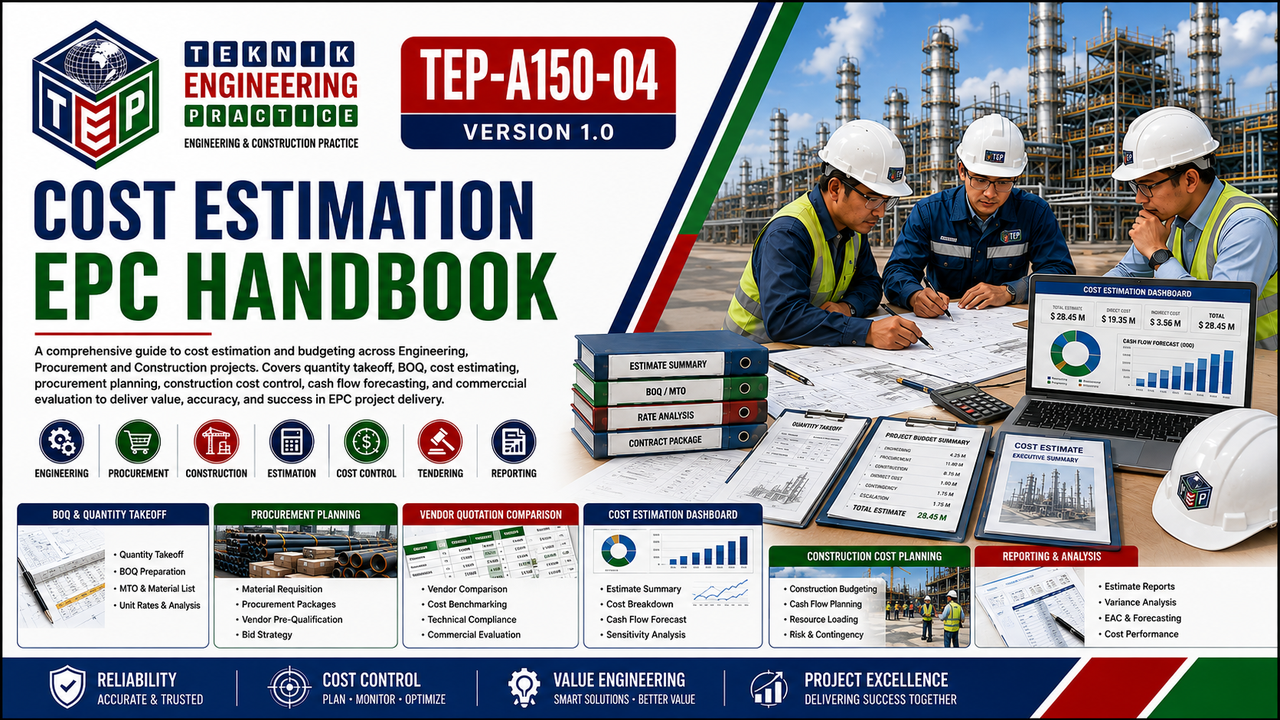
COST ESTIMATION EPC HANDBOOK presents a structured cost-estimation framework for capital EPC projects. It integrates estimate governance, project-definition maturity, Basis of Estimate, WBS/CBS/OBS coding, data normalization, estimate methods, discipline quantities, vendor pricing, labor productivity, logistics, indirect costs, commissioning, owner costs, currency, escalation, contingency, probabilistic risk analysis, schedule-cost integration, bid pricing, review, change control, earned value, forecasting and close-out. The handbook contains forty technical chapters and thirty-six practical appendices. Each chapter includes a 3D engineering visualization, representative field visualization, governing logic or formula, worked example, execution procedure, quality checklist, failure modes and minimum records. The appendices provide reusable templates for the Basis of Estimate, coding structures, equipment and bulk material cost sheets, labor productivity, vendor comparison, indirects, risk, contingency, escalation, cash flow, estimate review, bid approval and handover.

Rp499.000
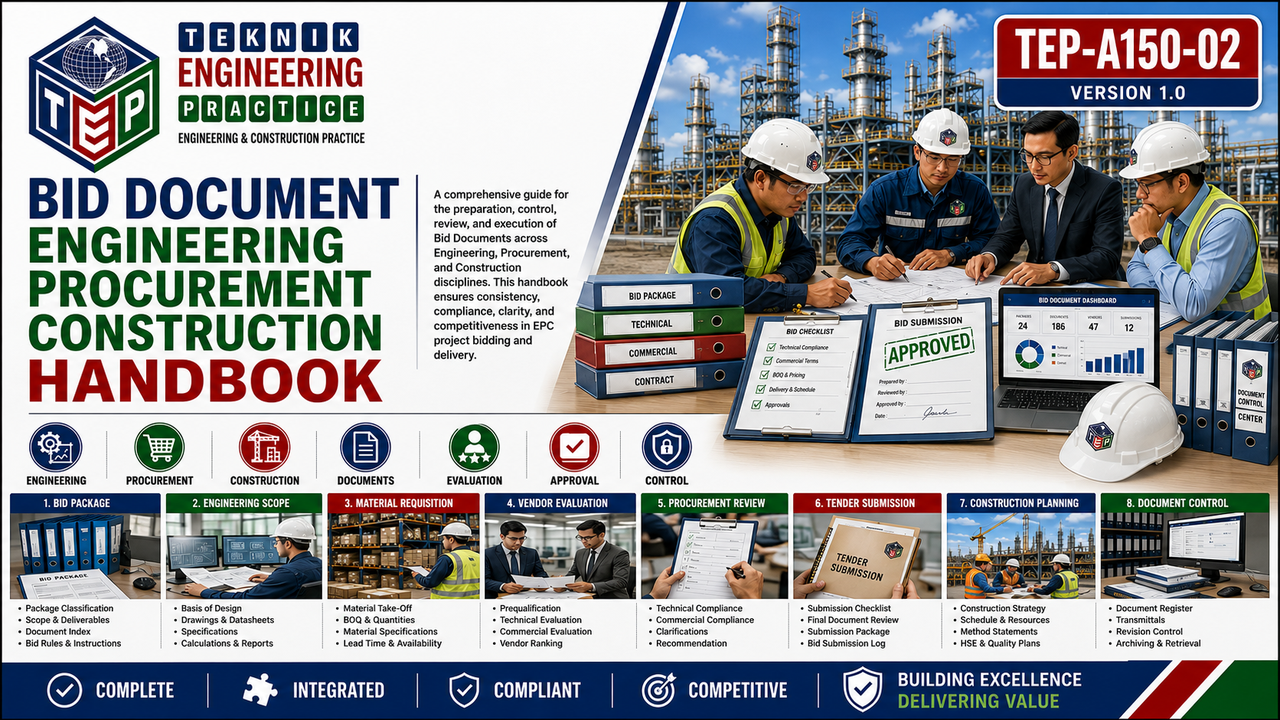
Thumbnail for TEP-A150-02 BID DOCUMENT ENGINEERING PROCUREMENT CONSTRUCTION HANDBOOK VERSION 1.0
Digital Resource

TEP-A150-02 BID DOCUMENT ENGINEERING PROCUREMENT CONSTRUCTION HANDBOOK VERSION 1.0

BID DOCUMENT ENGINEERING PROCUREMENT CONSTRUCTION HANDBOOK VERSION 1.0 provides a comprehensive working framework for preparing and controlling EPC tender documents from opportunity registration through bid/no-bid, tender review, technical and commercial development, vendor and subcontractor engagement, estimating, management approval, submission, negotiation, award, and project handover. The handbook contains forty-seven chapters covering governance, compliance, scope, contract review, engineering basis, deliverables, quantities, procurement, approved vendors, fabrication, logistics, construction, commissioning, commercial controls, risk, submission, negotiation, award handover and a dedicated equipment-and-material lifecycle deep dive from design through reliability readiness. The final appendix series includes a complete fictional Oil & Gas EPC bid dossier for training and adaptation. Fifty-two appendices provide directly usable registers, matrices, checklists, evaluation forms, schedule and estimating controls, HSE and quality templates, equipment datasheet requirements, material receiving inspection, fabrication ITP, shipping, installation, commissioning and maintenance-readiness forms.

Rp499.000
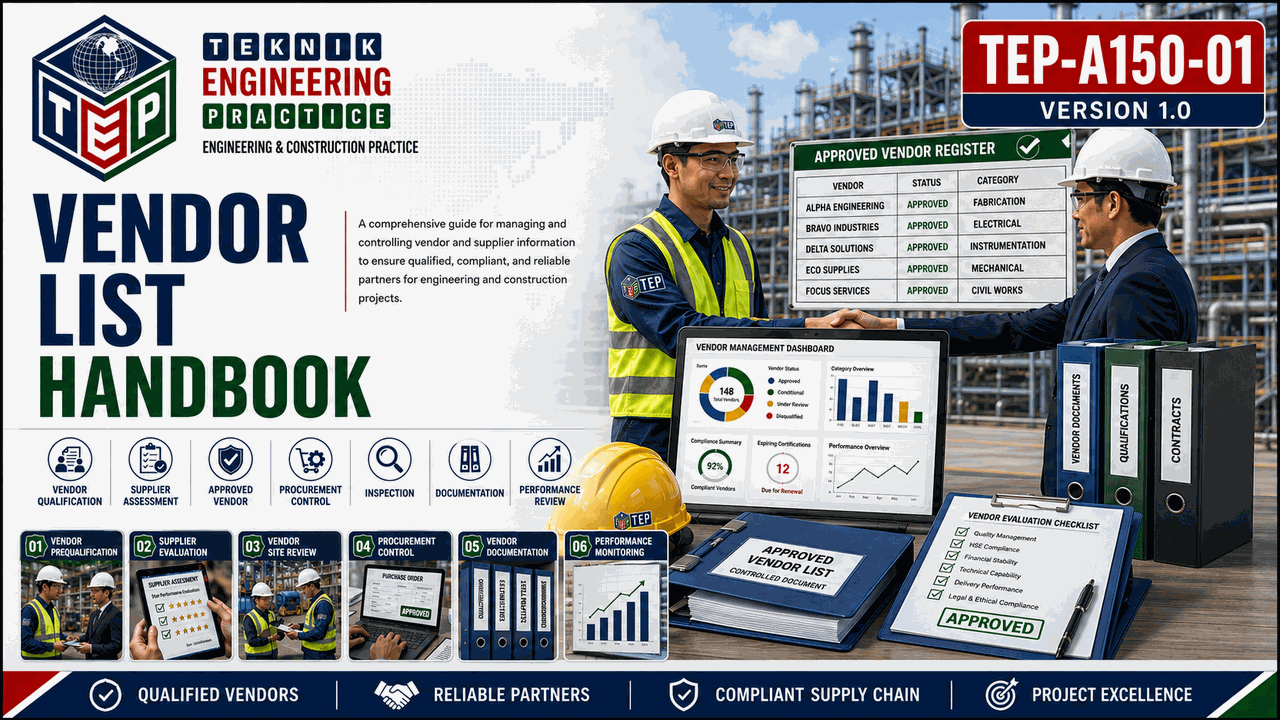
Thumbnail for TEP-A150-01 VENDOR LIST HANDBOOK VERSION 1.0
Digital Resource

TEP-A150-01 VENDOR LIST HANDBOOK VERSION 1.0

Vendor List Handbook Version 1.0 establishes a risk-based and auditable system for managing vendor information and approved vendor status throughout the project and asset lifecycle. It addresses policy, approval authority, commodity classification, registration data, legal and ethical screening, technical capability, quality assurance, HSE and sustainability, financial strength, insurance, tax, cybersecurity, approved vendor list structure, onboarding, sourcing, inspection, logistics, performance, corrective action, renewal, industrial-sector applications, digital systems, RACI, KPI reporting, record retention and maturity development.

Rp499.000
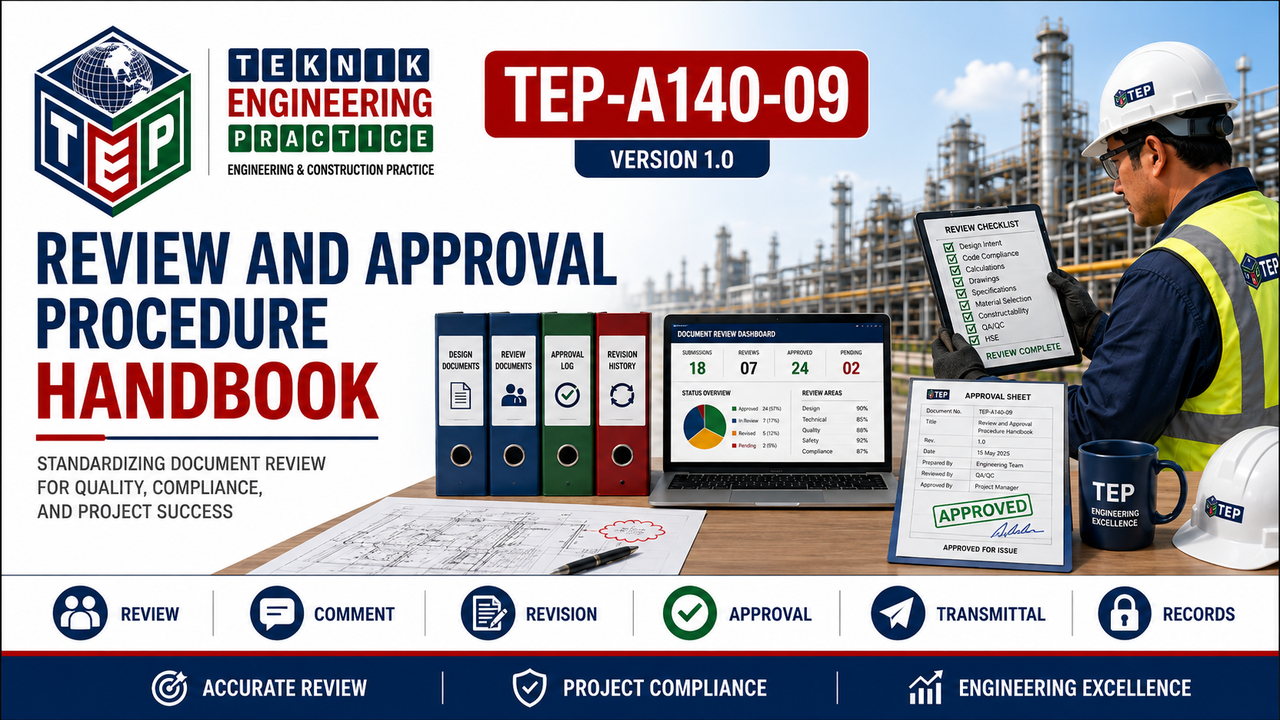
Thumbnail for TEP-A140-09 REVIEW AND APRROVAL PROCEDURE HANDBOOK VERSION 1.0
Digital Resource

TEP-A140-09 REVIEW AND APRROVAL PROCEDURE HANDBOOK VERSION 1.0

This handbook defines a comprehensive and auditable system for planning, performing, recording and controlling the review and approval of project documents and technical information. It covers document classification, criticality, RACI, competence, input readiness, self-check, discipline checking, interdisciplinary review, independent verification, external review, vendor data, comment management, approval status, revision control, digital workflow, field release, commissioning readiness, KPIs, audit, security and record retention. Thirty-two implementation chapters are supported by eighteen practical appendices containing matrices, checklists, forms, logs, authority templates, worked KPI examples, audit questions, digital workflow requirements and a sector application matrix. Each chapter includes a workflow visual, control intent, mandatory requirements, evidence table, checklist, risk controls and performance measure. The procedure is designed for oil and gas, petrochemical, chemical, power, water and wastewater, mining, manufacturing, offshore, infrastructure and marine projects. It shall be tailored to the governing contract, applicable law, client procedures, project quality plan, discipline standards and approved information-management system.

Rp499.000
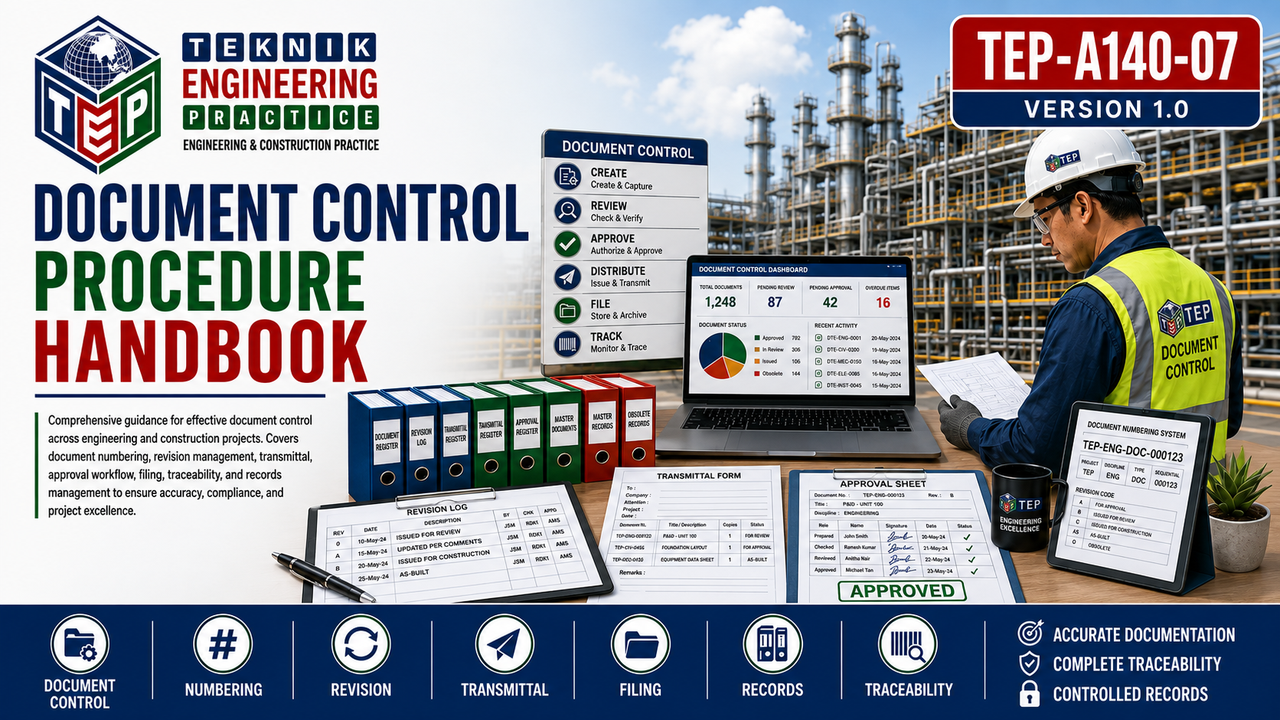
Thumbnail for TEP-A140-07 DOCUMENT CONTROL PROCEDURE HANDBOOK VERSION 1.0
Digital Resource

TEP-A140-07 DOCUMENT CONTROL PROCEDURE HANDBOOK VERSION 1.0

This handbook defines a comprehensive document control framework for engineering and capital projects. It establishes requirements for document identification, numbering, metadata, master document registers, preparation, checking, interdisciplinary review, approval, issue, transmittal, controlled distribution, revision, supersession, vendor data, site documents, redlines, as-built records, information security, retention, auditing and business continuity. The method is aligned with internationally recognized quality, documented-information, records-management, information-security and common-data-environment principles. It provides an auditable lifecycle in which each document has a unique identity, an accountable owner, an approved status, a traceable issue history and an authorized retention or disposition outcome. Implementation outputs include a project Document Control Plan, coding specification, master document register, workflow and approval matrix, distribution matrix, vendor document register, retention schedule, audit programme, KPI dashboard and final handover index. The appendices provide ready-to-adapt templates for those outputs

Rp499.000
Thumbnail for TEP-A140-05 COMMUNICATION AND CORRESPONDENCE PROCEDURE HANDBOOK VERSION 1.0
Digital Resource

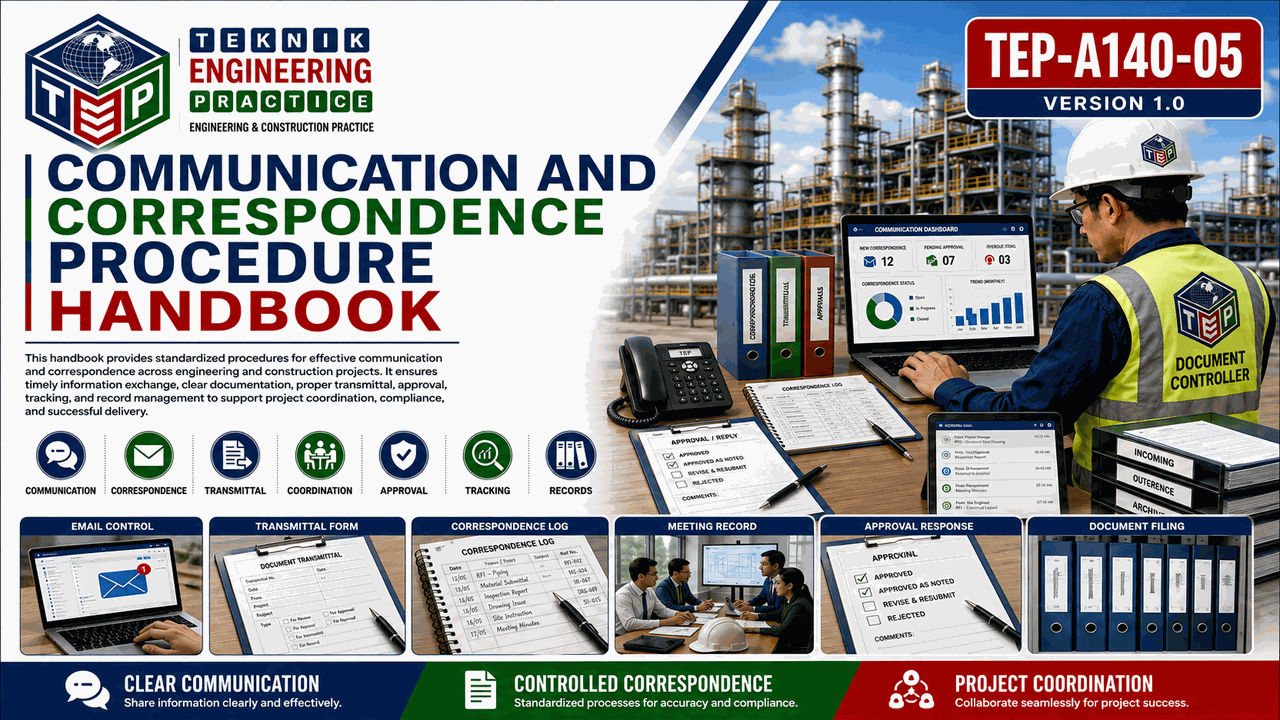
TEP-A140-05 COMMUNICATION AND CORRESPONDENCE PROCEDURE HANDBOOK VERSION 1.0

COMMUNICATION AND CORRESPONDENCE PROCEDURE HANDBOOK VERSION 1.0 provides a structured framework for controlling project communication across engineering, procurement, manufacturing, logistics, construction, commissioning, handover and close-out. It integrates stakeholder analysis, communication planning, correspondence classification, formal letters, email protocol, transmittals, incoming and outgoing registration, response control, meeting minutes, technical queries, vendor and client interfaces, site instructions, contractual notices, confidentiality, digital platforms, crisis communication, performance monitoring and records management. Thirty-six chapters explain the control philosophy, required workflows, roles, records, KPIs, risks and implementation checks. Twenty-six appendices provide reusable plans, matrices, registers, forms, dashboards, writing guidance, audit tools and sector-application references. The handbook is applicable to oil and gas, petrochemical, chemical, power, water and wastewater, mining, manufacturing, offshore, marine and infrastructure projects.

Rp499.000
Thumbnail for TEP-A140-08 PROGRES CALCULATION AND REPORTING HANDBOOK VERSION 1.0
Digital Resource

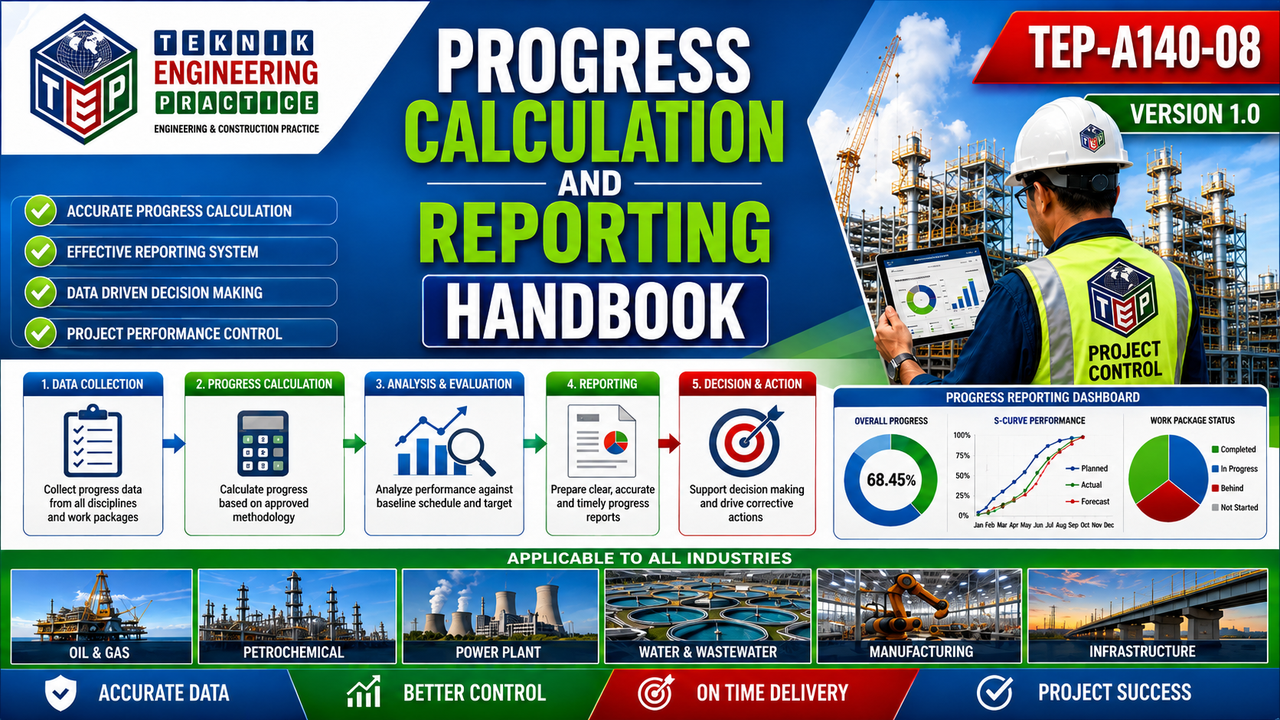
TEP-A140-08 PROGRES CALCULATION AND REPORTING HANDBOOK VERSION 1.0

This handbook defines an integrated system for calculating and reporting project progress across engineering, procurement, construction, pre-commissioning, commissioning, and handover. It explains how the Work Breakdown Structure, Cost Breakdown Structure, Organization Breakdown Structure, control accounts, work packages, quantities, budgeted man-hours, contract values, and weighted milestones are converted into an approved performance measurement baseline. Methods addressed include zero-hundred, fifty-fifty, weighted milestones, units complete, apportioned effort, level of effort, physical percentage complete, rule of credit, earned value management, earned schedule, productivity analysis, S-curves, variance analysis, trend evaluation, and forecast-at-completion. Worked examples demonstrate engineering deliverable credit, procurement package milestones, construction quantity measurement, integrated EPC progress, schedule and cost performance indices, estimate at completion, and recovery planning. Appendices provide sample forms, report structures, checklists, responsibility matrices, milestone libraries, calculation sheets, and audit questions. Overall Project Progress (%) = SUM [Stage Weight x Stage Progress] All weights are expressed as fractions or percentage points and shall total 100%.

Rp499.000
Thumbnail for TEP-A140-02 EQUIPMENT AND PIPING NUMBERING PROCEDURE HANDBOOK VERSION 1.0
Digital Resource

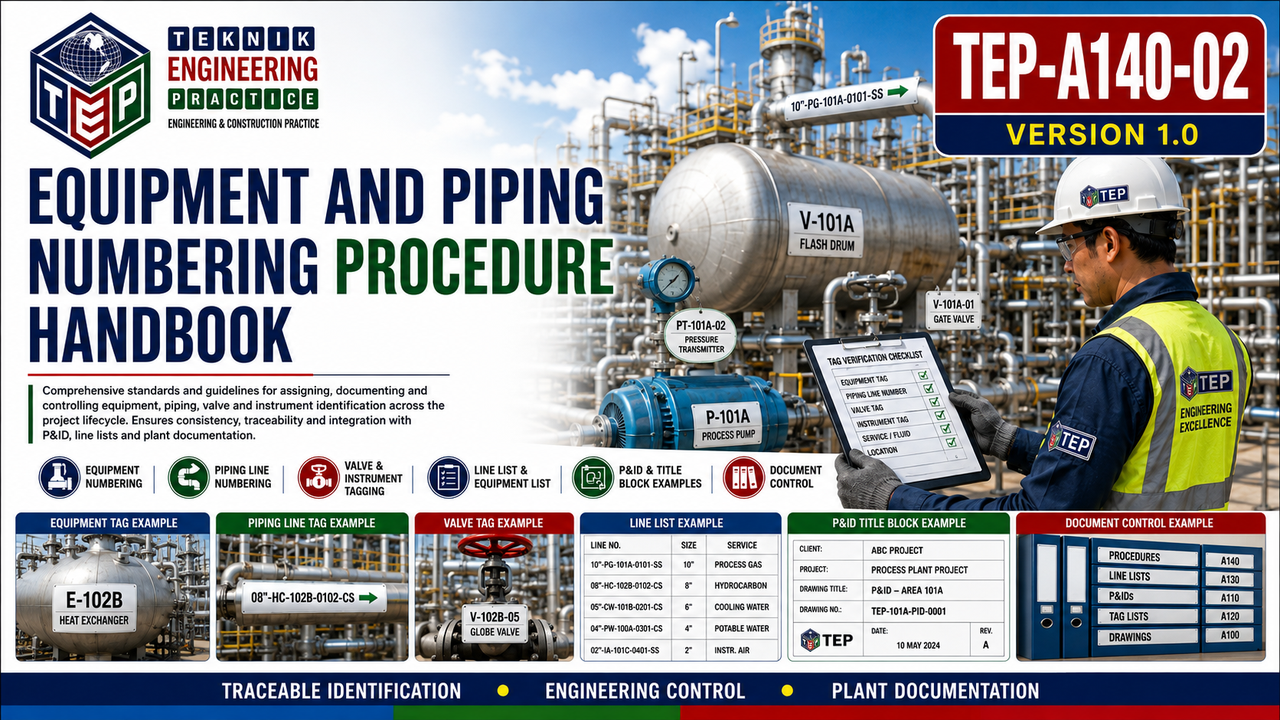
TEP-A140-02 EQUIPMENT AND PIPING NUMBERING PROCEDURE HANDBOOK VERSION 1.0

EQUIPMENT AND PIPING NUMBERING PROCEDURE HANDBOOK establishes a unified procedure for equipment and piping numbering. The equipment method uses a facility context, controlled equipment-type code, sequential number, optional parallel suffix and optional sub-item code. The piping method uses nominal size, service code, line sequence, material class, insulation and tracing identifiers. The exact display order is confirmed in a project configuration sheet. The procedure covers numbering governance, facility breakdown, sequence allocation, package and vendor equipment, brownfield reconciliation, service and material-class codes, branches and line continuations, specification breaks, valves and specialties, vents and drains, battery limits, tie-ins, safety-critical systems, register integration, changes, audits and handover. The principal output is a trusted master register whose identifiers match every controlled engineering and operational system. The expected result is zero duplicate active tags, complete mandatory attributes, consistent numbering across deliverables and a traceable lifecycle history from reservation through as-built closeout.

Rp499.000
Thumbnail for TEP-A140-01 DOCUMENT NUMBERING PROCEDURE HANDBOOK VERSION 1.0
Digital Resource

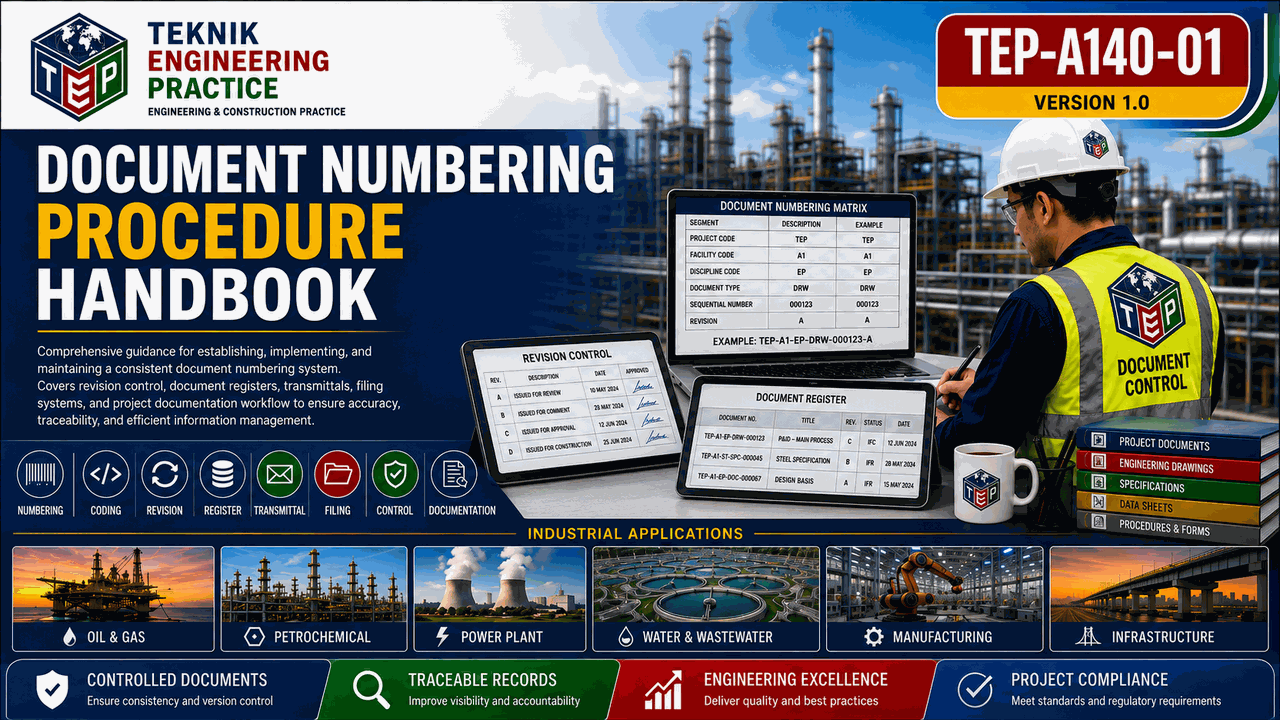
TEP-A140-01 DOCUMENT NUMBERING PROCEDURE HANDBOOK VERSION 1.0

Document Numbering Procedure Handbook Version 1.0 defines a comprehensive framework for the identification and control of project information. It explains the relationship between corporate procedure numbers, project deliverable numbers, vendor native numbers, equipment tags, electronic file names, revisions, statuses, suitability codes, and EDMS metadata. The handbook contains thirty-five chapters and twenty appendices. Topics include governance, numbering philosophy, syntax design, project and originator codes, discipline and document-type coding, area and system segmentation, sequence allocation, revision and status management, drawing and report numbering, correspondence, vendor documents, file naming, metadata, MDR integration, duplicate prevention, renumbering, audit, implementation, and troubleshooting.

Rp499.000
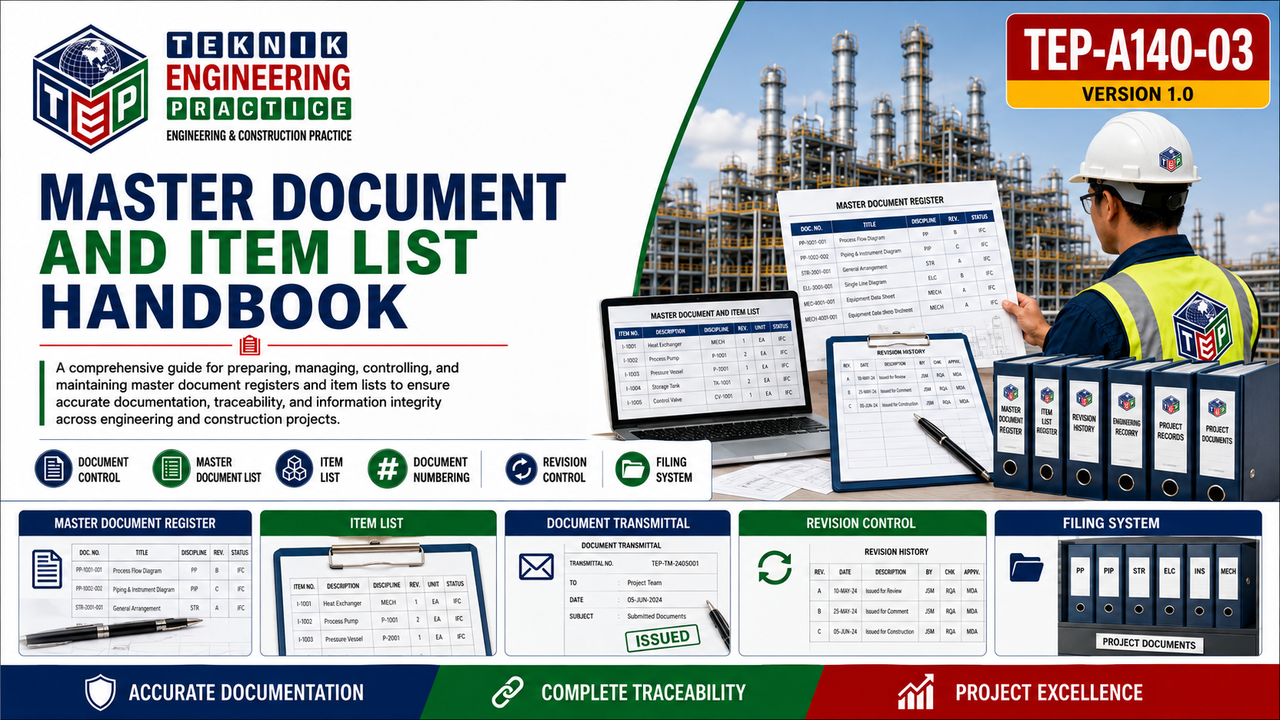
Thumbnail for TEP-A140-03 MASTER DOCUMENT AND ITEM LIST HANDBOOK VERSION 1.0
Digital Resource

TEP-A140-03 MASTER DOCUMENT AND ITEM LIST HANDBOOK VERSION 1.0

MASTER DOCUMENT AND ITEM LIST HANDBOOK VERSION 1.0 provides a practical framework for planning, coding, registering, reviewing, issuing, revising, distributing, validating, archiving and handing over project documents and item data. It integrates engineering deliverables, vendor documents, procurement items, equipment tags, piping lines, electrical and instrument objects, civil assets, quality records, construction work packs, commissioning systems and final dossiers. The handbook includes workflow diagrams, control requirements, required-record matrices, roles, risk controls, KPIs, checklists and twenty-four project-ready appendices. It is designed for oil and gas, petrochemical, chemical, power, water and wastewater, mining, manufacturing, offshore, marine and infrastructure projects.

Rp499.000
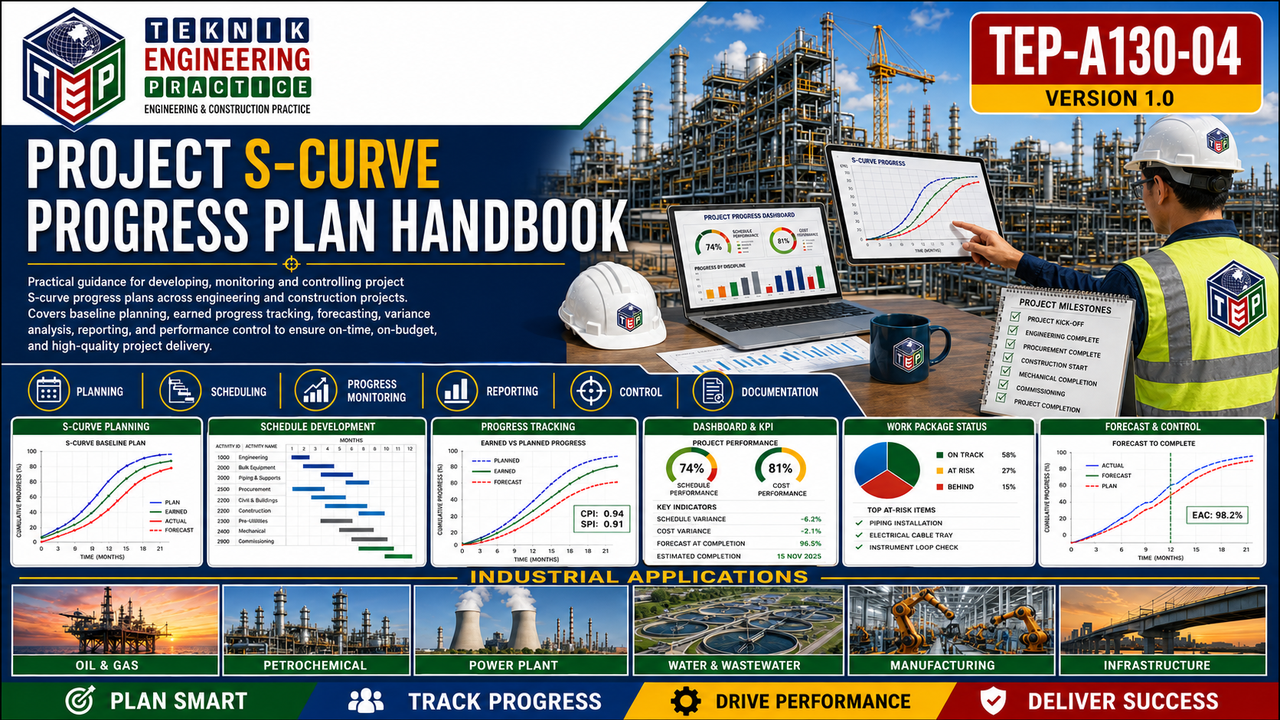
Thumbnail for TEP-A130-04 PROJECT S-CURVE PROGRESS PLAN HANDBOOK VERSION 1.0
Digital Resource

TEP-A130-04 PROJECT S-CURVE PROGRESS PLAN HANDBOOK VERSION 1.0

ABSTRACT This handbook defines the lifecycle of a project S-curve progress plan from scope decomposition through baseline approval, periodic status, earned progress, variance analysis, forecasting, recovery and close-out. It explains planned value, earned value, actual cost, schedule and cost performance indices, quantity-weighted progress, milestone weighting, resource-loaded curves, cost curves and composite physical progress. Worked examples demonstrate monthly and weekly calculations, discipline weighting, engineering deliverable credit, procurement milestone credit, construction installed-quantity measurement, commissioning system completion, forecast-at-completion and recovery scenarios. Templates are provided for a progress measurement basis, weight register, data collection sheet, monthly report, change log, recovery plan and audit checklist. The framework is aligned conceptually with current international project-management and earned-value guidance, including ISO 21508:2026, ISO 21512:2024, ISO 21502:2020 and the PMI Standard for Earned Value Management, subject always to project-specific contractual requirements. • Baseline, actual and forecast S-curves. • WBS/CBS and organizational integration. • Progress evidence and data quality controls. • EVM, productivity, trend and completion forecasting. • Cross-industry application and governance.

Rp499.000
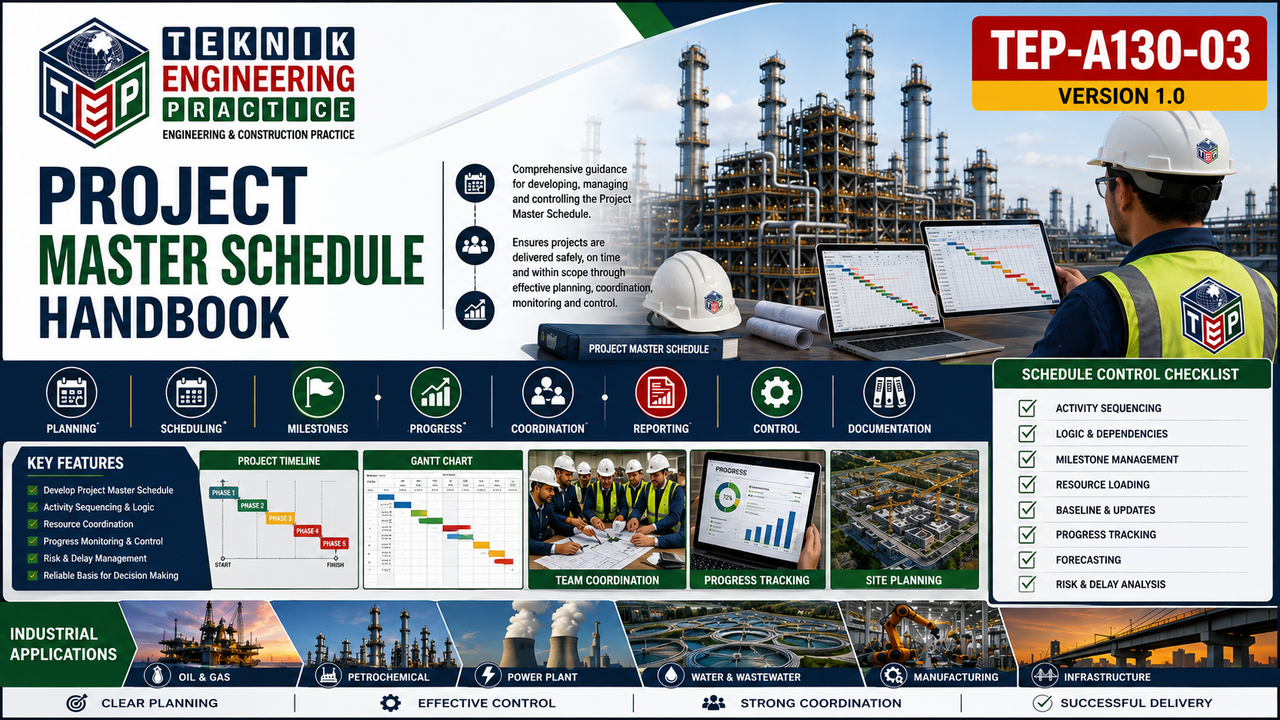
Thumbnail for TEP-A130-03 PROJECT MASTER SCHEDULE HANDBOOK VERSION 1,0
Digital Resource

TEP-A130-03 PROJECT MASTER SCHEDULE HANDBOOK VERSION 1,0

Project Master Schedule - development, control and assurance Scope. The handbook covers schedule governance, WBS integration, schedule hierarchy, milestone control, logic and duration development, critical path, float, resource and cost loading, phase integration, baseline control, progress measurement, look-ahead planning, forecasting, recovery, schedule risk, change, delay analysis, reporting, quality assessment, digital integration and closeout. Method. A lifecycle and control-cycle approach is used. Each schedule requirement is translated into defined inputs, execution rules, outputs, records, approval steps and verification checks. Worked examples explain CPM, PERT, weighted progress and earned-value indicators. Key outputs. Typical outputs include the schedule management plan, basis of schedule, integrated Level 1-4 schedules, milestone register, coding dictionary, progress measurement system, baseline package, update package, schedule narrative, risk analysis, recovery plan, time-impact analysis, delay register, quality report and final as-built schedule. Management value. When properly implemented, the framework improves coordination, early warning, decision quality, resource planning, forecast reliability, change management, audit readiness and contractual defensibility.

Rp499.000
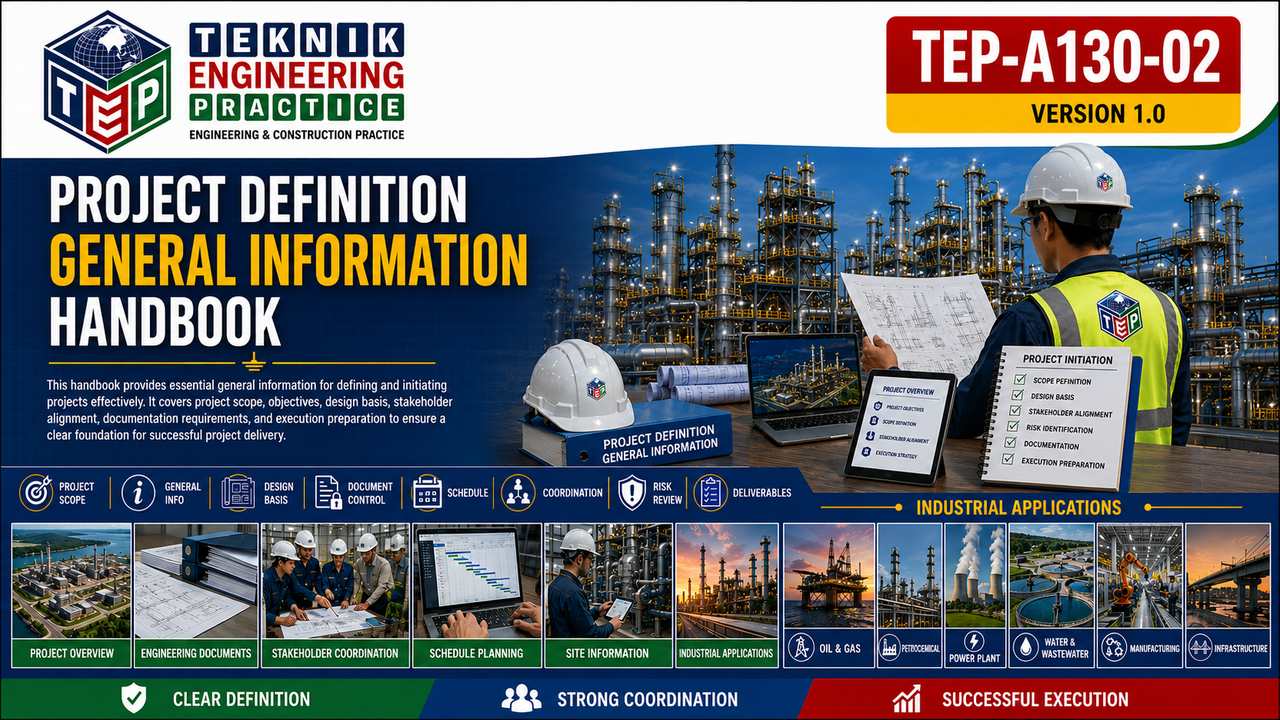
Thumbnail for TEP-A130-02 PROJECT DEFINITION GENERAL INFORMATION HANDBOOK VERSION 1.0
Digital Resource

TEP-A130-02 PROJECT DEFINITION GENERAL INFORMATION HANDBOOK VERSION 1.0

This handbook presents a structured framework for preparing, reviewing and approving project definition and general information for industrial, energy, infrastructure and construction projects. It integrates business need, scope, design basis, key project data, stakeholder requirements, site conditions, execution strategy, schedule, cost, risk, HSE, quality, engineering, procurement, construction, commissioning, operations readiness, information management and governance. The methodology uses a lifecycle and gate-based approach supported by controlled registers, responsibility matrices, interface management, assumption closure, risk analysis, decision records, evidence indexing and a measurable project definition maturity assessment. The framework is scalable and can be tailored to greenfield, brownfield, revamp, offshore, onshore, utility, manufacturing and infrastructure projects. Typical outputs include an approved project data sheet, scope statement, battery-limit matrix, stakeholder requirement register, design basis, codes-and-standards register, execution and contracting strategy, WBS, milestone schedule, estimate basis, risk register, HSE and quality requirements, discipline definition deliverables, long-lead strategy, construction and commissioning philosophy, operations-readiness requirements, interface and permit registers, change log, maturity assessment and final approval package. When applied with competent professional review and project-specific requirements, the framework improves decision quality, definition completeness, cost and schedule predictability, interface clarity, authorization readiness and transition into detailed execution. Keywords: project definition, general information, business case, scope, design basis, front-end planning, FEED, project controls, risk, cost estimate, schedule, execution readiness, gate review, EPC, engineering management.

Rp499.000
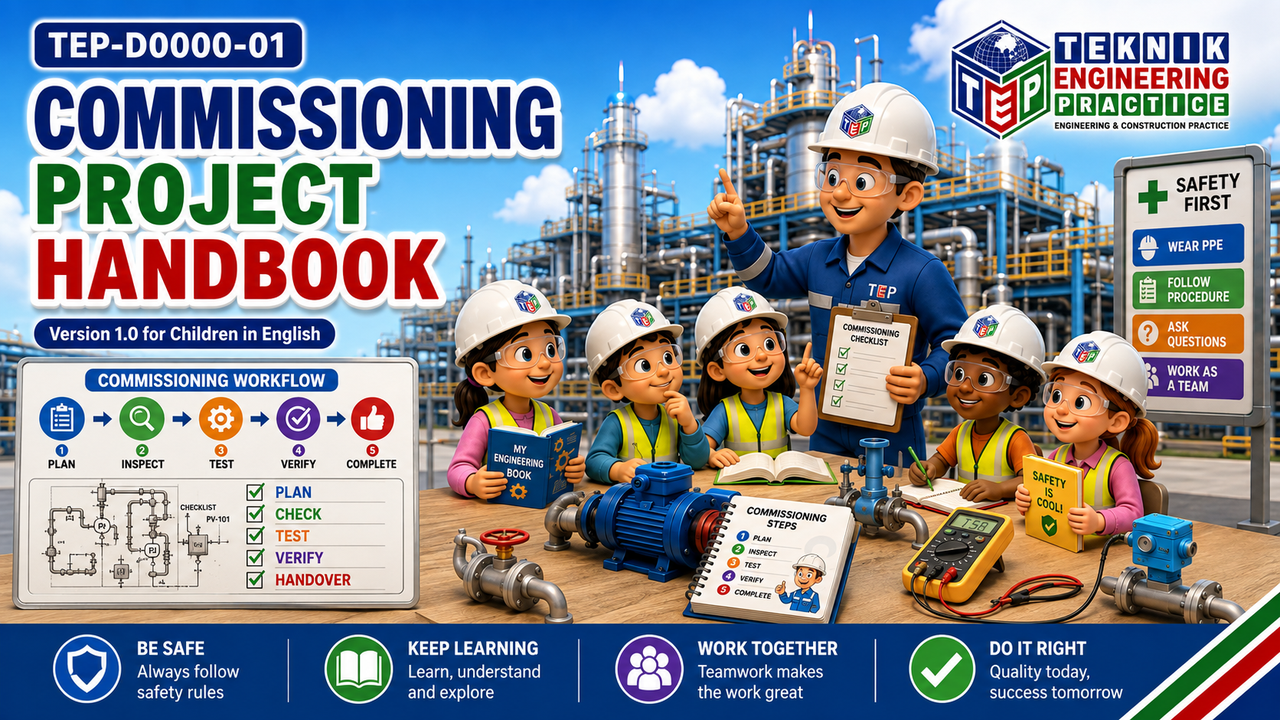
Thumbnail for TEP-D000-01 COMMISSIONING PROJECT HANDBOOK FOR CHILDREN
Digital Resource

TEP-D000-01 COMMISSIONING PROJECT HANDBOOK FOR CHILDREN

This handbook presents a comprehensive framework for managing and executing commissioning activities in EPC, oil and gas, petrochemical, power, industrial, utility, infrastructure, and process plant projects. It covers systemization, mechanical completion, pre-commissioning, commissioning, start-up, performance testing, safety management, discipline interfaces, records, certificates, handover requirements, and lessons learned. Core content includes commissioning organization, planning, scheduling, resource control, risk assessment, SIMOPS, permit-to-work, isolation/LOTO, cleaning, flushing, drying, leak testing, electrical energization, instrument calibration, loop testing, rotating equipment checks, static equipment preparation, piping commissioning, control system verification, fire and gas readiness, vendor support, and completion dossier management. The methodology emphasizes prerequisites, field execution, verification, acceptance evidence, and risk control for each commissioning subject. It links procedures, checklists, test records, certificates, and punch-list categories to clear handover gates so that no system proceeds to the next phase without controlled acceptance evidence. The final objective is to support safe start-up, reliable operation, contractual compliance, and disciplined transfer of care, custody, and control from construction to commissioning and from commissioning to operations. The document is intended as a professional training and project execution reference and shall be used together with approved project specifications and applicable standards

Rp499.000
Thumbnail for TEP-C000-01 CONSTRUCTION HANDBOOK VERSION 1.0 FOR CHILDREN
Digital Resource

TEP-C000-01 CONSTRUCTION HANDBOOK VERSION 1.0 FOR CHILDREN

Construction for Children Handbook — Version 1.0 is an illustrated English learning guide that adapts the complete construction life-cycle framework of the TEP-C000 professional handbook into thirty-six child-friendly chapters. The content moves from purpose, teamwork, drawings, and planning through site preparation, civil and structural construction, mechanical equipment, piping, electrical and instrumentation systems, safety, quality, testing, handover, materials, digital construction, project controls, environmental care, and careers. The expanded final part follows equipment and materials from design and fabrication through delivery, installation, integrated construction, commissioning, and handover. Every chapter uses a two-page learning pattern: a Young Builder Diagram, a Big Idea, learning goals, a four-step process, a Safety Star rule, Builder’s Words, a safe Try It! activity, a Quick Check, a Career Corner, and a Remember statement. Six part dividers connect the chapters into a simple story of how projects are discovered, prepared, built, equipped, checked, completed, and improved. The handbook emphasizes that children should not enter active construction areas or reproduce professional field activities. Its activities use drawing, paper models, observation, organization, and classroom discussion. Real work requires approved engineering information, competent personnel, permits, risk controls, inspections, and authorized supervision.

Rp499.000
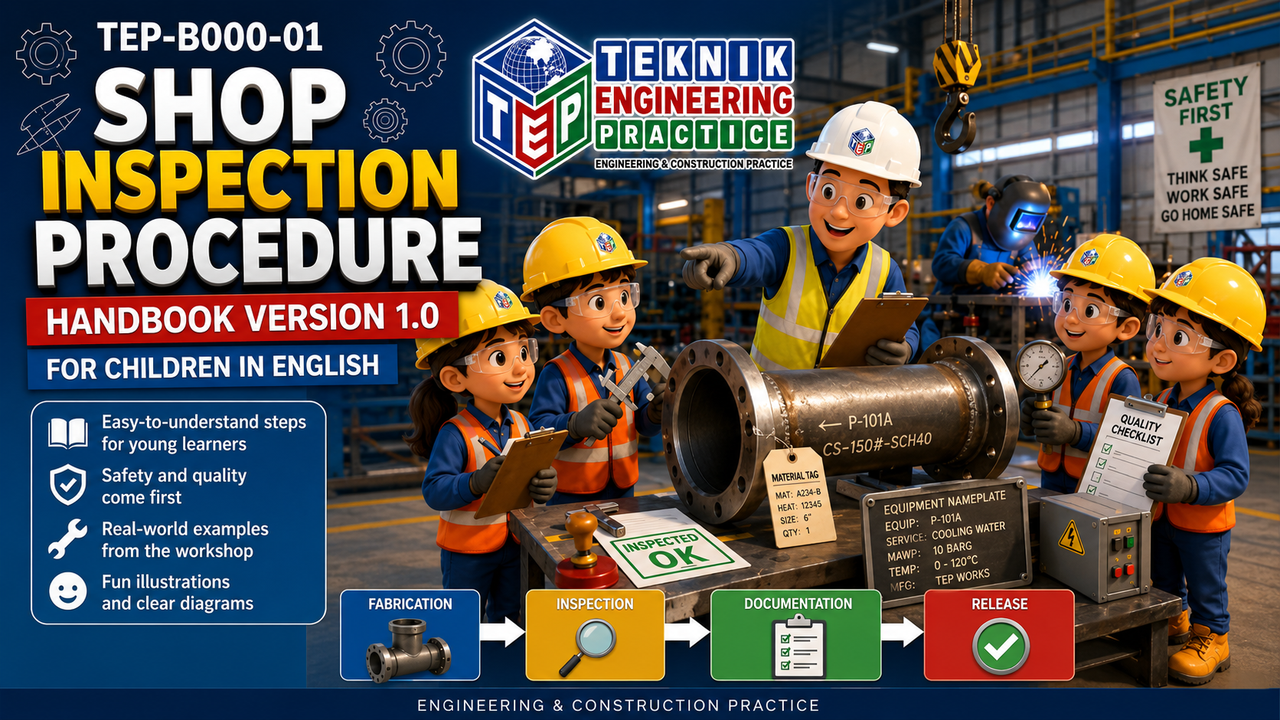
Thumbnail for TEP-B000-01 SHOP INSPECTION PROCEDURE HANDBOOK FOR CHILDREN VERSION 1.0
Digital Resource

TEP-B000-01 SHOP INSPECTION PROCEDURE HANDBOOK FOR CHILDREN VERSION 1.0

This 145-page handbook defines a complete, evidence-based approach to shop inspection for industrial equipment, fabricated items, piping, structures, electrical equipment, instruments, control systems, packages, and materials. It combines technical depth with child-friendly explanation and safe learning activities. Scope of learning • Governance, roles, quality planning, supplier readiness, document control, and risk-based surveillance. • ITP preparation and control of Hold, Witness, Review, Surveillance, Monitoring, and Release points. • Material certificates, traceability, PMI, preservation, fabrication, welding, NDE, dimensions, testing, and coating. • Equipment-specific, electrical, instrument, FAT, packing, shipment, NCR, MRB, HSE, ethics, and final handover controls. • Calculation notes, worked examples, material specifications, procurement control, forms, maintenance, reliability, commissioning, and industrial-sector applications.

Rp499.000
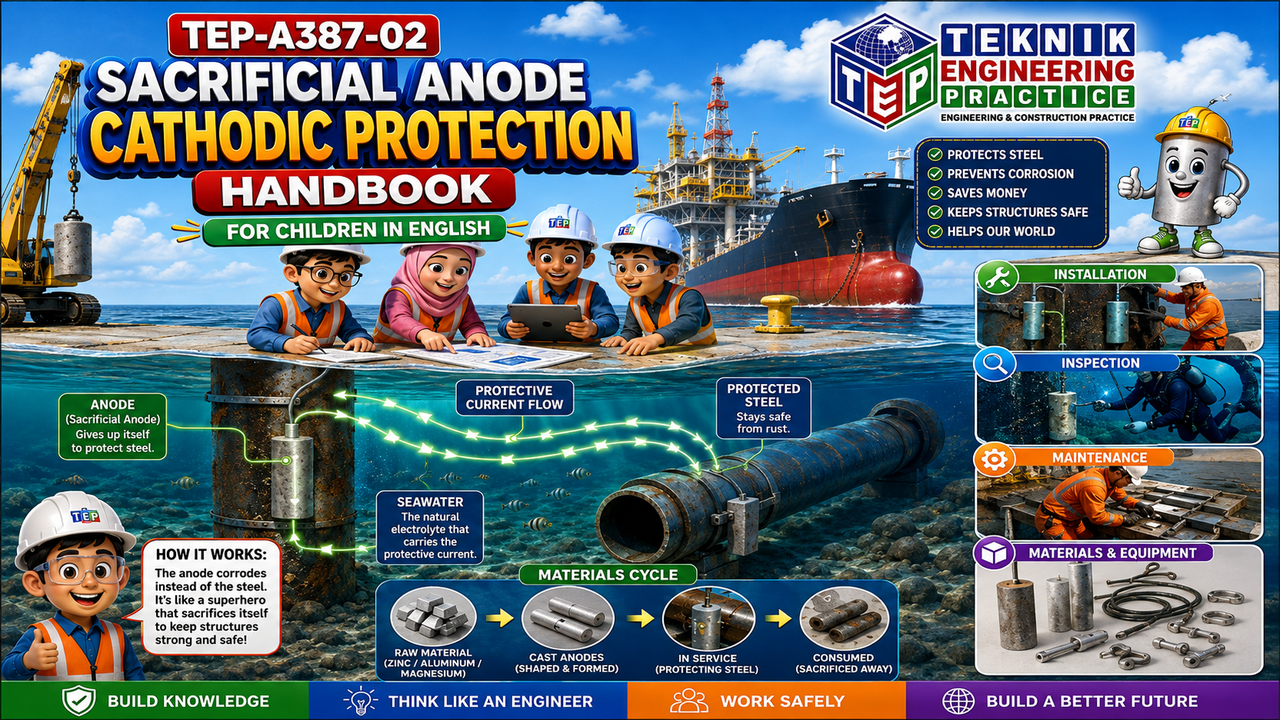
Thumbnail for TEP-A387-02 SACRIFICIAL ANODE CATHODIC PROTECTION HANDBOOK VERSION 1.0 FOR CHILDREN
Digital Resource

TEP-A387-02 SACRIFICIAL ANODE CATHODIC PROTECTION HANDBOOK VERSION 1.0 FOR CHILDREN

This handbook explains how sacrificial anodes help protect buried and submerged metal. Young learners discover corrosion cells, protection measurements, reference electrodes, magnesium, zinc and aluminium anodes, coatings, soil and water resistivity, current demand, anode life, safe installation, inspection, commissioning, monitoring and maintenance. Teacher notes preserve the controlled engineering terms, equations, standards, checklists and project forms used in real work.

Rp499.000
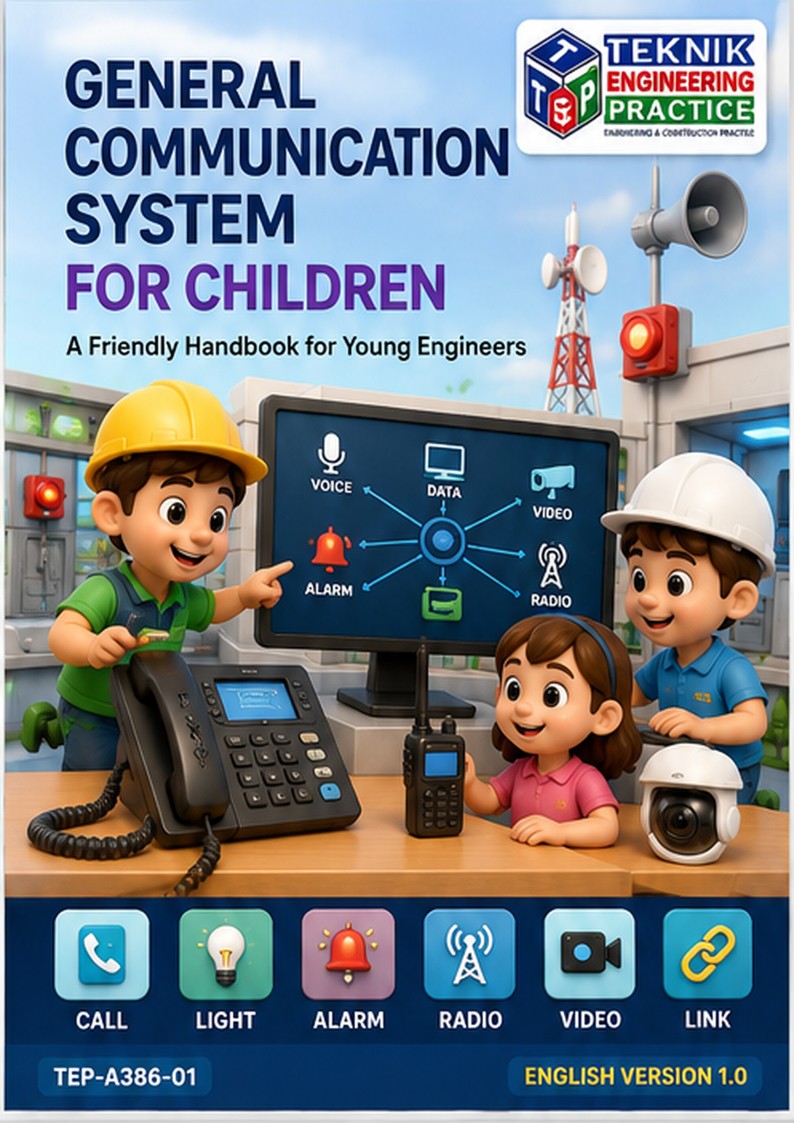
Thumbnail for TEP-A386-01 GENERAL COMMUNICATION SYSTEM VERSION 1.0 FOR CHILDREN
Digital Resource

TEP-A386-01 GENERAL COMMUNICATION SYSTEM VERSION 1.0 FOR CHILDREN

This handbook explains how industrial communication systems help people and machines exchange information. It follows a simple learning path: understand messages and system boundaries, plan a communication architecture, choose suitable wired and wireless paths, protect emergency and security services, test the completed system, and care for it throughout its life. Learners explore structured cabling, fiber-optic links, network switches, IP addresses, VLANs, Quality of Service, VoIP, emergency telephones, public address and general alarm, radio, wireless LAN, CCTV, access control, master clocks, telecom rooms, UPS, earthing, electromagnetic compatibility, hazardous environments, cybersecurity, microwave and satellite links, FAT, SAT, commissioning, maintenance, spares, and troubleshooting.

Rp499.000
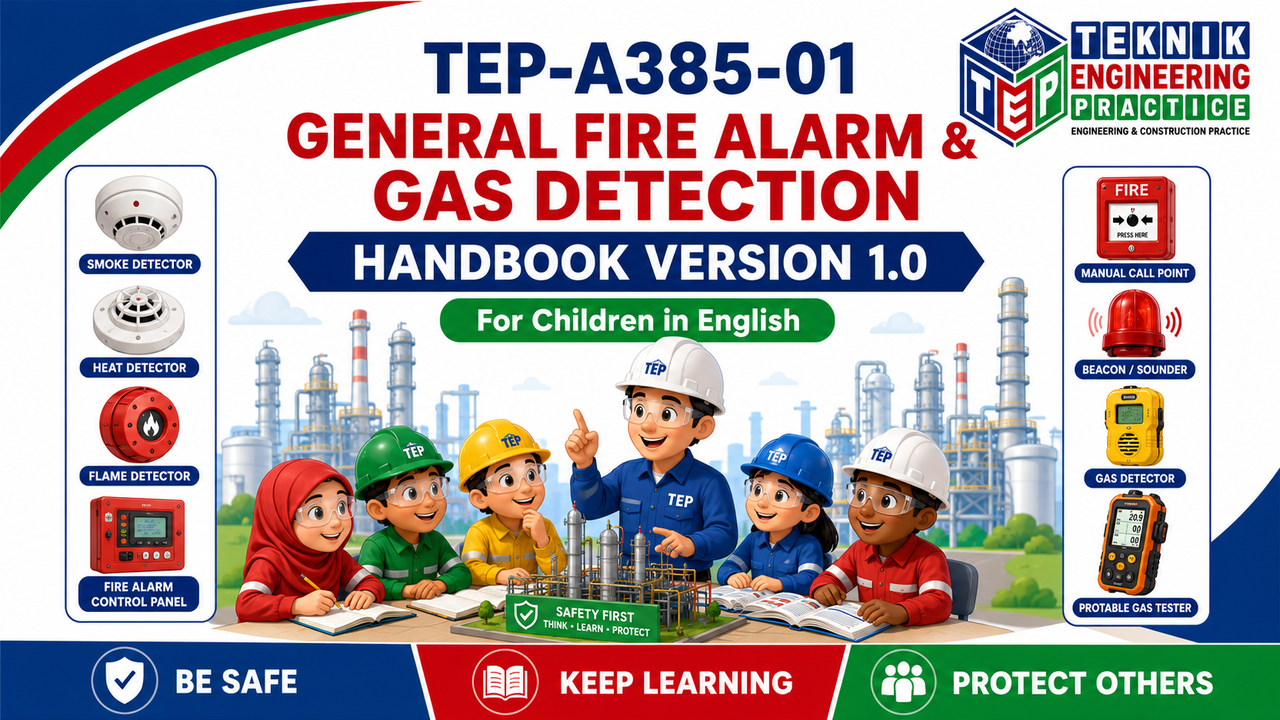
Thumbnail for TEP-A385-01 GENERAL FIRE ALARM GAS DETECTION HANDBOOK VERSION 1.0 FOR CHILDREN
Digital Resource

TEP-A385-01 GENERAL FIRE ALARM GAS DETECTION HANDBOOK VERSION 1.0 FOR CHILDREN

This handbook introduces the main ideas of Fire Alarm and Gas Detection systems for young learners. It explains fire and gas hazards, fire detectors, gas sensor technologies, detector placement, alarms, cause-and-effect logic, control panels, power, cables, hazardous areas, installation, testing, maintenance, documents, and HSE teamwork. The book follows the lifecycle of a real project: understand the hazard, choose approved rules, design the system, select equipment, place detectors, build alarm logic, install devices, test the complete signal path, maintain the system, and keep accurate records. Learning Area Child-Friendly Focus Fire Alarm How smoke, heat, flame, and manual devices start warnings. Gas Detection How sensors detect combustible, toxic, and oxygen hazards. System Thinking How sensors, panels, alarms, interfaces, and people work together. Safe Engineering Why standards, certification, inspection, testing, and records matter. Life Skills Observation, communication, teamwork, responsibility, and emergency behavior.

Rp499.000
Thumbnail for TEP-A383-01 LIGHTING FIXTURE SPECIFICATION HANDBOOK VERSION 1.0 FOR CHILDREN
Digital Resource

TEP-A383-01 LIGHTING FIXTURE SPECIFICATION HANDBOOK VERSION 1.0 FOR CHILDREN

Lighting Fixture Specification Handbook for Children is a structured educational handbook that introduces the purpose, construction, specification, and lifecycle of lighting fixtures used in buildings and industrial facilities. The handbook covers light sources, LEDs, common fixture types, lumen/lux/watt, beam angle, color quality, data sheets, fixture selection, lighting layouts, quantity estimation, inspection, maintenance, energy efficiency, and cross-industry use. Additional technical content includes worked examples, material specification notes, procurement control, inspection and test planning, maintenance procedures, industrial application matrices, and project-stage discussions covering design, fabrication, delivery, installation, construction, and commissioning.

Rp499.000
Thumbnail for TEP-A381-11 UPS CAPACITY AND SPECIFICATION HANDBOOK VERSION 1.0 FOR CHILDREN
Digital Resource

TEP-A381-11 UPS CAPACITY AND SPECIFICATION HANDBOOK VERSION 1.0 FOR CHILDREN

This handbook presents an integrated engineering method for defining, sizing, specifying, procuring, installing, testing, commissioning, operating, and maintaining industrial uninterruptible power supply systems. It covers critical-load assessment, real and apparent power, diversity and simultaneity, future growth, site derating, modular and parallel arrangements, N+1 and 2N architectures, battery autonomy, end-of-life factors, charger sizing, generator compatibility, bypass rating, protection coordination, earthing, HVAC, monitoring, cybersecurity interfaces, and lifecycle documentation. Worked examples, calculation sheets, technical data schedules, inspection and test plans, FAT/SAT checklists, maintenance frequencies, risk registers, bid-evaluation criteria, and industrial application guidance are included. The method is applicable to oil and gas, petrochemical, chemical, power generation, water and wastewater, mining, manufacturing, offshore, marine, infrastructure, data-center, and other critical facilities.

Rp499.000
Thumbnail for TEP-A381-06 POWER TRANSFORMER SPECIFICATION HANDBOOK VERSION 1.0 FOR CHILDREN
Digital Resource

TEP-A381-06 POWER TRANSFORMER SPECIFICATION HANDBOOK VERSION 1.0 FOR CHILDREN

Power Transformer Specification Handbook for Children in English, Version 1.0, is a supervised learning guide to liquid-immersed power transformers. It explains what transformers do, how their core and windings work, why insulation and cooling are essential, how ratings and connections are selected, and how protection, testing, transport, installation, commissioning and maintenance fit together. The handbook contains 39 chapters and 13 appendices. Young Engineer Summaries and 3D learning visuals provide a simple entry point, while the detailed engineering sections, tables, calculations, checklists, ITP/FAT/SAT forms and example data sheets are retained for guided study by older learners and adults. The book is intended for schools, families, technical training programs and supervised engineering education. It must never be used as a substitute for site rules, safe-work procedures, approved project documents or qualified professional judgment.  

Rp499.000
Thumbnail for TEP-A380-07 ELECTRICAL GENERAL SPECIFICATION VERSION 1.0 FOR CHILDREN
Digital Resource

TEP-A380-07 ELECTRICAL GENERAL SPECIFICATION VERSION 1.0 FOR CHILDREN

Electrical General Specification Handbook for Children – Version 1.0 presents a structured introduction to electrical safety, power distribution, diagrams, cables, switchgear, transformers, motors, lighting, earthing, protection, inspection, commissioning, maintenance, procurement, documentation, calculations, and industrial applications. The expanded edition contains twenty-four chapters and practical appendices. Each chapter provides learning objectives, deeper theory, a unique 3D visual learning poster, technical parameters, material specifications, worked examples, inspection and test checklists, maintenance frequencies, and an industrial-sector perspective. The material is designed for guided education, not unsupervised electrical work. Safe low-voltage activities, adult supervision, clear communication, and respect for professional boundaries are central themes throughout the handbook. Keywords: electrical engineering, children, safety, power distribution, cable, switchgear, transformer, motor, earthing, commissioning, maintenance, reliability, quality, inspection, education.

Rp499.000
Thumbnail for TEP-A377-06 INSTRUMENT WORK HANDBOOK VERSION 1.0 FOR CHILDREN
Digital Resource

TEP-A377-06 INSTRUMENT WORK HANDBOOK VERSION 1.0 FOR CHILDREN

TEP-A377-06 Instrument Work Handbook for Children, Version 1.0, is an English-language educational guide for learners approximately 10–16 years old. It introduces industrial instrumentation through a safe, children-friendly sequence from sensing to control, testing, quality, and handover. Learning Scope Theme Examples Learning Outcome Measurement Pressure, temperature, flow, level Explain what each measurement tells us. Signals and Control Analog, digital, 4–20 mA, feedback Trace information from sensor to action. Field Work Cables, junction boxes, tubing, valves Recognize major components and good-work ideas. Safety Systems SIS, fire and gas, hazardous areas Describe why special protection and trained adults are required. Quality and Testing Calibration, loop checks, inspection Explain how engineers prove that results are correct. Project Completion Commissioning, punch lists, handover Understand that records are part of a complete engineering job.

Rp499.000
Thumbnail for TEP-A376-01 INSTRUMENT MONITORING SYSTEM VERSION 1.0 FOR CHILDREN
Digital Resource

TEP-A376-01 INSTRUMENT MONITORING SYSTEM VERSION 1.0 FOR CHILDREN

Instrument Monitoring System Handbook for Children presents a structured introduction to industrial measurement and monitoring. It explains the purpose of sensors, transmitters, signal paths, controllers, human-machine interfaces, trends, alarms, protective trips, inspection, calibration, maintenance, and safe learning behavior. The handbook focuses on temperature, pressure, level, flow, and vibration measurements, then connects them into a complete field-to-control-room information journey.

Rp499.000
Thumbnail for TEP-A375-02 SPECIFICATION ANALYZER FOR CHILDREN HANDBOOK VERSION 1.0 FOR CHILDREN
Digital Resource

TEP-A375-02 SPECIFICATION ANALYZER FOR CHILDREN HANDBOOK VERSION 1.0 FOR CHILDREN

This handbook presents a complete visual method for analyzer specification analysis across engineering design, procurement, fabrication, shipping, installation, construction, commissioning, maintenance and handover. It combines document analysis with practical knowledge of analyzer measurement principles, sample conditioning, analyzer houses, materials, utilities, inspection and reliability.

Rp499.000
Thumbnail for TEP-A374-01 CONTROL VALVE DESIGN FOR CHILDREN HANDBOOK VERSION 1.0 FOR CHILDREN
Digital Resource

TEP-A374-01 CONTROL VALVE DESIGN FOR CHILDREN HANDBOOK VERSION 1.0 FOR CHILDREN

Control Valve Design for Children Handbook Version 1.0 is an English-language educational reference that introduces industrial control valve engineering in a safe and age-appropriate form. It explains control loops, valve parts and types, trim, actuators, positioners, signals, fail action, P&IDs, design data, liquid and gas sizing concepts, Cv and Kv, flow characteristics, cavitation, flashing, noise, vibration, materials, installation, calibration, FAT, SAT, commissioning, maintenance, troubleshooting and safety final elements. Twenty-four chapters combine concept pages, application pages and chapter-specific engineering deep-dive pages. The added technical extensions cover calculation notes, material and procurement controls, lifecycle checkpoints, inspection evidence, commissioning, maintenance, reliability and sector applications. Appendices provide simplified equations, worked examples, a child-friendly datasheet, inspection and commissioning forms, maintenance records, an industrial application matrix, a glossary and references. The handbook does not authorize industrial design or operation. Its purpose is to help learners understand how engineers think: define the duty, gather data, calculate carefully, select equipment, verify performance, document evidence and place safety before production.

Rp499.000
Thumbnail for TEP-A371-06 INSTRUMENT LOCAL PANEL HANDBOOK VERSION 1.0 FOR CHILDREN
Digital Resource

TEP-A371-06 INSTRUMENT LOCAL PANEL HANDBOOK VERSION 1.0 FOR CHILDREN

Instrument Local Panel Handbook for Children presents a structured English-language introduction to local industrial control panels. It explains enclosure functions, operator devices, internal components, signals, design inputs, calculations, material selection, fabrication, wiring, installation, inspection, testing, commissioning, operation, alarms, maintenance, reliability, troubleshooting, documentation, procurement, logistics, and industrial applications. The handbook contains fifteen chapters and ten appendices. Technical subjects are supported by basic formulas and worked examples, including power and current, 4-20 mA scaling, heat and spare capacity, voltage drop, support loading, measurement error, availability, document completion, shipping volume, and project progress. Professional templates are included for material lists, datasheets, inspection and test plans, inspection records, FAT/SAT, commissioning, field release, maintenance, reliability tracking, and sector application review. Classroom projects use only teacher-approved low-voltage models and emphasize planning, labeling, testing, recording, and safe teamwork. The intended outcome is not authorization to work on industrial equipment. It is a strong foundation for engineering awareness, safety culture, technical vocabulary, and future STEM learning.

Rp499.000
Thumbnail for TEP-A371-04 FIRE AND GAS SAFETY HANDBOOK VERSION 1.0 FOR CHILDREN
Digital Resource

TEP-A371-04 FIRE AND GAS SAFETY HANDBOOK VERSION 1.0 FOR CHILDREN

This revised children's edition adds more detailed explanations, larger text for easier reading, and more illustrations and photo-based learning pages to help young readers understand fire and gas safety step by step. ● Longer explanations in every chapter ● Larger reading text for children ● Additional image-based learning and picture talk prompts

Rp499.000
Thumbnail for TEP-A371-01 DISTRIBUTED CONTROL SYSTEM HANDBOOK VERSION 1.0 FOR CHILDREN
Digital Resource

TEP-A371-01 DISTRIBUTED CONTROL SYSTEM HANDBOOK VERSION 1.0 FOR CHILDREN

This handbook introduces the main ideas of Distributed Control Systems for young learners. It explains how sensors measure a process, how signals enter input modules, how controllers make decisions, how outputs move valves and motors, and how operators use Human-Machine Interface (HMI) screens to supervise a plant. The book also introduces reliable hardware, redundant power and networks, industrial communication, alarm management, Safety Instrumented Systems, Factory Acceptance Testing (FAT), Site Acceptance Testing (SAT), commissioning, maintenance, backup and recovery, basic cybersecurity, and simple engineering calculations.

Rp499.000
Thumbnail for TEP-A367-02 PIPING MATERIAL ENGINEERING HANDBOOK VERSION 1.0 FOR CHILDREN
Digital Resource

TEP-A367-02 PIPING MATERIAL ENGINEERING HANDBOOK VERSION 1.0 FOR CHILDREN

This handbook introduces the complete piping material engineering journey: discipline scope, codes and standards, design inputs, material selection, line classes, pipe dimensions, fittings, flanges, valves, gaskets, bolting, corrosion, welding, inspection, traceability, procurement, vendor review, storage, construction support, quality gates and oil-and-gas material lists. Each chapter contains a professional field illustration adapted from the uploaded handbook, a colorful learning drawing, child-friendly explanations, key vocabulary, a safe mini activity, a safety warning and review questions. Appendices provide a glossary, classroom projects, a knowledge check, industry-sector examples and a reference register.

Rp499.000
Thumbnail for TEP-A366-03 PIPING DIMENSION HANDBOOK VERSION 1.0 FOR CHILDREN
Digital Resource

TEP-A366-03 PIPING DIMENSION HANDBOOK VERSION 1.0 FOR CHILDREN

Piping Dimension Handbook Version 1.0 for Children is a professional learning handbook that introduces piping dimension engineering in English for young learners. The handbook explains nominal pipe size, outside diameter, wall thickness, inside diameter, schedules, fittings, flanges, valves, supports, tolerances, drawings, inspection, maintenance, and commissioning. It also includes technical tables, sample forms, worked examples, material lists, industrial sector applications, and classroom learning activities. This final edition has been prepared as a ready-to-print document with a full cover, Table of Contents, consistent chapter layout, enlarged captions, and clear engineering visuals.

Rp499.000
Thumbnail for TEP-A364-05 PIPE THERMOWELL FOR CHILDREN HANDBOOK VERSION 1.0 FOR CHILDREN
Digital Resource

TEP-A364-05 PIPE THERMOWELL FOR CHILDREN HANDBOOK VERSION 1.0 FOR CHILDREN

This handbook presents a comprehensive engineering framework for the design, selection and lifecycle management of industrial thermowells. It covers straight, tapered and stepped profiles; threaded, flanged, weld-in and Van Stone connections; materials for general, corrosive, erosive, sour, chloride, high-temperature, offshore and special services; and the integration of RTD and thermocouple sensors. Technical content includes process-data definition, unsupported and insertion length, pressure and static strength concepts, vortex shedding, natural frequency, frequency ratio, damping and resonance avoidance, thermal response, measurement accuracy, fabrication and welding controls, NDE, pressure testing, procurement traceability, site installation, commissioning, maintenance and root-cause analysis. Worked examples and forms are provided for engineering training and project control. The handbook supports oil and gas, petrochemical, chemical, power generation, water and wastewater, mining, manufacturing, offshore, LNG, infrastructure and marine applications. It is intended to improve measurement reliability, pressure-boundary integrity, maintainability and consistency of project execution.

Rp499.000
Thumbnail for TEP-A364-01 PIPE NOZZLE HANDBOOK VERSION 1.0 FOR CHILDREN
Digital Resource

TEP-A364-01 PIPE NOZZLE HANDBOOK VERSION 1.0 FOR CHILDREN

A pipe nozzle is a controlled opening or short branch that connects piping, valves, instruments, vents, drains, samples, or other systems to a pipe, tank, vessel, boiler, heat exchanger, filter, reactor, pump, or machine. A nozzle must provide a flow path while preserving strength, sealing, alignment, accessibility, inspectability, and safe operation. Sixteen chapters cover nozzle functions and locations; parts; shapes and connection types; flanges and gaskets; materials and corrosion; flow, pressure, and temperature; loads and supports; design and calculations; fabrication and welding; inspection and testing; installation and commissioning; procurement and logistics; heavy equipment and construction; maintenance and reliability; industrial applications; and engineering careers. Seven appendices provide calculation worksheets, material and procurement controls, ITP and inspection forms, field release and commissioning forms, maintenance records, an industrial-sector matrix, a glossary, quiz, answer key, references, and photo credits. The handbook is educational and must not be used as a substitute for qualified engineering judgment.

Rp499.000
Thumbnail for TEP-A361-01 PIPING ENGINEERING HANDBOOK VERSION 1.0 FOR CHILDREN
Digital Resource

TEP-A361-01 PIPING ENGINEERING HANDBOOK VERSION 1.0 FOR CHILDREN

This English Version 1.0 presents a structured, professional, and child-friendly introduction to industrial piping engineering. The handbook contains twenty chapters and technical appendices covering piping systems, safety, components, valves, supports, design conditions, flow, materials, corrosion, codes, layout, equipment interfaces, process services, stress, drawings, fabrication, welding, inspection, testing, commissioning, maintenance, sustainability, and smart engineering. Each chapter includes a large technical visual, a field learning image, a deeper engineering explanation, a formula or calculation note, a lifecycle workflow, a material list, inspection checks, maintenance frequency guidance, an inspection record, an industrial-sector application matrix, a safe activity, vocabulary, and review questions. The handbook is intended for education, career awareness, STEM learning, technical English, and supervised classroom activities. It is not a substitute for governing codes, project calculations, professional competence, inspection certification, statutory approval, or site-specific procedures.

Rp499.000
Thumbnail for TEP-A340-06 GAS TURBINE HANDBOOK VERSION 1.0 FOR CHILDREN
Digital Resource

TEP-A340-06 GAS TURBINE HANDBOOK VERSION 1.0 FOR CHILDREN

A gas turbine follows a repeating energy story: air is taken in, compressed, heated, expanded through turbine blades, and sent to the exhaust. The spinning shaft can make electricity or drive a compressor or pump. 1 TAKE IN AIR 2 SQUEEZE 3 ADD HEAT 4 SPIN 5 USE POWER The handbook also explains clean air, fuel, oil, controls, fire protection, exhaust, foundations, performance, testing, transportation, installation, first fire, operation, maintenance, and applications in different industries. THE FIVE-STEP ENERGY STORY 1 AIR IN 2 SQUEEZE 3 ADD HEAT 4 SPIN 5 USE POWER Clean air enters. Pressure rises. Fuel releases heat. Hot gas turns blades. The shaft does useful work. SCIENCE air, heat, pressure, motion ENGINEERING design, tests, calculations, records SAFETY hazards, barriers, alarms, PPE LIFECYCLE build, deliver, install, run, maintain

Rp499.000
Thumbnail for TEP-A340-04 STEAM TURBINES HANDBOOK  VERSION 1.0 FOR CHILDREN
Digital Resource

TEP-A340-04 STEAM TURBINES HANDBOOK VERSION 1.0 FOR CHILDREN

A steam turbine converts the pressure and thermal energy of steam into rotary mechanical power by expanding steam through stationary nozzles and moving blades. The shaft can drive a generator, compressor, pump, fan, blower, or marine equipment, while exhaust or extraction steam may remain useful for heating and cogeneration. RELIABLE OPERATION Dry and clean steam, correct materials, stable lubrication, accurate alignment, controlled warm-up and drainage, responsive governing, independent overspeed protection, disciplined operation, condition-based maintenance, and traceable records work together. HANDBOOK SCOPE Twenty-one chapters and eight technical appendices provide child-friendly theory, basic equations, worked examples, material notes, inspection forms, maintenance procedures, sector applications, safety checklists, and glossary terms.

Rp499.000
Thumbnail for TEP-A340-01 PUMPS HANDBOOK VERSION 1.0 FOR CHILDREN
Digital Resource

TEP-A340-01 PUMPS HANDBOOK VERSION 1.0 FOR CHILDREN

TEP-A340-01 PUMPS HANDBOOK VERSION 1.0 FOR CHILDREN presents an illustrated introduction to pump engineering in English. It explains what pumps do, how centrifugal and positive displacement pumps work, how major components fit together, and how complete pumping systems are designed, installed, controlled, inspected, commissioned, operated, and maintained. The handbook introduces flow, pressure, head, power, efficiency, pump curves, system curves, operating points, Best Efficiency Point, suction reliability, NPSH, cavitation, minimum flow, materials, corrosion, seals, bearings, couplings, motors, controls, alarms, trips, alignment, pipe strain, lubrication, vibration, and troubleshooting. Project and quality topics include data sheets, specifications, technical bid evaluation, vendor documents, material traceability, Inspection and Test Plans, factory and site tests, preservation, packing, transportation, receiving, construction checklists, commissioning records, maintenance frequency, and reliability learning. The final sections provide an industrial application matrix, editable-style forms, a glossary, a hands-on water-moving activity, a quiz, a completion certificate, and closing learning guidance. The handbook is educational and does not replace project-specific professional engineering

Rp499.000
Thumbnail for TEP-A333-01 COMPRESSOR HANDBOOK FOR VERSION 1.0 FOR CHILDREN
Digital Resource

TEP-A333-01 COMPRESSOR HANDBOOK FOR VERSION 1.0 FOR CHILDREN

This handbook introduces compressor fundamentals, major compressor types, gas properties, basic performance calculations, drivers, auxiliary systems, safety, project lifecycle, materials, inspection, installation, commissioning, troubleshooting, maintenance, reliability, compressor-station integration, industrial applications, and key engineering vocabulary. Part Coverage Fundamentals Compression, pressure, flow, temperature, compressor families, and power. Package Systems Intake, cooling, receivers, dryers, filters, piping, controls, and protection. Project Execution Design, procurement, fabrication, shipping, installation, inspection, and commissioning. Operation and Maintenance Start-up, shutdown, troubleshooting, maintenance frequency, condition monitoring, and spare parts. Lifecycle Assurance Safety, reliability, station integration, industrial applications, records, quizzes, and activities.

Rp499.000
Thumbnail for TEP-A330-07 REFRIGERATED STORAGE TANK HANDBOOK VERSION 1.0 FOR CHILDREN
Digital Resource

TEP-A330-07 REFRIGERATED STORAGE TANK HANDBOOK VERSION 1.0 FOR CHILDREN

This English-language children’s handbook explains how aboveground refrigerated storage tank systems keep liquefied gases cold, contained, monitored, and available for controlled transfer. It introduces product properties, tank types, capacity, heat leak, boil-off gas, pressure, vacuum, cold-temperature materials, inner and outer containers, roofs, foundations, insulation, piping connections, relief devices, instruments, alarms, fire and gas systems, and electrical support. Project-execution chapters explain how engineers prepare drawings and specifications, purchase materials, inspect fabrication, plan transport, erect the tank, control welding, perform tests, dry and purge systems, cool the tank, introduce the first liquid, test performance, and assemble handover records. Operation chapters cover filling, storage, transfer, inspection, maintenance, abnormal conditions, integrity, and emergency organization.

Rp499.000
Thumbnail for TEP-A330-05 ATMOSPHERIC STORAGE TANK VERSION 1.0 FOR CHILDREN
Digital Resource

TEP-A330-05 ATMOSPHERIC STORAGE TANK VERSION 1.0 FOR CHILDREN

This handbook introduces children to aboveground atmospheric storage tanks: large containers that store liquids at pressure close to the air around us. It explains where tanks are used, how different roof types work, and how the main parts fit together. The book covers the tank life cycle from design and construction to testing, operation, inspection, maintenance, environmental protection, and retirement. Complex topics—such as venting, hydrostatic pressure, overfill protection, corrosion, settlement, alarms, and emergency systems—are presented with child-friendly language and visual examples. The mathematics section introduces cylinder volume, level percentage, and liquid pressure using guided examples. Checklists, observation activities, a glossary, worksheets, and a final quiz support learning and discussion. The central message is simple: good engineering combines science, careful design, teamwork, inspection, clear records, and a strong safety culture.

Rp499.000
Thumbnail for TEP-A330-02 REACTOR ENGINEERING HANDBOOK VERSION 1.0 FOR CHILDREN
Digital Resource

TEP-A330-02 REACTOR ENGINEERING HANDBOOK VERSION 1.0 FOR CHILDREN

This expanded young learners edition introduces the complete reactor lifecycle in 30 technical chapters, a 22-page visual learning track, editable engineering worksheets, appendices, glossary activities and a learning certificate. The handbook uses larger text, clear diagrams, representative industrial photographs, simple formulas, checklists and safety-first explanations. BOOK STRUCTURE Pages 5-8 contain linked contents and navigation. The handbook includes 30 technical chapters, a 22-page visual learning track, eight editable worksheets, appendices, review activities and a learning certificate. Final verified layout: 110 pages

Rp499.000
Thumbnail for TEP-A330-01 TANK MIXING HANDBOOK VERSION 1.0 FOR CHILDREN
Digital Resource

TEP-A330-01 TANK MIXING HANDBOOK VERSION 1.0 FOR CHILDREN

This 145-page handbook presents tank mixing as an integrated engineering system for young learners. It covers objectives, safety, tank geometry, drive components, phases, density, viscosity, rheology, flow regimes, flow direction, vortices, impellers, mechanical integrity, sensors, blend time, heat and mass transfer, scale-up, fabrication, commissioning, maintenance, industrial applications, classroom projects, quizzes, and glossary terms. Each chapter includes unique visuals, equations, worked examples, material lists, inspection records, maintenance frequencies, and sector applications.

Rp499.000
Thumbnail for TEP-A325-01 STAIRWAY AND LADDER HANDBOOK VERSION 1.0 FOR CHILDREN
Digital Resource

TEP-A325-01 STAIRWAY AND LADDER HANDBOOK VERSION 1.0 FOR CHILDREN

The handbook introduces standard stairs, fixed ladders, portable ladders, special stairs, platforms, handrails, guardrails, toe plates, gates, supports and safety systems. It also explains how materials are selected, parts are fabricated, modules are transported, structures are installed, inspections are recorded and defects are repaired. LIFECYCLE CHILD-FRIENDLY LEARNING GOAL DESIGN Choose the safest access, set geometry, follow the load path and coordinate the route. BUILD Use controlled materials, drawings, welding, dimensions and coatings. INSTALL Survey, lift, brace, align, connect, repair finishes and release safely. USE Train users, keep routes clean, control weather and plan emergencies. MAINTAIN Inspect, classify defects, repair correctly and learn from repeat problems.

Rp499.000
Thumbnail for TEP-A323-02 PILE FOUNDATION DESIGN VERSION 1.0 FOR CHILDREN
Digital Resource

TEP-A323-02 PILE FOUNDATION DESIGN VERSION 1.0 FOR CHILDREN

Pile Foundation Design for Children introduces deep foundations through clear English, larger text, simplified diagrams, model activities, vocabulary tables, and short quizzes. The book explains why foundations are needed, how engineers investigate soil and groundwater, common pile types, skin friction and end bearing, pile groups and caps, driven and bored pile construction, quality control, pile testing, common problems, special applications, and a junior engineer design challenge. Learning Outcomes • Use important foundation words correctly. • Explain how loads travel from a structure into piles and ground. • Recognize the main steps of pile design, construction, inspection, and testing. • Create and test a safe classroom model using an engineering record. • Understand that real design requires qualified professionals and project-specific information.

Rp499.000
Thumbnail for TEP-A321-07 ERECTION STEEL STRUCTURE FOR VERSION 1.0 FOR CHILDREN
Digital Resource

TEP-A321-07 ERECTION STEEL STRUCTURE FOR VERSION 1.0 FOR CHILDREN

Coverage The handbook covers introduction, structural steel materials, structural components, engineering documents, fabrication, construction planning, erection equipment, rigging, steel erection, bolting, welding, alignment, grouting, corrosion protection, quality control, safety, inspection and testing, commissioning support, maintenance, and appendices. Technical Learning The pages include calculation notes, worked examples, material specifications, procurement controls, ITP concepts, inspection and field-release records, commissioning forms, maintenance frequencies, and reliability procedures. Industrial Applications Examples connect steel structures to Oil & Gas, Petrochemical, Chemical, Power Plant, Water & Wastewater, Mining, Manufacturing, Offshore, Infrastructure, and Marine work. Expected Result Young readers should be able to name common members, explain the erection sequence, identify major hazards, recognize inspection records, and describe why maintenance protects structural reliability.

Rp499.000
Thumbnail for TEP-A321-03 SHOP STEEL FABRICATION HANDBOOK VERSION 1.0 FOR CHILDREN
Digital Resource

TEP-A321-03 SHOP STEEL FABRICATION HANDBOOK VERSION 1.0 FOR CHILDREN

Shop Steel Fabrication for Children Handbook Version 1.0 presents the complete structural-steel fabrication lifecycle in clear English. It covers materials and grades, drawings, nesting, cutting, drilling, forming, fit-up, welding, bolting, dimensional control, inspection, coating, nonconformance, final release, packing, transportation, site receiving, HSE, planning, and equipment reliability. Each chapter combines professional technical content with a child-friendly 3D learning scene, an actual field photograph, a calculation note, inspection ideas, a safety message, and a Young Engineer activity or question. The handbook is intended for supervised education and career awareness, not for unsupervised practical work. The appendices include calculation examples, procurement controls, an inspection and test plan, fabrication forms, maintenance procedures, a sector application matrix, and a glossary.

Rp499.000
Thumbnail for TEP-A319-02 MARINE FACILITY HANDBOOK VERSION 1.0 FOR CHILDREN
Digital Resource

TEP-A319-02 MARINE FACILITY HANDBOOK VERSION 1.0 FOR CHILDREN

This final harmonized edition contains 18 detailed chapters covering marine facility systems, waves and tides, ports and terminals, coastal protection, jetties and quays, berthing, mooring, fenders, navigation aids, cargo systems, offshore facilities, foundations, materials and corrosion, marine construction, inspection and maintenance, safety, environmental protection, and smart sustainable facilities. The handbook includes linked contents, enlarged captions, consistent image sizing, dedicated children-focused 3D and actual-style learning visuals in every chapter, technical flow diagrams, material specifications, procurement controls, ITP and inspection forms, maintenance records, worked examples, an industrial application matrix, a glossary, templates, quizzes, and an answer guide

Rp499.000
Thumbnail for TEP-A317-01 FENCE AND GATE HANDBOOK VERSION 1.0 FOR CHILDREN
Digital Resource

TEP-A317-01 FENCE AND GATE HANDBOOK VERSION 1.0 FOR CHILDREN

This handbook introduces the purpose, parts, types, planning, foundations, mesh, gate movement, access control, sensors, safety, materials, construction, inspection, testing, maintenance and basic calculations associated with fence and gate systems. Eighteen learning chapters use a five-page pattern: a 3D learning drawing, an explanation page, a field learning scene, a safety page and an activity-and-quiz page. The appendices provide a glossary, safety rules, a site visit checklist, an inspection form, a maintenance calendar, answer keys, references and a junior engineer certificate.

Rp499.000
Thumbnail for TEP-A316-05 PREPARATION OF UNDERGROUND FACILITY DESIGN HANDBOOK VERSION 1.0 FOR CHILDREN
Digital Resource

TEP-A316-05 PREPARATION OF UNDERGROUND FACILITY DESIGN HANDBOOK VERSION 1.0 FOR CHILDREN

This handbook introduces the preparation of underground facility design for industrial and infrastructure projects. It covers underground piping, firewater, drainage, electrical cables, instrument and communication routes, earthing, crossings, trenches, bedding, chambers, structures, buoyancy, corrosion, waterproofing, materials, calculations, 3D models, constructability, inspection, testing, HSE, maintenance, industrial applications, case studies, and lessons learned. Each chapter uses two learning pages. The first page explains the big idea with a technical illustration. The second page connects the idea to field practice, a simple engineering rule, a safety message, and a hands-on mini challenge.

Rp499.000
Thumbnail for TEP-A316-01 DRAINAGE HANDBOOK VERSION 1.0 FOR CHILDREN
Digital Resource

TEP-A316-01 DRAINAGE HANDBOOK VERSION 1.0 FOR CHILDREN

Drainage Handbook for Children – English Version 1.0 presents a complete introduction to stormwater drainage and related civil engineering work. The content covers rainfall and runoff, catchments, slopes, inlets, channels, pipes, culverts, manholes, outlets, erosion protection, green drainage, construction safety, materials, inspection, maintenance, testing, and community flood preparedness. Simple engineering relationships are introduced, including the Rational Method for peak runoff, continuity of flow, channel slope, and basic measurement. Worked examples are supported by calculation notes, material lists, inspection forms, maintenance schedules, field-release checks, and commissioning records. The handbook also explains how drainage is used in Oil & Gas, Petrochemical, Chemical, Power Plant, Water & Wastewater, Mining, Manufacturing, Offshore, Infrastructure, and Marine sectors. The result is a print-ready learning resource that combines child-friendly visuals with professional terminology, lifecycle thinking, and safe engineering behavior.

Rp499.000
Thumbnail for TEP-A313-02 CONCRETE WORK HANDBOOK FOR CHILDREN  VERSION 1.0
Digital Resource

TEP-A313-02 CONCRETE WORK HANDBOOK FOR CHILDREN VERSION 1.0

Concrete work is a multidisciplinary activity connecting engineering design, procurement, materials, batching, transportation, temporary works, reinforcement, placement, compaction, finishing, curing, inspection, testing, safety, repair, handover, and maintenance. Weak control at any stage can lead to low strength, cracking, honeycombing, leakage, poor cover, misaligned anchors, unsafe conditions, or incomplete records. This handbook presents twenty child-friendly chapters and twelve practical appendices. Each chapter begins with a unique 3D learning visual and includes an actual field image, detailed theory, basic formulas, worked examples, material or technical specifications, process diagrams, equipment lists, industry applications, inspection checklists, safety controls, maintenance frequencies, and supervised activities.

Rp499.000
Thumbnail for TEP-A311-02 SOIL INVESTIGATION FOR CHILDREN HANDBOOK FOR CHILDREN VERSION 1.0
Digital Resource

TEP-A311-02 SOIL INVESTIGATION FOR CHILDREN HANDBOOK FOR CHILDREN VERSION 1.0

Soil Investigation for Children Handbook Version 1.0 in English presents a complete framework for understanding the planning, execution, supervision, documentation, and reporting of geotechnical investigation work. The handbook preserves the professional structure of the project source while adding child-friendly explanations, safety boundaries, 3D learning illustrations, real-world images, larger text, uniform captions, technical tables, checklists, material lists, maintenance frequencies, inspection records, and flow diagrams. The handbook covers site reconnaissance, investigation layout, borehole drilling, disturbed and undisturbed sampling, SPT and other in-situ tests, groundwater observations, laboratory testing, QA/QC, HSE, data management, reporting, detailed work execution, equipment and calibration, team responsibilities, schedule control, PPE, industrial-sector applications, specialized methods, calculation notes and worked examples, procurement control, ITP and field release, maintenance and reliability, equipment/material lifecycle, installation, construction, commissioning, and handover. Industrial applications include Oil & Gas, Petrochemical, Chemical, Power Plant, Water & Wastewater, Mining, Manufacturing, Offshore, and Infrastructure / Marine. The educational objective is to help young readers learn how engineers observe, record, compare, test, verify, communicate, and protect people and the environment while trained adults perform the hazardous activities. This edition is prepared as a professional print-ready Word master. Project users shall update controlled data and apply the latest approved project requirements before formal use.

Rp499.000
Thumbnail for TEP-A310-08 FIREPROOFING FOR STEEL STRUCTURES HANDBOOK FOR CHILDREN VERSION 1.0
Digital Resource

TEP-A310-08 FIREPROOFING FOR STEEL STRUCTURES HANDBOOK FOR CHILDREN VERSION 1.0

This handbook presents a comprehensive technical framework for passive fireproofing of structural steel. It explains fire exposure scenarios, steel thermal response, section factor, critical steel temperature, fire-resistance ratings and the use of tested system data for protection-thickness selection. The document reviews spray-applied cementitious fireproofing, epoxy and thin-film intumescent coatings, fire-resistant boards, concrete or mortar encasement, reinforcement, primers, sealers and topcoats. Requirements for compatibility, durability, weather resistance, chemical exposure, mechanical damage and corrosion control are addressed. Engineering and execution guidance covers design deliverables, fireproofing schedules, standard details, material specifications, procurement control, batch traceability, fabrication, preservation, transport, erection, field application, curing, thickness measurement, adhesion and density testing, defect assessment, repair, field release and commissioning. Worked examples and calculation notes demonstrate the relationship between member geometry, section factor, fire exposure, limiting steel temperature, required duration and certified thickness. Inspection and test plans, records, checklists, maintenance frequencies and industrial-sector application matrices are included for practical project use. The handbook emphasizes that final acceptance shall be based on the approved project specification and the complete certified system, supported by traceable documentation and competent inspection

Rp499.000
Thumbnail for TEP-A227-07 FIRE FIGHTING SYSTEM HANDBOOK FOR CHILDREN VERSION 1.0
Digital Resource

TEP-A227-07 FIRE FIGHTING SYSTEM HANDBOOK FOR CHILDREN VERSION 1.0

This expanded children’s handbook introduces the purpose, design basis, equipment, calculations, materials, construction, testing, commissioning, operation, maintenance, quality control, and documentation of fire fighting systems. It follows the organization and terminology of the professional TEP-A227-07 source handbook and presents each chapter through three learning pages. Page 1 — Understand • Child-friendly overview and learning outcomes. • Unique 3D or actual-like visual. • Big ideas, system path, safety, and new words. Page 2 — Explore • Source-based engineering discussion. • Basic theory, formula, and worked example. • Technical visual and design checkpoints. Page 3 — Apply • Design-to-maintenance lifecycle. • Material/procurement controls. • ITP, inspection, commissioning, and maintenance records. Industrial Applications • Oil & Gas, Petrochemical, Chemical, Power Plant, Water & Wastewater, Mining, Manufacturing, Offshore, and Infrastructure / Marine.

Rp499.000
Thumbnail for TEP-A225-01 PREPARATION PFD HANDBOOK FOR CHILDREN HANDBOOK VERSION 1.0
Digital Resource

TEP-A225-01 PREPARATION PFD HANDBOOK FOR CHILDREN HANDBOOK VERSION 1.0

This handbook introduces Process Flow Diagrams (PFDs) through child-friendly explanations, colorful 3D learning illustrations, safe classroom activities and practical engineering examples. The content covers PFD fundamentals, design basis, process streams, major equipment, heat and material balance, utilities, process safety, review stages, standards and examples from oil and gas, power, chemical and water facilities. It is designed to help young learners understand how engineers organize information, follow material and energy flows, check consistency and communicate a process clearly. It is an educational reference and not a field operating manual.

Rp499.000
Thumbnail for TEP-A212-01 HEALTH AND SAFETY PROCEDURE MANUAL FOR CHILDREN HANDBOOK
Digital Resource

TEP-A212-01 HEALTH AND SAFETY PROCEDURE MANUAL FOR CHILDREN HANDBOOK

What the Handbook Covers This handbook presents thirty-one child-friendly chapters based on the professional TEP health and safety framework. Topics include safety leadership, laws and roles, contractor control, hazard identification, risk assessment, hierarchy of controls, task planning, permit to work, lockout/tagout, simultaneous operations, PPE, high-risk work, occupational health, emergencies, medical response, environmental care, weather, incident learning, assurance, competency, records and industry adaptation. Each chapter now also includes a dedicated 3D visual learning supplement combining a child-friendly scene, an actual workplace reference and an equipment-and-material safety lifecycle diagram. The central lesson is that safe work depends on verified barriers, competent adults, clear communication and the courage to stop when conditions are not right. Paperwork supports these controls but does not replace them. Twenty-one simplified appendices provide classroom worksheets, observation checklists and teacher-led exercises. They are learning aids only and are not operational permits or certificates.

Rp499.000
Thumbnail for TEP-A211-02 SITE HSE MANAGEMENT FOR CHILDREN HANDBOOK FOR CHILDREN VERSION 1.0
Digital Resource

TEP-A211-02 SITE HSE MANAGEMENT FOR CHILDREN HANDBOOK FOR CHILDREN VERSION 1.0

This 116-page handbook presents a professional child-friendly introduction to Site Health, Safety and Environment management based on the TEP-A211-02 technical handbook. It contains twenty-four chapters, unique chapter visuals, technical flow diagrams, supervised activities, calculation notes, equipment and material lists, inspection frequencies, lifecycle controls, records, forms, industry applications, a quiz, and an HSE pledge. The content covers HSE leadership, hazard identification, risk assessment, organization, Permit to Work, PPE, workplace control, work at height, lifting, excavation, confined spaces, electrical isolation, fire safety, heavy equipment, occupational health, environmental management, emergency response, incident learning, assurance, competency, safety in design, SIMOPS, digital HSE, and controlled documents. The intended outcome is awareness and respect for disciplined work control. It is not technical authorization. Project implementation must use approved current requirements and competent field verification.

Rp499.000
Thumbnail for TEP-A150-03 PROJECT SCHEDULE EPC FOR CHILDREN  VERSION 1.0
Digital Resource

TEP-A150-03 PROJECT SCHEDULE EPC FOR CHILDREN VERSION 1.0

TEP-A150-03 for Children explains the complete EPC schedule journey from contract review and schedule basis through engineering, procurement, construction, commissioning, progress updates, risk, change, recovery and close-out. The handbook introduces schedule Levels 1 to 5, engineering deliverables, vendor packages, construction work fronts, commissioning systems, CPM logic, calendars, durations, resources, baselines and schedule quality in child-friendly English. Worked examples show physical progress, SPI and CPI, float, long-lead procurement, work-front readiness, P50 and P80 dates, change fragnets and recovery options. Mini activities encourage learners to draw networks, calculate durations and explain decisions. The professional reference framework remains based on the standards and recommended practices listed in this handbook. Adult users shall verify the latest edition and contractual applicability. Children shall use the concepts only in supervised learning activities.

Rp499.000
Thumbnail for TEP-A140-10 PROJECT QUALITY PLAN FOR CHILDREN VERSION 1.0
Digital Resource

TEP-A140-10 PROJECT QUALITY PLAN FOR CHILDREN VERSION 1.0

This English children's handbook explains how a Project Quality Plan is created, approved, used, monitored, improved and closed. It keeps the professional EPC framework while presenting the main ideas through clear learning goals, colorful illustrations, simple explanations and practical evidence examples. The chapters cover quality objectives, organization, document hierarchy, design assurance, procurement, supplier control, inspection and test plans, material traceability, welding and NDE, construction disciplines, calibration, nonconformity, auditing, commissioning, digital records, training, logistics, sustainability and project closeout. Twenty-three appendices provide reusable registers, inspection forms, audit tools, dashboards, discipline checklists, calculation notes and self-assessment tools. Children should explore these templates with an adult mentor and use classroom examples rather than real project approvals. Standards status note: the technical reference baseline is retained from the source handbook. Project teams shall always reconfirm the current edition and contractual applicability before professional use.

Rp499.000
Thumbnail for TEP-A130-01 PROJECT EXECUTION PLAN HANDBOOK FOR CHILDREN VERSION 1.0
Digital Resource

TEP-A130-01 PROJECT EXECUTION PLAN HANDBOOK FOR CHILDREN VERSION 1.0

This handbook presents a simplified English learning framework for understanding how engineering, procurement, construction, commissioning, and project management teams work together from project idea to final handover. The book follows a lifecycle approach. Children learn how teams define scope, organize roles, prepare designs, obtain materials, build safely, inspect quality, protect health and the environment, manage time and money, control risk and change, communicate through documents and reports, test completed systems, and capture lessons learned. The primary learning outputs are a mini project charter, RACI chart, simple schedule, risk register, budget, quality checklist, HSE risk assessment, progress report, and closeout package. These tools help children practice responsibility, evidence-based decisions, teamwork, and continuous improvement.

Rp499.000
Thumbnail for TEP-A387-02 SACRIFICIAL ANODE CATHODIC PROTECTION HANDBOOK VERSION 1.0
Digital Resource

TEP-A387-02 SACRIFICIAL ANODE CATHODIC PROTECTION HANDBOOK VERSION 1.0

This handbook presents an integrated engineering methodology for sacrificial-anode cathodic protection of buried and submerged metallic assets. It covers electrochemical principles, protection criteria, reference electrodes, magnesium/zinc/aluminium anode alloys, coating breakdown, soil and water resistivity, current-demand calculations, design-life charge balance, anode mass and current-output sizing, electrical continuity and isolation, interference control, application-specific design, detailed drawings, procurement, manufacturing QA, construction, commissioning, monitoring and maintenance. The document incorporates current standard references including ISO 15589-1:2026, ISO 15589-2:2024, AMPP SP0169-2024, DNV-RP-B401, DNV-RP-F103, API RP 651, ISO 12696:2022, ISO 21857:2021 and ISO 18086:2019. Original technical illustrations, worked examples, checklists and project forms are embedded throughout.

Rp499.000
Thumbnail for TEP-A387-01 IMPRESSED CURRENT CATHODIC PROTECTION HANDBOOK VERSION 1.0
Digital Resource

TEP-A387-01 IMPRESSED CURRENT CATHODIC PROTECTION HANDBOOK VERSION 1.0

This handbook provides comprehensive guidance for impressed current cathodic protection systems applied to buried pipelines, tank bottoms, marine structures, water facilities and other metallic assets. It covers electrochemical principles, protection criteria, design basis, resistivity surveys, current-demand calculations, transformer-rectifier selection, impressed-current anodes, shallow and deep groundbeds, cables, test stations, reference electrodes, isolation, interference, remote monitoring, procurement, fabrication, construction, commissioning, operation, maintenance and troubleshooting. The document interfaces ICCP design with coating, pipeline and tank engineering, electrical power supply, earthing, hazardous-area classification, civil works, instrumentation, SCADA, asset integrity and document control. It provides calculation notes, worked examples, specifications, checklists, inspection and test plans, FAT forms, field release records, commissioning sheets, survey forms and maintenance matrices. Application sectors include Oil & Gas, Petrochemical, Chemical, Power Plant, Water & Wastewater, Mining, Manufacturing, Offshore, Infrastructure and Marine. The handbook emphasizes project-specific criteria, competent-person review, safe isolation, data quality, interference control, lifecycle records and continuous performance assurance.

Rp499.000
Thumbnail for TEP-A386-02 COMMUNICATION SYSTEM DESIGN HANDBOOK VERSION 1.0
Digital Resource

TEP-A386-02 COMMUNICATION SYSTEM DESIGN HANDBOOK VERSION 1.0

This handbook describes the engineering design of integrated industrial communication systems. It covers overall architecture, LAN/WAN, structured cabling, fiber optics, industrial Ethernet, telephony and VoIP, emergency telephones, public address and general alarm, radio communication, CCTV, access control, master clock, telecom rooms, power, earthing, hazardous area requirements, cybersecurity, third-party interfaces and lifecycle management. Technical calculation notes include fiber-optic link budget, radio path loss, CCTV storage, VoIP bandwidth, availability and power/autonomy concepts. Procurement, material specification, installation, inspection, FAT, SAT, commissioning, operation, maintenance, spares, configuration backup and handover requirements are included. The objective is to provide a consistent EPC workflow that produces measurable requirements, coordinated deliverables and objective acceptance evidence across industrial sectors.

Rp499.000
Thumbnail for TEP-A382-05 POWER WIRING LAYOUT HANDBOOK VERSION 1.0
Digital Resource

TEP-A382-05 POWER WIRING LAYOUT HANDBOOK VERSION 1.0

Power Wiring Layout Handbook Version 1.0 is a practical engineering reference for industrial and infrastructure power cable installations. It covers low-voltage, medium-voltage and associated DC power wiring where included by project scope. The handbook addresses design inputs, layout drawings, cable construction and sizing, trays, conduits, duct banks, trenches, segregation, EMC, fire and hazardous areas, equipment entries, glanding and termination, earthing and bonding, cable pulling, inspection, testing, commissioning, maintenance, fault investigation, templates and final close-out. Primary Objectives • Provide a consistent power wiring layout workflow from approved design inputs to as-built handover. • Reduce clashes, unsafe access, cable damage, overheating, electromagnetic interference and uncontrolled field changes. • Standardize review evidence, calculation interfaces, construction records, tests and final dossier requirements. • Support competency development while preserving project-specific engineering authority.

Rp499.000
Thumbnail for TEP-A382-02 CABLE TRAY CALCULATION HANDBOOK VERSION 1.0
Digital Resource

TEP-A382-02 CABLE TRAY CALCULATION HANDBOOK VERSION 1.0

This handbook covers cable tray and cable ladder calculation for industrial power, control, instrumentation, communication, fire and fiber-optic systems. It provides design-basis guidance, fill and width methods, cable mass and line-load calculations, support reactions, bracket and trapeze checks, thermal and ampacity interfaces, earthing and bonding, cable cleats, expansion, vertical risers, route coordination and field release. Six worked examples demonstrate typical applications: LV multicore power tray sizing, instrument tray growth, divided tray allocation, MV single-core trefoil arrangement and cleat screening, trapeze support loading, and brownfield spare-capacity assessment. Editable templates are included for calculation inputs, cable schedules, tray segment summaries, support loads, reviews, field verification and final dossier control.

Rp499.000
Thumbnail for TEP-A382-01 CABLE SIZE CALCULATION HANDBOOK VERSION 1.0
Digital Resource

TEP-A382-01 CABLE SIZE CALCULATION HANDBOOK VERSION 1.0

This handbook presents a comprehensive IEC-based methodology for low-voltage and medium-voltage fixed power-cable sizing for industrial, infrastructure, utility, marine, offshore, and process-plant applications. The handbook includes design-current calculation, ampacity determination, correction factors, voltage-drop assessment, motor-starting analysis, short-circuit withstand, protection coordination, neutral and protective-earth sizing, harmonic assessment, parallel cable arrangements, cable cleat considerations, material specification, inspection and test plans, maintenance procedures, and industrial application guidance.

Rp499.000
Thumbnail for TEP-A381-11 UPS CAPACITY AND SPECIFICATION HANDBOOK VERSION 1.0
Digital Resource

TEP-A381-11 UPS CAPACITY AND SPECIFICATION HANDBOOK VERSION 1.0

This handbook presents an integrated engineering method for defining, sizing, specifying, procuring, installing, testing, commissioning, operating, and maintaining industrial uninterruptible power supply systems. It covers critical-load assessment, real and apparent power, diversity and simultaneity, future growth, site derating, modular and parallel arrangements, N+1 and 2N architectures, battery autonomy, end-of-life factors, charger sizing, generator compatibility, bypass rating, protection coordination, earthing, HVAC, monitoring, cybersecurity interfaces, and lifecycle documentation. Worked examples, calculation sheets, technical data schedules, inspection and test plans, FAT/SAT checklists, maintenance frequencies, risk registers, bid-evaluation criteria, and industrial application guidance are included. The method is applicable to oil and gas, petrochemical, chemical, power generation, water and wastewater, mining, manufacturing, offshore, marine, infrastructure, data-center, and other critical facilities.

Rp499.000
Thumbnail for TEP-A381-08 SWITCHGEAR SPECIFICATION HANDBOOK VERSION 1.0
Digital Resource

TEP-A381-08 SWITCHGEAR SPECIFICATION HANDBOOK VERSION 1.0

This handbook provides a comprehensive technical basis for the specification and lifecycle management of low-voltage and medium-voltage switchgear used in industrial and infrastructure projects. It addresses equipment classification, service conditions, ratings, insulation coordination, short-circuit withstand, busbar design, circuit breakers, instrument transformers, enclosure construction, earthing, protection, control power, interlocking, arc-flash and internal-arc performance, automation, IEC 61850, SCADA, cybersecurity, auxiliary wiring and vendor documentation. Project-execution requirements include material and procurement control, inspection and test plans, factory acceptance testing, packing and preservation, receiving inspection, installation, site acceptance testing, commissioning, controlled energization and final handover. Lifecycle chapters cover operating discipline, preventive and condition-based maintenance, reliability management, troubleshooting, obsolescence and management of change. The handbook also includes calculation notes and worked examples, editable datasheets and schedules, protection and interlock matrices, inspection forms, field-release records, commissioning certificates, maintenance-frequency guidance and an industrial-sector application matrix for oil and gas, petrochemical, chemical, power, water and wastewater, mining, manufacturing, offshore, infrastructure and marine facilities. The requirements are intended to be tailored through the approved project standards register, system studies and vendor-specific verification evidence.

Rp499.000
Thumbnail for TEP-A381-06 POWER TRANSFORMER SPECIFICATION HANDBOOK VERSION 1.0
Digital Resource

TEP-A381-06 POWER TRANSFORMER SPECIFICATION HANDBOOK VERSION 1.0

Power Transformer Specification Handbook Version 1.0 provides a comprehensive framework for liquid-immersed power-transformer engineering and procurement. It covers application and system design basis; service conditions; transformer type; ratings; connections and earthing; tap changing; impedance and short-circuit duty; insulation coordination; core, winding, fluid and thermal design; tank, bushings and accessories; protection and monitoring; noise, fire and environmental requirements; losses and lifecycle cost; vendor documentation; manufacturing quality; inspection; factory tests; transport; installation; site acceptance; energization; operation and diagnostics. The handbook contains 33 technical chapters and six project-control appendices. The appendices include a project data sheet, guaranteed technical particulars, vendor document requirement list, ITP/FAT/SAT forms, alarm and I/O schedule, and technical bid/final acceptance tools. The primary reference framework is the IEC 60076 series with selected IEEE C57 guidance. The applicable code family and edition shall always be frozen by the project or purchase order. The handbook is intended for adaptation across utilities, power generation, oil and gas, petrochemical, LNG, mining, water, infrastructure and industrial facilities.

Rp499.000
Thumbnail for TEP-A381-04 MOTOR SPECIFICATION AND DATA SHEET HANDBOOK VERSION 1.0
Digital Resource

TEP-A381-04 MOTOR SPECIFICATION AND DATA SHEET HANDBOOK VERSION 1.0

This handbook defines comprehensive requirements and standardized data-sheet practices for industrial low-voltage, medium-voltage, fixed-speed, variable-speed, hazardous-area, horizontal, vertical, synchronous, and special-purpose motors. The document addresses motor rating, efficiency, starting current, acceleration, torque, insulation, temperature rise, enclosure, cooling, bearings, terminal boxes, VFD compatibility, protection, inspection, factory testing, site commissioning, maintenance, repair, reliability, risk management, and lifecycle documentation. It also provides completed example data sheets, technical bid evaluation forms, calculation worksheets, FAT and SAT records, oil and gas project philosophy, troubleshooting decision trees, competency assessments, and controlled-document publication requirements.

Rp499.000
Thumbnail for TEP-A380-01 ONE LINE DIAGRAM HANDBOOK VERSION 1.0
Digital Resource

TEP-A380-01 ONE LINE DIAGRAM HANDBOOK VERSION 1.0

This handbook provides comprehensive guidance for the development, review, interpretation and application of electrical One Line Diagrams in industrial projects. It covers the technical information required to represent source, transformer, switchgear, MCC, distribution board, UPS, DC system, generator, protection device, metering device, cable, feeder, load and earthing arrangement in a clear engineering format. The document explains how One Line Diagrams interface with load lists, cable schedules, equipment lists, electrical design basis, short-circuit studies, relay coordination studies, motor starting studies, vendor drawings, construction records, commissioning dossiers and as-built documentation. It also provides practical quality control methods for document checking, field verification and final handover. The handbook includes 3D technical illustrations, actual-style engineering figures, flow diagrams, technical tables, checklists, calculation notes, material specification guidance, inspection forms, commissioning forms and maintenance procedures. The content is applicable to Oil & Gas, Petrochemical, Chemical, Power Plant, Water & Wastewater, Mining, Manufacturing, Offshore, Infrastructure and Marine sectors. By applying the guidance in this handbook, project teams can improve design consistency, procurement accuracy, construction readiness, commissioning safety, operational clarity, maintainability and long-term electrical system reliability.

Rp499.000
Thumbnail for TEP-A374-02 DESIGN CRITERIA VALVE HANDBOOK VERSION 1.0
Digital Resource

TEP-A374-02 DESIGN CRITERIA VALVE HANDBOOK VERSION 1.0

Design Criteria Valve Handbook Version 1.0 defines a comprehensive engineering framework for manual, check, actuated, control, emergency isolation and specialty valves used in oil and gas, petrochemical, chemical, power, water and wastewater, mining, manufacturing, offshore, infrastructure and marine facilities. The handbook covers valve function classification; gate, globe, ball, butterfly, plug, check and specialty valve criteria; pressure-temperature ratings; end connections; materials and trim; corrosion, erosion, cavitation and flashing; control-valve sizing; actuator torque and thrust; fail-safe philosophy; fugitive emissions; fire-safe and antistatic requirements; sour, hydrogen, cryogenic and oxygen service; slurry and abrasive service; noise and surge; accessibility; digital data; procurement; manufacturing; inspection; pressure and seat-leak testing; installation; commissioning; maintenance and reliability. The principal output is a traceable selection and acceptance process supported by datasheets, calculations, vendor documents, ITPs, test reports, commissioning records and lifecycle maintenance data. Worked examples and matrices are illustrative and require project-specific verification.

Rp499.000
Thumbnail for TEP-A373-03 INSTRUMENT MEASUREMENT HANDBOOK VERSION 1.0
Digital Resource

TEP-A373-03 INSTRUMENT MEASUREMENT HANDBOOK VERSION 1.0

Instrument Measurement Handbook Version 1.0 provides a structured reference for the engineering, application, and lifecycle management of industrial measurement systems. It covers metrology, SI units, traceability, uncertainty, instrumentation symbols, analog and digital signals, pressure, differential pressure, temperature, thermowells, major flow technologies, level measurement, analytical instruments, gas detection, density, viscosity, moisture, weighing, force, vibration, speed, instrument selection, installation engineering, tubing, manifolds, hook-ups, cabling, grounding, hazardous areas, calibration, FAT, SAT, loop checking, commissioning, functional safety, reliability, smart instruments, cybersecurity, procurement, vendor documentation, and sector applications. Worked examples illustrate signal scaling, uncertainty combination, pressure-head correction, RTD conversion, thermowell screening, Reynolds number, differential-pressure flow, magnetic flow, turbine meter K-factor, hydrostatic level, radar distance, pH, detector response, loop voltage, intrinsic-safety entity checks, calibration error, proof-test coverage, and reliability metrics. Reusable forms support design reviews, inspection, calibration, field release, loop testing, commissioning, and maintenance. The handbook emphasizes fit-for-service selection, measurement-chain integrity, traceability, field accessibility, safe isolation, diagnostics, configuration management, and risk-based maintenance. It is applicable to oil and gas, petrochemical, chemical, power, water and wastewater, mining, manufacturing, offshore, infrastructure, and marine facilities.

Rp499.000
Thumbnail for TEP-A371-06 LOCAL PANEL CONTROL SYSTEM HANDBOOK VERSION 1.0t describes local and remote control authority, PLC and HMI
Digital Resource

TEP-A371-06 LOCAL PANEL CONTROL SYSTEM HANDBOOK VERSION 1.0t describes local and remote control authority, PLC and HMI

This handbook presents an integrated lifecycle approach for Local Panel Control Systems. It describes local and remote control authority, PLC and HMI design, power distribution, I/O, alarms, trips, permissives, interlocks, communication, MCC/VFD and actuator interfaces, functional safety interfaces, installation, FAT, SAT, proof testing, maintenance, cybersecurity, reliability, and final turnover. Worked calculation principles are included for power-supply sizing, UPS autonomy, panel thermal load, analog scaling, availability, spare I/O, and voltage drop. Comprehensive appendices provide templates for inspection, testing, commissioning, training, audit, and handover records.

Rp499.000
Thumbnail for TEP-A371-05 CAUSE AND EFFECT CHART CONTROL SYSTEM HANDBOOK VERSION 1.0
Digital Resource

TEP-A371-05 CAUSE AND EFFECT CHART CONTROL SYSTEM HANDBOOK VERSION 1.0

Conceptual Instrumentation Handbook Version 1.0 presents a complete framework for instrumentation engineering during concept selection, pre-FEED, FEED and early EPC. It covers design basis, standards, project inputs, measurement and control philosophies, control and shutdown valves, DCS/PLC/SCADA, SIS/ESD, fire and gas, I/O estimation, networks, cybersecurity, power, instrument air, hazardous areas, field installation, cabling, control rooms, alarm management, package interfaces, procurement, constructability, inspection, commissioning, maintenance and industrial applications. The handbook includes worked project examples, screening calculations, material and procurement controls, ITPs, inspection forms, loop-check records, field-release forms, commissioning templates and design-review checklists. Original TEP diagrams illustrate each chapter. The document is intended to improve consistency, traceability and lifecycle value while making the limits of conceptual data explicit.  

Rp499.000
Thumbnail for TEP-A371-04 FIRE AND GAS SYSTEM HANDBOOK VERSION 1.0
Digital Resource

TEP-A371-04 FIRE AND GAS SYSTEM HANDBOOK VERSION 1.0

This professional handbook presents a vendor-neutral framework for Fire and Gas System engineering in industrial facilities. It covers the FGS role in process safety, applicable standards, hazard scenario definition, performance-based design, fire and gas mapping, detector technologies, detector placement, zoning, Cause and Effect, voting, controllers, I/O, power, cabinets, cables, HMI, interfaces, cybersecurity and response-time calculations. The execution chapters address technical specifications, procurement, fabrication, FAT, packing, receipt, installation, bump testing, calibration, SAT, commissioning, performance validation, operation, preventive maintenance, troubleshooting, impairment control, Management of Change, spare parts and obsolescence. Technical appendices provide project templates for the design basis, detector datasheets, I/O lists, C&E, mapping inputs, calculation sheets, inspection forms, FAT/SAT, calibration, commissioning, maintenance, impairments, MOC, audits, industrial-sector adaptation and handover.

Rp499.000
Thumbnail for TEP-A370-10 CONCEPTUAL INSTRUMENTATION HANDBOOK VERSION 1.0
Digital Resource

TEP-A370-10 CONCEPTUAL INSTRUMENTATION HANDBOOK VERSION 1.0

Conceptual Instrumentation Handbook Version 1.0 presents a complete framework for instrumentation engineering during concept selection, pre-FEED, FEED and early EPC. It covers design basis, standards, project inputs, measurement and control philosophies, control and shutdown valves, DCS/PLC/SCADA, SIS/ESD, fire and gas, I/O estimation, networks, cybersecurity, power, instrument air, hazardous areas, field installation, cabling, control rooms, alarm management, package interfaces, procurement, constructability, inspection, commissioning, maintenance and industrial applications. The handbook includes worked project examples, screening calculations, material and procurement controls, ITPs, inspection forms, loop-check records, field-release forms, commissioning templates and design-review checklists. Original TEP diagrams illustrate each chapter. The document is intended to improve consistency, traceability and lifecycle value while making the limits of conceptual data explicit.

Rp499.000
Thumbnail for TEP-A366-08 PIPING INFORMATION HANDBOOK VERSION 1.0
Digital Resource

TEP-A366-08 PIPING INFORMATION HANDBOOK VERSION 1.0

Piping Information Handbook Version 1.0 presents a complete framework for developing, controlling, validating, exchanging, and handing over piping engineering information across the full asset lifecycle. The handbook covers design inputs, line numbering, line lists, piping material classes, valve and specialty registers, P&ID extraction, plot plan and 3D model attributes, isometrics, spools, welds, material take-off, pipe supports, stress-analysis data, fabrication traceability, NDE records, inspection and test packs, construction redlines, as-built information, systemization, commissioning, CFIHOS and ISO 15926-aligned data exchange, integrity management, and management of change. Worked examples demonstrate completeness, reconciliation, schedule, dimensional, stress-interface, inspection, test, as-built, handover, and integrity metrics. The appendices provide practical forms and registers that can be adapted for oil and gas, petrochemical, chemical, power, water and wastewater, mining, manufacturing, offshore, infrastructure, and marine projects. The document is designed as a professional working reference for greenfield and brownfield EPC projects, owner-operator improvement programs, digital handover initiatives, and competency development.

Rp499.000
Thumbnail for TEP-A366-05 DESIGN GUIDE FOR PIPING ARRANGEMENT HANDBOOK VERSION 1.0
Digital Resource

TEP-A366-05 DESIGN GUIDE FOR PIPING ARRANGEMENT HANDBOOK VERSION 1.0

This handbook presents a structured design guide for piping arrangement in process plants, utilities, terminals, power facilities, water systems, mining facilities, manufacturing plants, offshore installations, marine facilities, and brownfield projects. It begins with design philosophy, codes, inputs, plot-plan interfaces, routing hierarchy, and piperack strategy. It then provides equipment-specific guidance for pumps, compressors, exchangers, air coolers, columns, vessels, heaters, tanks, packaged units, relief systems, drains, steam, cryogenic, slurry, sanitary, and high-energy services. The handbook integrates valve and instrument access, support design, stress-analysis feedback, thermal expansion, lifting, maintenance, safety zoning, 3D model review, fabrication, testing, brownfield tie-ins, digital data quality, review gates, calculation notes, material control, inspection forms, commissioning, and reliability. Worked examples and appendices provide practical templates for design review, field verification, stress interfaces, material procurement, inspection and test planning, hydrotest and reinstatement, start-up readiness, and maintenance inspection. The central principle is that piping arrangement is not cosmetic routing. It is a multidisciplinary engineering function that determines whether the plant can be built, operated, maintained, tested, modified, and kept safe throughout its life.

Rp499.000
Thumbnail for TEP-A366-03 PIPING DIMENSION HANDBOOK VERSION 1.0
Digital Resource

TEP-A366-03 PIPING DIMENSION HANDBOOK VERSION 1.0

Piping Dimension Handbook Version 1.0 provides a structured framework for selecting, calculating, coordinating, verifying, and recording piping dimensions throughout the complete facility lifecycle. The handbook addresses nominal pipe sizes, wall thicknesses, schedules, bores, fittings, flanges, valves, branches, supports, spools, equipment interfaces, layouts, clearances, underground systems, specialty piping, metrology, tolerance control, digital survey, construction, commissioning, reliability, modification, and final handover. It is applicable to oil and gas, petrochemical, chemical, power, water, wastewater, mining, manufacturing, offshore, marine, terminal, pharmaceutical, hydrogen, district-cooling, and infrastructure facilities.

Rp499.000
Thumbnail for TEP-A365-05 ANTI VIBRATION SUPPORT HANDBOOK VERSION 1.0
Digital Resource

TEP-A365-05 ANTI VIBRATION SUPPORT HANDBOOK VERSION 1.0

This handbook provides a structured engineering reference for anti-vibration support systems used in industrial plants, utilities, buildings, offshore facilities and marine infrastructure. It covers resilient supports, elastomeric mounts, steel springs, spring hangers, inertia bases, dampers, snubbers, flexible connectors, dynamic restraints and vibration-control pipe supports. Core analytical topics include natural frequency, damping, frequency ratio, transmissibility, dynamic stiffness, force transmission, six-axis motion, resonance avoidance, static deflection, load distribution and acceptance testing. The lifecycle chapters address design inputs, vendor data, material specification, fabrication, inspection, transport, storage, installation, construction, pre-commissioning, commissioning, condition monitoring and troubleshooting. Worked examples and forms are included so that the handbook can be used as a practical project tool. The standards reference section identifies representative international and industry documents that shall be checked against the latest project requirements before use. The expanded technical edition adds detailed design equations, equipment-specific calculation checks, procurement and fabrication controls, delivery and installation procedures, commissioning records, reliability tasks, and sector-specific application guidance for the complete project lifecycle.

Rp499.000
Thumbnail for TEP-A365-04 HEAT AND COLD INSULATION SUPPORT HANDBOOK VERSION 1.0
Digital Resource

TEP-A365-04 HEAT AND COLD INSULATION SUPPORT HANDBOOK VERSION 1.0

Heat and Cold Insulation Support Handbook Version 1.0 provides an integrated engineering framework for insulated piping and equipment supports in hot, cold, and cryogenic services. The handbook addresses heat transfer, condensation and dew point, insulation materials, pipe shoes and saddles, load-bearing inserts, vapor barriers, thermal bridges, movement and support spacing, structural calculations, CUI prevention, cladding, coating, procurement, fabrication, transport, site installation, ITP, inspection forms, commissioning, maintenance, repair, HSE, and industrial applications. Worked examples demonstrate heat-loss resistance, surface temperature, condensation control, support reaction, friction, insert bearing stress, thermal expansion, plate and weld checks, anchor-bolt actions, and span limits. The expanded technical appendices provide calculation templates, material specifications, procurement controls, ITP and field forms, commissioning records, maintenance procedures, reliability indicators, and sector-specific application matrices.

Rp499.000
Thumbnail for TEP-A364-07 STRAINER HANDBOOK VERSION 1.0
Digital Resource

TEP-A364-07 STRAINER HANDBOOK VERSION 1.0

STRAINER HANDBOOK provides end-to-end engineering guidance for Y-type, basket, duplex, T-type, temporary, automatic, self-cleaning, magnetic, jacketed, sanitary, cryogenic, and special-service strainers. The document covers design basis, hydraulic sizing, mesh and basket engineering, materials, data sheets, procurement, fabrication, inspection, packaging, installation, commissioning, operation, maintenance, troubleshooting, HSE, industrial applications, worked examples, and standard project forms. Each chapter includes a dedicated three-dimensional engineering illustration and a representative field-installation visual. Appendices provide calculation worksheets, ITPs, inspection forms, commissioning records, maintenance forms, technical bid evaluation templates, and spare-parts controls.

Rp499.000
Thumbnail for TEP-A364-05 THERMOWELL HANDBOOK VERSION 1.0
Digital Resource

TEP-A364-05 THERMOWELL HANDBOOK VERSION 1.0

This handbook presents a comprehensive engineering framework for the design, selection and lifecycle management of industrial thermowells. It covers straight, tapered and stepped profiles; threaded, flanged, weld-in and Van Stone connections; materials for general, corrosive, erosive, sour, chloride, high-temperature, offshore and special services; and the integration of RTD and thermocouple sensors. Technical content includes process-data definition, unsupported and insertion length, pressure and static strength concepts, vortex shedding, natural frequency, frequency ratio, damping and resonance avoidance, thermal response, measurement accuracy, fabrication and welding controls, NDE, pressure testing, procurement traceability, site installation, commissioning, maintenance and root-cause analysis. Worked examples and forms are provided for engineering training and project control. The handbook supports oil and gas, petrochemical, chemical, power generation, water and wastewater, mining, manufacturing, offshore, LNG, infrastructure and marine applications. It is intended to improve measurement reliability, pressure-boundary integrity, maintainability and consistency of project execution.

Rp499.000
Thumbnail for TEP-A363-02 STRESS ANALYSIS FOR PIPING SYSTEM HANDBOOK VERSION 1.0
Digital Resource

TEP-A363-02 STRESS ANALYSIS FOR PIPING SYSTEM HANDBOOK VERSION 1.0

This handbook provides an integrated professional reference for piping stress analysis in process plants, power facilities, terminals, offshore installations, utilities and industrial systems. It covers design-basis development, code stress categories, material properties, model geometry, sustained and thermal analysis, occasional and dynamic loads, supports, spring hangers, equipment nozzle loads, expansion joints, fatigue, vibration, buried piping, non metallic piping, offshore movement, local stress, quality control, construction verification and commissioning. The technical expansion adds an advanced equation compendium, nine transparent worked examples, component-level procurement requirements, inspection and field-release forms, and risk-based maintenance and reliability procedures.

Rp499.000
Thumbnail for TEP-A362-03 PIPING CALCULATION PROCEDURE HANDBOOK VERSION 1.0
Digital Resource

TEP-A362-03 PIPING CALCULATION PROCEDURE HANDBOOK VERSION 1.0

Piping Calculation Procedure Handbook Version 1.0 provides a practical, calculation-centered framework for process and utility piping. The handbook covers scope definition, codes and standards, fluid-property preparation, line sizing, velocity limits, pressure-drop and hydraulic analysis, pump suction and NPSH, gas and steam flow, thermal expansion and flexibility, pipe stress, support design, testing, documentation, maintenance and industrial applications. The appendices provide standardized calculation sheets and worked examples for pressure thickness, branch reinforcement, flange joints, bolting and torque, support and nozzle loads, hydrostatic and pneumatic testing, material procurement, MTC/PMI traceability, inspection test plans, field release, punch-list closure and reliability planning. The handbook is designed to support consistent calculations, independent checking, technical review, procurement, fabrication, installation, commissioning and lifecycle integrity management across Oil & Gas, Petrochemical, Chemical, Power Plant, Water & Wastewater, Mining, Manufacturing, Offshore and Infrastructure/Marine projects

Rp499.000
Thumbnail for TEP-A340-10 VACUUM EQUIPMENT HANDBOOK VERSION 1.0
Digital Resource

TEP-A340-10 VACUUM EQUIPMENT HANDBOOK VERSION 1.0

This handbook provides an integrated engineering reference for vacuum equipment used in oil and gas, refinery, petrochemical, chemical, power generation, water and wastewater, mining, manufacturing, offshore, infrastructure and marine facilities. It explains vacuum terminology, pressure ranges, gas-flow regimes, pressure measurement, equipment classification and technology-selection criteria. Design sections address process data, gas load, air leakage, condensable vapour, pump-down time, effective pumping speed, piping conductance, motor power, seal-liquid heat balance, cavitation, materials, corrosion, instrumentation, control logic and package layout. Execution sections cover requisitioning, vendor review, fabrication, inspection, testing, preservation, transportation, installation, alignment, pre-commissioning, start-up and performance acceptance. Operation and reliability sections include routine surveillance, preventive and predictive maintenance, troubleshooting, failure analysis, spare parts and competency requirements. Appendices provide calculation examples, datasheet templates, material-selection guidance, inspection and test plans, commissioning checklists, operating logs and maintenance forms.

Rp499.000
Thumbnail for TEP-A340-08 LIQUID SURGE ANALYSIS HANDBOOK VERSION 1.0
Digital Resource

TEP-A340-08 LIQUID SURGE ANALYSIS HANDBOOK VERSION 1.0

Liquid surge, also described as hydraulic transient or water hammer, is the time-dependent response of a pressurized liquid system to a change in momentum. The response may include high pressure, sub-atmospheric pressure, flow reversal, vapor cavities, gas compression, valve slam and rapidly varying mechanical loads. This handbook presents the governing equations, wave-speed calculation, Method of Characteristics, pump and valve dynamics, cavitation modeling, sensitivity analysis and pressure acceptance criteria. It then develops practical protection methods using surge vessels, relief and anticipation valves, air valves, vacuum breakers, VFD ramps, controlled valve movement and operating procedures. Engineering lifecycle coverage includes design basis, input-data control, procurement, material specification, fabrication, inspection, delivery, installation, pre-commissioning, commissioning, field validation, maintenance and troubleshooting. Application guidance is provided for oil and gas, petrochemical, chemical, power, water and wastewater, mining, manufacturing, offshore, infrastructure and marine systems.

Rp499.000
Thumbnail for TEP-A340-07 HYDRAULIC HANDBOOK VERSION 1.0
Digital Resource

TEP-A340-07 HYDRAULIC HANDBOOK VERSION 1.0

Hydraulic Handbook Version 1.0 presents a structured engineering reference for industrial hydraulic systems. The handbook covers fluid power fundamentals; fluid selection; pumps, reservoirs, cylinders, motors, valves, accumulators, piping, hoses, seals, filtration and thermal control; hydraulic power-unit and circuit design; engineering documentation; fabrication and quality control; testing, transportation, installation, flushing and commissioning; operation, maintenance, troubleshooting, safety, industrial applications and smart monitoring. The technical method emphasizes auditable design calculations, lifecycle interfaces and acceptance evidence. Worked relationships address force, speed, displacement, torque, power, pressure loss, reservoir dwell time, accumulator gas law, filtration efficiency and heat balance. Values shown are instructional examples and shall be replaced by approved project data. Applicable reference families include hydraulic system safety, fluid power vocabulary and symbols, fluid classification, contamination coding, filter performance, component cleanliness, measurement methods and energy-efficient system design. Project specifications, legal requirements and vendor limits remain controlling.

Rp499.000
Thumbnail for TEP-A340-06 GAS TURBINE HANDBOOK VERSION 1.0
Digital Resource

TEP-A340-06 GAS TURBINE HANDBOOK VERSION 1.0

Gas Turbine Handbook Version 1.0 presents an integrated reference for industrial gas turbines used in power generation, mechanical drive, cogeneration, offshore and remote applications. It covers thermodynamics, compressor and turbine aerodynamics, combustion, hot-section materials, fuel systems, lubrication, controls, fire protection, emissions, driven-equipment integration, foundations, performance correction, degradation, combined cycle, procurement, manufacturing, testing, delivery, installation, commissioning, operation and overhaul. The technical approach emphasizes clearly defined system boundaries, corrected performance, design margins, equipment interfaces, quality gates and objective acceptance evidence. Practical tables, checklists, formulas and worked examples are provided to support design reviews, vendor evaluations, inspection planning, commissioning and reliability improvement. The handbook aligns conceptually with API 616 for petroleum and process-industry gas-turbine services, the ISO 3977 procurement series, ASME PTC 22 for gas-turbine performance testing, ASME PTC 46 for overall plant performance and NFPA 37 for installation and fire-hazard controls. Applicable editions and project requirements shall be verified at the start of each project.

Rp499.000
Thumbnail for TEP-A340-05 FAN AND BLOWER HANDBOOK VERSION 1.0
Digital Resource

TEP-A340-05 FAN AND BLOWER HANDBOOK VERSION 1.0

This handbook presents end-to-end engineering guidance for centrifugal fans, axial fans, mixed-flow fans, rotary-lobe blowers, screw blowers, multistage centrifugal blowers and regenerative blowers. It explains flow, pressure, density, performance curves, fan laws, duct resistance, equipment selection, absorbed power, mechanical design, materials, vibration, noise and control. The document includes calculation notes, worked examples, procurement controls, material requirements, inspection and test plans, field-release forms, commissioning check sheets, maintenance schedules, troubleshooting matrices and industrial application guidance. Special attention is given to actual versus standard flow, system effects, stable operating range, driver sizing, alignment, cleanliness, baseline condition monitoring and evidence-based acceptance. Applications cover oil and gas, petrochemical, chemical, power generation, water and wastewater, mining, manufacturing, offshore, marine and infrastructure facilities. Each chapter includes a dedicated equipment-only 3D engineering visual and practical quality controls. Project teams should supplement these visuals with approved vendor or site photographs when available.

Rp499.000
Thumbnail for TEP-A340-04 GAS EXPANDER HANDBOOK VERSION 1.0
Digital Resource

TEP-A340-04 GAS EXPANDER HANDBOOK VERSION 1.0

This handbook provides an integrated reference for gas expander and turboexpander systems used for refrigeration, natural-gas liquids recovery, cryogenic processing, pressure letdown and energy recovery. It covers thermodynamics, phase behavior, aerodynamic sizing, wheel and shaft design, casing, bearings, seals, rotordynamics, load devices, oil systems, controls, overspeed protection, instrumentation, materials, piping interfaces, manufacturing, inspection, FAT, construction, commissioning, operation, maintenance and industrial applications.

Rp499.000
Thumbnail for TEP-A330-09 INLINE MIXING HANDBOOK VERSION 1.0
Digital Resource

TEP-A330-09 INLINE MIXING HANDBOOK VERSION 1.0

Inline Mixing Handbook Version 1.0 provides an end-to-end technical reference for pipe-mounted mixing systems. It covers static mixers, dynamic inline mixers, injection devices, flow regimes, rheology, pressure drop, mixing performance, scale-up, CFD, materials, mechanical design, procurement, fabrication, inspection, construction, commissioning, operation, maintenance and reliability. Core calculations include velocity, Reynolds number, local pressure loss, hydraulic power, additive dosing, coefficient of variation, residence time and screening calculations for laminar and turbulent static mixer applications. Worked examples demonstrate how performance targets and pressure-drop limits are converted into design decisions. The handbook includes integrated equipment visuals and original technical schematics, material and application matrices, ITP and inspection forms, installation and commissioning checklists, maintenance schedules, troubleshooting guides, method-statement controls, a typical S-curve and a deliverable register. It is intended to improve consistency, safety, traceability and lifecycle performance across engineering and field execution.

Rp499.000
Thumbnail for TEP-A330-07 REFRIGERATED STORAGE TANK HANDBOOK VERSION 1.0
Digital Resource

TEP-A330-07 REFRIGERATED STORAGE TANK HANDBOOK VERSION 1.0

This handbook provides an integrated reference for the engineering and lifecycle management of aboveground refrigerated liquefied-gas storage tank systems. It addresses product properties, containment concepts, capacity, heat ingress, boil-off gas, pressure and vacuum design, low-temperature materials, primary and secondary containment, roofs, foundations, frost-heave protection, insulation, piping connections, relief systems, instrumentation, fire and gas protection and hazardous-area electrical design. Project-execution chapters cover detailed engineering, procurement, fabrication, transportation, field erection, welding, NDE, hydrostatic and leak testing, drying, inerting, cooldown, first fill, performance testing and handover. Operating chapters cover routine transfer, inspection, reliability, troubleshooting, emergencies and remaining-life assessment. Technical appendices provide calculation frameworks, material controls, ITP examples, commissioning forms, maintenance frequencies and standards registers. The handbook is written in English and formatted for A4 portrait use as a practical engineering reference. It intentionally avoids reproducing copyrighted code text and instead identifies the engineering decisions that must be demonstrated using the full governing standards and approved project documentation.

Rp499.000
Thumbnail for TEP-A330-06 HIGH PRESSURE STORAGE TANK HANDBOOK VERSION 1.0
Digital Resource

TEP-A330-06 HIGH PRESSURE STORAGE TANK HANDBOOK VERSION 1.0

High Pressure Storage Tank Handbook Version 1.0 establishes a structured engineering framework for pressurized storage vessels and associated systems. It covers configuration selection, design basis, construction codes, process safety, pressure-temperature-load cases, materials, mechanical design, nozzles, supports, foundations, relief and depressurization, piping interfaces, instrumentation, fabrication, welding, NDE, pressure testing, coatings, transportation, installation, commissioning, operation, inspection, RBI, fitness-for-service, maintenance, repair, failure learning, and industrial applications. Technical appendices provide preliminary calculation notes, procurement controls, inspection and test plans, installation and commissioning checklists, maintenance procedures, industrial-sector matrices, data-sheet templates, references, definitions, and final document-quality checks. The document is arranged in A4 portrait format with chapter-specific engineering visualizations, practical tables, and field-oriented forms.

Rp499.000
Thumbnail for TEP-A330-04 DRUM ENGINEERING HANDBOOK VERSION 1.0
Digital Resource

TEP-A330-04 DRUM ENGINEERING HANDBOOK VERSION 1.0

This handbook provides an integrated reference for industrial drum engineering from concept selection through decommissioning. It addresses phase equilibrium, physical properties, vessel orientation, two-phase and three-phase separation, knockout and flare drums, compressor scrubbers, reflux and surge drums, steam and utility drums, slug handling, inlet devices, mist eliminators, liquid residence, level bands, nozzles, special services, pressure-vessel design, materials, fabrication, NDE, instrumentation, process safety, procurement, installation, commissioning, operation, maintenance and industrial applications.

Rp499.000
Thumbnail for TEP-A330-03 TOWER ENGINEERING HANDBOOK VERSION 1.0
Digital Resource

TEP-A330-03 TOWER ENGINEERING HANDBOOK VERSION 1.0

This handbook provides an integrated reference for industrial tower engineering from concept selection through decommissioning. It addresses phase equilibrium, balances, distillation, absorption, stripping, trays, packing, distributors, hydraulics, diameter and height, feed devices, demisters, pressure-vessel design, wind and seismic response, materials, corrosion, fabrication, NDE, instrumentation, process safety, relief and vacuum protection, procurement, transportation, erection, commissioning, operation, inspection, maintenance and industrial applications.

Rp499.000
Thumbnail for TEP-A330-02 REACTOR ENGINEERING HANDBOOK VERSION 1.0
Digital Resource

TEP-A330-02 REACTOR ENGINEERING HANDBOOK VERSION 1.0

REACTOR ENGINEERING HANDBOOK provides an integrated reference for industrial reactor engineering from concept selection through decommissioning. It combines reaction theory, fundamental design equations, worked calculation notes, material and corrosion specifications, fabrication and welding controls, inspection forms and ITPs, pressure testing, delivery and lifting, installation and construction, commissioning, operation, maintenance, reliability and industrial applications. The document is intended as a practical training and engineering-review reference; final project work shall use verified data, approved procedures and the governing code and contract requirements.

Rp499.000
Thumbnail for TEP-A325-01 Stairway and Ladder Handbook Version 1.0
Digital Resource

TEP-A325-01 Stairway and Ladder Handbook Version 1.0

Stairway and Ladder Handbook provides an integrated methodology for industrial stairways, fixed ladders, portable ladders, special stairs, platforms, guardrails, handrails, toe plates, gates, supports and associated safety systems. The handbook contains design criteria, geometry relationships, structural checks, corrosion-protection guidance, 3D coordination practices, fabrication and welding controls, transport and erection requirements, inspection and commissioning forms, maintenance procedures and industrial application matrices.

Rp499.000
Thumbnail for TEP-A321-03 Shop Fabrication Steel Handbook Version 1.0
Digital Resource

TEP-A321-03 Shop Fabrication Steel Handbook Version 1.0

Shop Fabrication Steel Handbook provides practical requirements for structural-steel material receiving, traceability, shop detailing, cutting, drilling, forming, fit-up, welding, structural bolting, dimensional inspection, trial assembly, NDT, weld repair, abrasive blasting, painting, galvanizing, nonconformance control, final release, packing, transportation, site support, HSE, production planning, equipment reliability, and industrial application. The handbook contains worked calculations, inspection checklists, records lists, an inspection and test plan, fabrication forms, maintenance procedures, and a sector application matrix. It is intended to be adapted into project-specific controlled procedures and forms.

Rp499.000
Thumbnail for TEP-A316-05 Preparation of Underground Facility Design Handbook Version 1.0
Digital Resource

TEP-A316-05 Preparation of Underground Facility Design Handbook Version 1.0

This handbook defines a systematic method for preparing underground facility design on EPC and industrial projects. It covers underground piping, firewater networks, drainage and sewer systems, electrical and instrument cable systems, earthing grids, duct banks, trenches, manholes, valve pits, underground tanks, chambers, crossings, corrosion protection, waterproofing and associated civil works. The method integrates site surveys, geotechnical and hydrogeological data, design loads, system operating requirements, code compliance, routing philosophy, minimum clearances, hydraulic and structural calculations, material specifications, 3D coordination, construction sequencing, inspection and testing. Particular attention is given to interfaces between disciplines and to conditions that frequently cause rework, including uncertain existing utilities, congested corridors, groundwater, settlement, pipe flotation, insufficient access, incompatible levels and late routing changes. The handbook establishes the design basis as the controlling link between project inputs and engineering outputs. It describes registers, review gates, calculation-note expectations, compliance matrices and change-control practices required to demonstrate that underground designs are based on verified information and approved assumptions. The expected result is a coordinated package of drawings, models, calculations, specifications, material requisitions, inspection and test plans, construction records, commissioning dossiers and as-built asset data. When applied correctly, the process reduces underground clashes, improves construction productivity, supports safe excavation and installation, and provides operations personnel with reliable records for inspection, repair and future modification. Abstract classification

Rp499.000
Thumbnail for TEP-A310-08 Fireproofing for Steel Structures Handbook Version 1.0
Digital Resource

TEP-A310-08 Fireproofing for Steel Structures Handbook Version 1.0

This handbook presents a comprehensive technical framework for passive fireproofing of structural steel. It explains fire exposure scenarios, steel thermal response, section factor, critical steel temperature, fire-resistance ratings and the use of tested system data for protection-thickness selection. The document reviews spray-applied cementitious fireproofing, epoxy and thin-film intumescent coatings, fire-resistant boards, concrete or mortar encasement, reinforcement, primers, sealers and topcoats. Requirements for compatibility, durability, weather resistance, chemical exposure, mechanical damage and corrosion control are addressed. Engineering and execution guidance covers design deliverables, fireproofing schedules, standard details, material specifications, procurement control, batch traceability, fabrication, preservation, transport, erection, field application, curing, thickness measurement, adhesion and density testing, defect assessment, repair, field release and commissioning. Worked examples and calculation notes demonstrate the relationship between member geometry, section factor, fire exposure, limiting steel temperature, required duration and certified thickness. Inspection and test plans, records, checklists, maintenance frequencies and industrial-sector application matrices are included for practical project use. The handbook emphasizes that final acceptance shall be based on the approved project specification and the complete certified system, supported by traceable documentation and competent inspection.

Rp499.000
Thumbnail for TEP-A231-02 Flare and Blowdown System Handbook Version 1.0
Digital Resource

TEP-A231-02 Flare and Blowdown System Handbook Version 1.0

This handbook presents an integrated engineering framework for flare and blowdown systems used in oil and gas, refinery, petrochemical, chemical, LNG, power, offshore and other process facilities. It covers relief and depressuring scenarios; flare-network architecture; compressible and multiphase hydraulics; dynamic depressuring and low-temperature assessment; knock-out drums and seals; elevated, ground and enclosed flare arrangements; flare tips, pilots, ignition and purge; instrumentation, ESD, SIS and fire-and-gas integration; radiation, dispersion, noise, smoke and emissions; materials, corrosion, mechanical, electrical, structural and civil design; procurement, fabrication, construction, commissioning, operation and maintenance. Calculation notes provide simplified screening equations for ideal-gas blowdown, surge volume, point-source radiation and hydraulic verification. The appendices include material-control requirements, an inspection and test plan, field-release and commissioning forms, maintenance routines, an industrial-sector matrix, datasheet prompts, checklists, registers, glossary and reference list. The handbook is aligned conceptually with API 520, API 521, API 526, API 537, API RP 576, ISO 23251 and IEC 61511, together with the project-specified pressure-vessel, piping, structural, electrical, environmental and local regulatory requirements. It does not replace controlled copies of those documents.

Rp499.000
Thumbnail for TEP-A225-04 Design Criteria for P & ID Preparation Handbook Version 1.0
Digital Resource

TEP-A225-04 Design Criteria for P & ID Preparation Handbook Version 1.0

This handbook defines professional criteria for preparing and maintaining P&IDs for process and utility facilities. It covers document purpose, applicable standards, drawing layout, equipment and line identification, valves and specialty items, instrumentation and control, safety-instrumented functions, relief and disposal systems, package units, utility interfaces, operability, HAZOP, multidiscipline coordination, quality control, revision management and intelligent P&ID data exchange. The technical approach is based on clear information ownership, controlled symbol and tag libraries, reconciliation with engineering registers, risk-based reviews and traceable change management. The handbook includes worked screening calculations, material and procurement interfaces, inspection and commissioning forms, maintenance and reliability practices, and an industrial-sector matrix for Oil & Gas, Petrochemical, Chemical, Power, Water & Wastewater, Mining, Manufacturing, Offshore and Infrastructure / Marine applications. The expected result is a readable, consistent and auditable P&ID set that supports safe design, procurement, fabrication, construction, commissioning, operation, maintenance and future modification.

Rp499.000
Thumbnail for TEP-A223-04 Process Data Preparation Handbook Version 1.0
Digital Resource

TEP-A223-04 Process Data Preparation Handbook Version 1.0

Process Data Preparation Handbook defines a complete method for preparing, checking, approving and maintaining process engineering data. It covers project design basis, feed and product specifications, stream data, thermodynamic methods, heat and material balances, utility balances, equipment datasheets, hydraulics, control and analyzer requirements, relief and depressuring data, process safety inputs, diagram consistency, vendor-data integration, commissioning information and digital handover. The handbook combines theory, equations, worked examples, material and procurement controls, inspection and test plans, field-release forms, maintenance and reliability procedures, and an industrial-sector application matrix. Quality gates and master registers are used to maintain traceability from source documents to approved deliverables.

Rp499.000
Thumbnail for TEP-A223-01 Design Condition Handbook Version 1.0
Digital Resource

TEP-A223-01 Design Condition Handbook Version 1.0

Design Condition Handbook defines the methodology for identifying, validating, approving, applying, verifying, and revising physical, process, environmental, mechanical, structural, electrical, instrumentation, safety, construction, commissioning, operational, and maintenance design parameters. It integrates 30 technical chapters and 10 appendices containing practical registers, data sheets, calculation forms, inspection records, commissioning certificates, maintenance templates, sector matrices, and design-review checklists.

Rp499.000
Thumbnail for TEP-A220-03 Process Engineering Procedure Handbook Version 1.0
Digital Resource

TEP-A220-03 Process Engineering Procedure Handbook Version 1.0

This handbook defines a complete Process Engineering procedure for proposal, conceptual design, FEED, detailed engineering, procurement, construction support, pre-commissioning, commissioning, start-up and operating support. It establishes requirements for design-basis development, simulation, heat and material balance, BFD/PFD/P&ID preparation, equipment sizing, hydraulics, heat transfer, utilities, pressure relief, flare and drain systems, control philosophy, process safety, environmental data, datasheets, quality control and handover. The appendices provide calculation-note structures, design criteria, datasheet fields, review forms, HAZOP records, commissioning checklists, sector matrices, standards references and a technical glossary. The governing principles are traceability, proportional rigor, independent verification, interdisciplinary integration, controlled change and explicit transfer of residual risk.

Rp499.000
Thumbnail for TEP-A212-02 HSE System Procedure Handbook Version 1.0
Digital Resource

TEP-A212-02 HSE System Procedure Handbook Version 1.0

This handbook describes a complete HSE system procedure for managing occupational health, safety, process-safety interfaces and environmental risk. It begins with system scope, policy, legal compliance, organization, planning and risk assessment; proceeds through operational controls such as permit to work, isolation, contractor management, design HSE, occupational health, emergency response and high-risk work; and concludes with assurance, performance measurement, management review and document control. Detailed appendices provide reusable templates for HSE policy, HIRA/JSA, environmental aspect assessment, permit to work, lockout/tagout, toolbox talks, inspections, incident investigation, emergency drills, training matrices, KPI calculations, contractor evaluation and audit. Worked examples demonstrate risk scoring and performance calculations. The handbook is designed for multi-sector application in oil and gas, petrochemical, chemical, power generation, water and wastewater, mining, manufacturing, offshore, marine and infrastructure projects. It emphasizes lifecycle risk reduction, worker participation, critical-control verification and evidence-based continual improvement.

Rp499.000
Thumbnail for TEP-A212-01 Health and Safety Procedure Manual Handbook Version 1.0
Digital Resource

TEP-A212-01 Health and Safety Procedure Manual Handbook Version 1.0

This handbook presents an integrated health and safety procedure framework for industrial engineering and project execution. The content covers governance, legal compliance, contractor management, hazard identification, risk assessment, hierarchy of controls, job safety analysis, permit to work, lockout / tagout, simultaneous operations, PPE, work at height, lifting, confined space, hot work, excavation, electrical safety, traffic, pressure testing, chemical safety, occupational health, emergency response, medical readiness, environmental controls, heat stress, incident investigation, assurance, training and project close-out. The central operating principle is that high-risk work is controlled through verified physical and organizational barriers rather than paperwork alone. Each activity requires a clear scope, competent people, current risk assessment, effective isolation or engineering control, field verification, active supervision, defined stop-work triggers, emergency readiness and traceable close-out evidence. The manual includes technical illustrations, calculation notes, risk and control tables, and twenty-one controlled appendices covering the forms and registers most commonly required for project HSE management. The final industrial-sector matrix supports adaptation across oil and gas, petrochemical, chemical, power, water, mining, manufacturing, offshore, marine and infrastructure projects.

Rp499.000
Thumbnail for TEP-A140-10 Project Quality Plan Handbook Version 1.0
Digital Resource

TEP-A140-10 Project Quality Plan Handbook Version 1.0

This handbook provides a complete framework for establishing, reviewing, approving, implementing, monitoring, revising and closing a Project Quality Plan. It aligns project quality planning with internationally recognized quality-management and project-management guidance while retaining flexibility for client, statutory, industry and corporate requirements. The handbook covers project context, quality objectives, organization and authority, document hierarchy, design assurance, procurement quality, supplier prequalification, vendor surveillance, inspection and test plans, material traceability, special processes, discipline construction controls, calibration, NCR/CAR, auditing, commissioning, turnover, digital records, competence, cost of quality, climate relevance and continuous improvement. Twenty-three appendices provide reusable registers, inspection forms, audit tools, quality dashboards, discipline checklists, compliance assessment tools and worked calculations. The templates are deliberately generic and must be tailored to the specific contract and risk profile. Standards status note: the reference baseline is verified as at 15 July 2026. ISO 9001:2015 with Amendment 1:2024 remains the current published requirements standard pending the expected next edition; ISO 19011:2026 is used for current audit guidance. Project teams shall reconfirm status before contractual use.

Rp499.000
Thumbnail for TEP-A140-06 Project Reporting Procedure Handbook Version 1.0
Digital Resource

TEP-A140-06 Project Reporting Procedure Handbook Version 1.0

Project Reporting Procedure Handbook provides a complete guide for preparing, reviewing, approving, issuing, and controlling project reports. It covers daily, weekly, monthly, executive, engineering, procurement, construction, commissioning, schedule, cost, HSE, quality, risk, issue, action, dashboard, and close-out reporting. The handbook includes technical tables, checklists, calculation notes, material and procurement controls, inspection forms, field release forms, commissioning forms, maintenance and reliability procedures, industrial sector applications, and visual reporting guidance.

Rp499.000
Thumbnail for TEP-A380-09 – Electrical Construction Handbook – Version 1.0
Digital Resource

TEP-A380-09 – Electrical Construction Handbook – Version 1.0

This handbook provides a comprehensive engineering reference for the planning, installation, inspection, testing, commissioning, and life-cycle management of industrial electrical construction. It covers electrical construction practices, cable installation, earthing and bonding, equipment installation, hazardous area construction, quality control, safety management, engineering documentation, testing, commissioning, and handover. Intended for EPC projects and industrial facilities, it supports the safe, reliable, and efficient execution of electrical construction while ensuring compliance with applicable standards, technical specifications, and project requirements.

Rp499.000
Thumbnail for TEP-A140-04 – Project Coordination Procedure Handbook – Version 1.0
Digital Resource

TEP-A140-04 – Project Coordination Procedure Handbook – Version 1.0

This handbook provides a comprehensive engineering reference for the planning, coordination, monitoring, and life-cycle management of project execution activities. It covers project coordination procedures, scope, schedule, cost, quality, HSE, engineering deliverables, procurement, construction, commissioning, interface management, change control, reporting, and project close-out. Intended for EPC projects and industrial facilities, it supports the safe, reliable, and efficient execution of projects while ensuring compliance with applicable standards, technical specifications, and project requirements.

Rp499.000
Thumbnail for TEP-A224-01 – Restriction Orifice Handbook – Version 1.0
Digital Resource

TEP-A224-01 – Restriction Orifice Handbook – Version 1.0

This handbook provides a comprehensive engineering reference for the design, sizing, selection, installation, inspection, operation, maintenance, and life-cycle management of Restriction Orifices (RO). It covers restriction orifice principles, hydraulic design, pressure drop analysis, cavitation and noise evaluation, material selection, mechanical configuration, engineering documentation, testing, commissioning, troubleshooting, and maintenance. Intended for EPC projects and industrial facilities, it supports the safe, reliable, and efficient implementation of restriction orifice systems while ensuring compliance with applicable standards, technical specifications, and project requirements.

Rp499.000
Thumbnail for TEP-A375-02 – Specification Analyzer Handbook – Version 1.0
Digital Resource

TEP-A375-02 – Specification Analyzer Handbook – Version 1.0

This handbook provides a comprehensive engineering reference for the analysis, verification, review, and life-cycle management of engineering specifications for industrial projects. It covers specification analysis, document hierarchy, standards and code compliance, material and equipment verification, vendor document review, interface management, quality assurance, engineering documentation, compliance reporting, and project close-out. Intended for EPC projects and industrial facilities, it supports the accurate, reliable, and consistent implementation of engineering specifications while ensuring compliance with applicable standards, technical specifications, and project requirements.

Rp499.000
Thumbnail for TEP-A382-12 – Electrical Bulk Material Data Sheet and Specification Handbook –
Digital Resource

TEP-A382-12 – Electrical Bulk Material Data Sheet and Specification Handbook –

This handbook provides a comprehensive engineering reference for the specification, selection, documentation, and life-cycle management of electrical bulk materials for industrial facilities. It covers electrical bulk material classification, cable systems, cable trays, conduits, cable glands, junction boxes, earthing and lightning protection materials, lighting installation materials, engineering documentation, vendor documentation, inspection, material traceability, and project handover. Intended for EPC projects and industrial facilities, it supports the safe, reliable, and efficient implementation of electrical bulk materials while ensuring compliance with applicable standards, technical specifications, and project requirements.

Rp499.000
Thumbnail for TEP-A376-02 – Monitoring System Instrument Handbook – Version 1.0
Digital Resource

TEP-A376-02 – Monitoring System Instrument Handbook – Version 1.0

The handbook emphasizes a lifecycle approach. Detector selection and placement are linked to hazard identification, process layout, ventilation, environmental conditions, response time, accessibility, and alarm action. Alarm logic is treated as an engineered safety function requiring clear ownership, testing, bypass control, and traceable documentation.

Rp499.000
Thumbnail for TEP-A385-01 – Fire Alarm and Gas Detection System Handbook – Version 1.0
Digital Resource

TEP-A385-01 – Fire Alarm and Gas Detection System Handbook – Version 1.0

This handbook provides a comprehensive engineering reference for the design, implementation, operation, maintenance, and life-cycle management of Fire Alarm and Gas Detection Systems. It covers fire and gas detection technologies, alarm philosophy, control systems, hazardous area requirements, functional safety integration, engineering documentation, testing, commissioning, maintenance, and HSE practices. Intended for EPC projects and industrial facilities, it supports the safe, reliable, and efficient implementation of fire and gas detection systems while ensuring compliance with applicable standards, technical specifications, and project requirements.

Rp499.000
Thumbnail for TEP-A313-01 – Anchor Bolts Handbook – Version 1.0
Digital Resource

TEP-A313-01 – Anchor Bolts Handbook – Version 1.0

This handbook provides a comprehensive engineering reference for the design, selection, installation, inspection, maintenance, and life-cycle management of anchor bolt systems for industrial and structural foundations. It covers anchor bolt components, load transfer principles, material selection, embedment, grouting, corrosion protection, quality assurance, engineering documentation, installation, and field inspection. Intended for EPC projects and industrial facilities, it supports the safe, reliable, and efficient implementation of anchor bolt systems while ensuring compliance with applicable standards, technical specifications, and project requirements.

Rp499.000
Thumbnail for TEP-A319-02 – Marine Facility Handbook – Version 1.0
Digital Resource

TEP-A319-02 – Marine Facility Handbook – Version 1.0

This handbook provides a comprehensive engineering reference for the planning, design, construction, commissioning, operation, maintenance, and life-cycle management of marine facilities. It covers marine structures, berthing and mooring systems, loading and unloading facilities, dredging, shore protection, utilities, fire protection, engineering documentation, inspection, reliability, and integrity management. Intended for EPC projects and industrial facilities, it supports the safe, reliable, and efficient implementation of marine infrastructure while ensuring compliance with applicable standards, technical specifications, and project requirements.

Rp499.000
Thumbnail for TEP-A350-01 – Boiler Handbook – Version 1.0
Digital Resource

TEP-A350-01 – Boiler Handbook – Version 1.0

This handbook provides a comprehensive engineering reference for the design, operation, inspection, maintenance, and life-cycle management of industrial boiler systems. It covers boiler principles, heat transfer, steam generation, combustion systems, feedwater chemistry, corrosion prevention, engineering documentation, inspection, troubleshooting, reliability, and maintenance. Intended for EPC projects and industrial facilities, it supports the safe, reliable, and efficient operation of boiler systems while ensuring compliance with applicable standards, technical specifications, and project requirements.

Rp499.000
Thumbnail for TEP-A367-02 – Piping Material Engineering Handbook – Version 1.0
Digital Resource

TEP-A367-02 – Piping Material Engineering Handbook – Version 1.0

This handbook provides a comprehensive engineering reference for the design, specification, selection, procurement, and life-cycle management of piping materials for industrial facilities. It covers piping material selection, piping classes, pipes, fittings, flanges, valves, bolting, gaskets, corrosion control, welding requirements, material certification, procurement engineering, quality assurance, and engineering documentation. Intended for EPC projects and industrial facilities, it supports the safe, reliable, and efficient implementation of piping material systems while ensuring compliance with applicable standards, technical specifications, and project requirements.
Rp499.000
Thumbnail for TEP-A314-01 – Pile Load Test Handbook – Version 1.0
Digital Resource

TEP-A314-01 – Pile Load Test Handbook – Version 1.0

This handbook provides a comprehensive engineering reference for the planning, execution, inspection, analysis, and life-cycle management of pile load testing for deep foundation systems. It covers pile load test principles, static and dynamic testing methods, reaction systems, instrumentation, calibration, field execution, data analysis, quality assurance, engineering documentation, HSE requirements, and reporting. Intended for EPC projects and industrial facilities, it supports the safe, reliable, and efficient execution of pile load testing while ensuring compliance with applicable standards, technical specifications, and project requirements.

Rp499.000
Thumbnail for TEP-A364-03 – Flange Engineering Handbook – Version 1.0
Digital Resource

TEP-A364-03 – Flange Engineering Handbook – Version 1.0

This handbook provides a comprehensive engineering reference for the design, selection, procurement, installation, inspection, testing, maintenance, and life-cycle management of flange systems for industrial piping and equipment. It covers flange types, pressure ratings, material selection, gasket and bolting systems, joint assembly, leak prevention, quality assurance, engineering documentation, troubleshooting, and integrity management. Intended for EPC projects and industrial facilities, it supports the safe, reliable, and efficient implementation of flange systems while ensuring compliance with applicable standards, technical specifications, and project requirements.

Rp499.000
Thumbnail for TEP-A374-04 – Safety Relief Valve Handbook – Version 1.0
Digital Resource

TEP-A374-04 – Safety Relief Valve Handbook – Version 1.0

This handbook provides a comprehensive engineering reference for the design, selection, sizing, installation, inspection, testing, operation, maintenance, and life-cycle management of Safety Relief Valves (SRVs). It covers overpressure protection principles, relief load evaluation, valve sizing, piping design, material selection, engineering documentation, commissioning, troubleshooting, reliability, and HSE practices. Intended for EPC projects and industrial facilities, it supports the safe, reliable, and efficient implementation of pressure relief systems while ensuring compliance with applicable standards, technical specifications, and project requirements.

Rp499.000
Thumbnail for TEP-A317-00 – Perimeter Fence Engineering Handbook – Version 1.0
Digital Resource

TEP-A317-00 – Perimeter Fence Engineering Handbook – Version 1.0

This handbook provides a comprehensive engineering reference for the design, construction, inspection, operation, maintenance, and life-cycle management of perimeter fence systems for industrial facilities. It covers fence types, material selection, foundations, gates, access control interfaces, corrosion protection, quality assurance, engineering documentation, commissioning, and maintenance. Intended for EPC projects and industrial facilities, it supports the safe, reliable, and efficient implementation of perimeter protection systems while ensuring compliance with applicable standards, technical specifications, and project requirements.

Rp499.000
Thumbnail for TEP-A311-02 – Soil Investigation Handbook – Version 1.0
Digital Resource

TEP-A311-02 – Soil Investigation Handbook – Version 1.0

This handbook provides a comprehensive engineering reference for the planning, execution, supervision, documentation, and life-cycle management of soil investigation works. It covers site investigation planning, borehole drilling, sampling, in-situ and laboratory testing, groundwater observation, geotechnical evaluation, quality assurance, engineering documentation, HSE requirements, and reporting. Intended for EPC projects and industrial facilities, it supports the safe, reliable, and efficient execution of soil investigation activities while ensuring compliance with applicable standards, technical specifications, and project requirements.

Rp499.000
Thumbnail for TEP-A223-02 – Process Material Selection Handbook – Version 1.0
Digital Resource

TEP-A223-02 – Process Material Selection Handbook – Version 1.0

This handbook provides a comprehensive engineering reference for the selection, specification, evaluation, and life-cycle management of process materials for industrial facilities. It covers material selection principles, materials of construction, corrosion control, metallic and non-metallic materials, coatings, linings, claddings, engineering documentation, quality assurance, material verification, and procurement support. Intended for EPC projects and industrial facilities, it supports the safe, reliable, and efficient implementation of process material selection while ensuring compliance with applicable standards, technical specifications, and project requirements.

Rp499.000
Thumbnail for TEP-A330-05 – Atmospheric Storage Tank Handbook – Version 1.0
Digital Resource

TEP-A330-05 – Atmospheric Storage Tank Handbook – Version 1.0

This handbook provides a comprehensive engineering reference for the design, construction, inspection, testing, commissioning, operation, maintenance, and life-cycle management of atmospheric storage tanks. It covers storage tank principles, fixed roof and floating roof tanks, tank components, material selection, fire protection, instrumentation, engineering documentation, quality assurance, inspection, reliability, and maintenance. Intended for EPC projects and industrial facilities, it supports the safe, reliable, and efficient implementation of atmospheric storage tank systems while ensuring compliance with applicable standards, technical specifications, and project requirements.

Rp499.000
Thumbnail for TEP-A211-02 – Site Health, Safety and Environment (HSE) Handbook – Version 1.0
Digital Resource

TEP-A211-02 – Site Health, Safety and Environment (HSE) Handbook – Version 1.0

This handbook provides a comprehensive engineering reference for the planning, implementation, monitoring, and life-cycle management of Site Health, Safety, and Environment (HSE) activities. It covers HSE governance, risk management, permit-to-work systems, occupational health, environmental protection, contractor management, inspection, auditing, emergency preparedness, incident investigation, engineering documentation, performance monitoring, and project close-out. Intended for EPC projects and industrial facilities, it supports the safe, reliable, and efficient execution of site activities while ensuring compliance with applicable standards, technical specifications, regulatory requirements, and project HSE objectives.

Rp499.000
Thumbnail for TEP-A316-01 – Drainage System Handbook – Version 1.0
Digital Resource

TEP-A316-01 – Drainage System Handbook – Version 1.0

This handbook provides a comprehensive engineering reference for the planning, design, construction, inspection, commissioning, operation, maintenance, and life-cycle management of industrial drainage systems. It covers drainage philosophy, hydrologic and hydraulic design, surface grading, road and building drainage, culverts, sumps, pumped drainage, erosion and sediment control, quality assurance, engineering documentation, environmental protection, and maintenance. Intended for EPC projects and industrial facilities, it supports the safe, reliable, and efficient implementation of drainage systems while ensuring compliance with applicable standards, technical specifications, and project requirements.

Rp499.000
Thumbnail for TEP-A371-02 Emergency Shut Down System Handbook Version 1.0
Digital Resource

TEP-A371-02 Emergency Shut Down System Handbook Version 1.0

This handbook provides a comprehensive engineering reference for the design, implementation, operation, maintenance, and life-cycle management of Emergency Shutdown Systems (ESD). It covers ESD philosophy, system architecture, shutdown hierarchy, cause and effect logic, field sensors, logic solvers, final elements, system interfaces, bypass management, engineering documentation, testing, commissioning, proof testing, troubleshooting, and management of change. Intended for EPC projects and industrial facilities, it supports the safe, reliable, and efficient implementation of Emergency Shutdown Systems while ensuring compliance with applicable standards, technical specifications, and project requirements.

Rp499.000
Thumbnail for TEP-A361-01 – Piping Engineering Handbook – Version 1.0
Digital Resource

TEP-A361-01 – Piping Engineering Handbook – Version 1.0

This handbook provides a comprehensive engineering reference for the design, procurement, fabrication, construction, inspection, testing, commissioning, operation, maintenance, and life-cycle management of industrial piping systems. It covers piping design principles, material selection, pipes, fittings, flanges, valves, stress analysis, plant layout, engineering calculations, fabrication, welding, quality assurance, engineering documentation, testing, commissioning, integrity management, and maintenance. Intended for EPC projects and industrial facilities, it supports the safe, reliable, and efficient implementation of piping systems while ensuring compliance with applicable standards, technical specifications, and project requirements.

Rp499.000
Thumbnail for TEP-A340-04 – Steam Turbine Handbook – Version 1.0
Digital Resource

TEP-A340-04 – Steam Turbine Handbook – Version 1.0

This handbook provides a comprehensive engineering reference for the design, installation, operation, maintenance, and life-cycle management of steam turbine systems. It covers steam turbine principles, steam systems, mechanical design, lubrication, control and protection systems, installation, commissioning, inspection, condition monitoring, reliability, and maintenance. Intended for EPC projects and industrial facilities, it supports the safe, reliable, and efficient operation of steam turbine systems while ensuring compliance with applicable standards, technical specifications, and project requirements.

Rp499.000
Thumbnail for TEP-A384-01 – General Earthing and Lightning Protection Handbook – Version 1.0
Digital Resource

TEP-A384-01 – General Earthing and Lightning Protection Handbook – Version 1.0

This handbook provides a comprehensive engineering reference for the design, installation, inspection, testing, commissioning, and life-cycle management of general earthing and lightning protection systems. It covers protective, system, functional, instrument, and telecommunication earthing, lightning and surge protection, grounding systems, static bonding, engineering documentation, inspection, maintenance, and verification. Intended for EPC projects and industrial facilities, it supports the safe, reliable, and efficient implementation of earthing and lightning protection systems while ensuring compliance with applicable standards, technical specifications, and project requirements.
Rp499.000
Thumbnail for TEP-A371-01 – Distributed Control System (DCS) Handbook – Version 1.0
Digital Resource

TEP-A371-01 – Distributed Control System (DCS) Handbook – Version 1.0

This handbook provides a comprehensive engineering reference for the design, configuration, operation, maintenance, and life-cycle management of Distributed Control Systems (DCS). It covers DCS architecture, controllers, I/O systems, industrial communication networks, control strategies, HMI, historian, alarm management, functional safety interfaces, cybersecurity, engineering documentation, testing, commissioning, and maintenance. Intended for EPC projects and industrial facilities, it supports the safe, reliable, and efficient implementation of Distributed Control Systems while ensuring compliance with applicable standards, technical specifications, and project requirements.

Rp499.000
Thumbnail for TEP-A227-07 – Fire Fighting System Handbook – Version 1.0
Digital Resource

TEP-A227-07 – Fire Fighting System Handbook – Version 1.0

This handbook provides a comprehensive engineering reference for the design, specification, installation, inspection, testing, commissioning, operation, maintenance, and life-cycle management of industrial Fire Fighting Systems. It covers fire water systems, hydrants, monitors, sprinklers, deluge systems, foam systems, gaseous suppression systems, portable fire extinguishers, fire alarm and fire & gas integration, hydraulic design, engineering documentation, and maintenance. Intended for EPC projects and industrial facilities, it supports the safe, reliable, and efficient implementation of fire fighting systems while ensuring compliance with applicable standards, technical specifications, and project requirements.

Rp499.000
Thumbnail for TEP-A384-04 – Earthing Philosophy and Specification Handbook – Version 1.0
Digital Resource

TEP-A384-04 – Earthing Philosophy and Specification Handbook – Version 1.0

This handbook provides a comprehensive engineering reference for the design, specification, installation, inspection, testing, commissioning, and life-cycle management of industrial earthing systems. It covers system earthing, protective earthing, lightning protection, instrument and telecommunication earthing, bonding, grounding grid design, conductor and electrode selection, soil resistivity testing, earth resistance measurement, engineering documentation, and maintenance. Intended for EPC projects and industrial facilities, it supports the safe, reliable, and efficient implementation of earthing systems while ensuring compliance with applicable standards, technical specifications, and project requirements.

Rp499.000
Thumbnail for TEP-A377-06 – Instrument Work Handbook – Version 1.0
Digital Resource

TEP-A377-06 – Instrument Work Handbook – Version 1.0

This handbook provides a comprehensive engineering reference for the planning, installation, inspection, testing, commissioning, operation, maintenance, and life-cycle management of industrial instrumentation work. It covers field instrumentation, control valves, instrument cabling, tubing, junction boxes, panels, intrinsic safety, hazardous area installation, calibration, loop checking, engineering documentation, quality assurance, mechanical completion, and handover. Intended for EPC projects and industrial facilities, it supports the safe, reliable, and efficient execution of instrumentation work while ensuring compliance with applicable standards, technical specifications, and project requirements.

Rp499.000
Thumbnail for TEP-A225-01 Preparation Process Flow Diagram Version 1.0
Digital Resource

TEP-A225-01 Preparation Process Flow Diagram Version 1.0

This handbook provides a comprehensive engineering reference for the development, review, and life-cycle management of Process Flow Diagrams (PFDs) for industrial facilities. It covers process design principles, process flow development, heat and material balance, process equipment, utility systems, process safety, engineering documentation, interdisciplinary coordination, document review, and revision control. Intended for EPC projects and industrial facilities, it supports the accurate, reliable, and efficient preparation of Process Flow Diagrams while ensuring compliance with applicable standards, technical specifications, and project requirements.

Rp499.000
Thumbnail for TEP-B000 – Shop Inspection Procedure Handbook – Version 1.0
Digital Resource

TEP-B000 – Shop Inspection Procedure Handbook – Version 1.0

This handbook provides a comprehensive engineering reference for the planning, execution, verification, and life-cycle management of shop inspection activities for industrial equipment and materials. It covers inspection planning, document review, vendor surveillance, inspection and test plans, quality assurance, nonconformance management, engineering documentation, final inspection, preservation, shipment readiness, and handover. Intended for EPC projects and industrial facilities, it supports the safe, reliable, and efficient execution of shop inspections while ensuring compliance with applicable standards, technical specifications, contractual requirements, and project quality objectives.

Rp499.000
Thumbnail for TEP-E000 – Proposal EPC Project Handbook – Version 1.0
Digital Resource

TEP-E000 – Proposal EPC Project Handbook – Version 1.0

This handbook provides a comprehensive engineering reference for the preparation, review, coordination, and life-cycle management of Engineering, Procurement, and Construction (EPC) proposals. It covers proposal planning, scope definition, engineering basis, procurement strategy, construction methodology, commissioning approach, project management, HSE, quality management, commercial requirements, engineering documentation, tender evaluation, and proposal governance. Intended for EPC projects and industrial facilities, it supports the accurate, reliable, and efficient development of EPC proposals while ensuring compliance with applicable standards, technical specifications, contractual requirements, and project objectives.

Rp499.000
Thumbnail for TEP-A383-01 – Lighting Fixture Specification and Data Sheet Handbook – Version 1.0
Digital Resource

TEP-A383-01 – Lighting Fixture Specification and Data Sheet Handbook – Version 1.0

This handbook provides a comprehensive engineering reference for the specification, selection, installation, testing, commissioning, and life-cycle management of lighting fixtures for industrial facilities. It covers normal and emergency lighting, hazardous area luminaires, photometric requirements, electrical characteristics, fixture construction, engineering documentation, inspection, maintenance, and reliability. Intended for EPC projects and industrial facilities, it supports the safe, reliable, and efficient implementation of lighting systems while ensuring compliance with applicable standards, technical specifications, and project requirements.

Rp499.000
Thumbnail for TEP-A374-01 – Control Valve Handbook – Version 1.0
Digital Resource

TEP-A374-01 – Control Valve Handbook – Version 1.0

This handbook provides a comprehensive engineering reference for the design, sizing, selection, installation, operation, maintenance, and life-cycle management of industrial control valve systems. It covers control valve principles, sizing methodologies, valve and trim selection, actuator and accessory configuration, material selection, process control integration, engineering documentation, testing, commissioning, diagnostics, troubleshooting, and maintenance. Intended for EPC projects and industrial facilities, it supports the safe, reliable, and efficient implementation of control valve systems while ensuring compliance with applicable standards, technical specifications, and project requirements.

Rp499.000
Thumbnail for TEP-A230-02 –  Air Cooled Heat Exchanger Handbook – Version 1.0
Digital Resource

TEP-A230-02 – Air Cooled Heat Exchanger Handbook – Version 1.0

This handbook provides a comprehensive engineering reference for the design, selection, installation, operation, maintenance, and life-cycle management of Air Cooled Heat Exchangers (ACHE). It covers heat transfer principles, thermal and mechanical design, finned tubes, fans and motors, structural supports, piping, instrumentation, electrical integration, inspection, commissioning, troubleshooting, reliability, and maintenance. Intended for EPC projects and industrial facilities, it supports the safe, reliable, and efficient implementation of air cooled heat exchanger systems while ensuring compliance with applicable standards, technical specifications, and project requirements.

Rp499.000
Thumbnail for TEP-A340-01 – Pumps Handbook – Version 1.0
Digital Resource

TEP-A340-01 – Pumps Handbook – Version 1.0

This handbook provides a comprehensive engineering reference for the design, selection, installation, operation, maintenance, and life-cycle management of industrial pumps and pumping systems. It covers hydraulic principles, pump technologies, mechanical systems, engineering design, piping integration, instrumentation, engineering documentation, inspection, testing, commissioning, reliability, troubleshooting, and energy optimization. Intended for EPC projects and industrial facilities, it supports the safe, reliable, and efficient implementation of pump systems while ensuring compliance with applicable standards, technical specifications, and project requirements.
Rp499.000
Thumbnail for TEP-A382-08 – Agitated Vessel Handbook – Version 1.0
Digital Resource

TEP-A382-08 – Agitated Vessel Handbook – Version 1.0

This handbook provides a comprehensive engineering reference for the design, selection, fabrication, installation, operation, maintenance, and life-cycle management of agitated vessel systems. It covers process mixing principles, vessel and impeller design, mechanical systems, heat transfer, material selection, engineering documentation, inspection, testing, commissioning, reliability, troubleshooting, and life-cycle optimization. Intended for EPC projects and industrial facilities, it supports the safe, reliable, and efficient implementation of agitated vessel systems while ensuring compliance with applicable standards, technical specifications, and project requirements.
Rp499.000
Thumbnail for TEP-A333-01 – Compressor Handbook – Version 1.0
Digital Resource

TEP-A333-01 – Compressor Handbook – Version 1.0

This handbook provides a comprehensive engineering reference for the design, selection, installation, operation, maintenance, and life-cycle management of industrial compressor systems. It covers compressor principles, centrifugal and positive displacement compressors, package systems, process integration, control and safety systems, engineering documentation, inspection, testing, commissioning, reliability, troubleshooting, and asset integrity. Intended for EPC projects and industrial facilities, it supports the safe, reliable, and efficient implementation of compressor systems while ensuring compliance with applicable standards, technical specifications, and project requirements.

Rp499.000
Thumbnail for TEP-A130-01 | Project Execution Plan | Version 1.0
Digital Resource

TEP-A130-01 | Project Execution Plan | Version 1.0

Integrated EPC Project Execution Framework Handbook is a comprehensive management reference that provides a structured framework for planning, controlling, executing, monitoring, and closing EPC and construction projects. The handbook integrates project governance, engineering, procurement, construction, quality, HSE, project controls, commissioning, turnover, and closeout activities into a coordinated execution system. It is intended to support project managers, engineers, supervisors, and project teams in achieving disciplined execution, effective risk management, transparent reporting, and reliable project delivery throughout the entire project lifecycle.

Rp499.000
Thumbnail for TEP-A321-07 Erection Steel Structure Version 1.0
Digital Resource

TEP-A321-07 Erection Steel Structure Version 1.0

This handbook presents a comprehensive steel structure erection guide for industrial and EPC project environments. It covers the practical sequence of structural steel work including design philosophy, steel materials, structural components, engineering documents, fabrication, construction planning, erection equipment, rigging engineering, bolting, welding, alignment, grouting, corrosion protection, quality control, safety, inspection, commissioning support, maintenance and appendices. The content emphasizes the connection between engineering requirements and field execution. Each volume explains the purpose of the activity, major technical controls, typical risks, QA/QC checks, safety interfaces and deliverables required to complete steel erection work in a controlled and auditable manner. The handbook is suitable for use as a training reference, engineering checklist, construction planning aid and project execution support document. It is not intended to replace approved project specifications, certified calculations or statutory requirements.
Rp499.000
Thumbnail for TEP-A381-09 Motor Control System and Data Sheet Handbook Version 1.0
Digital Resource

TEP-A381-09 Motor Control System and Data Sheet Handbook Version 1.0

This handbook provides a comprehensive engineering reference for the design, specification, operation, maintenance, and life-cycle management of industrial motor control systems and motor datasheets. It covers motor control principles, motor starters, motor control centers (MCC), variable frequency drives (VFD), protection systems, PLC, DCS, SCADA, HMI integration, engineering documentation, testing, commissioning, and maintenance. Intended for EPC projects and industrial facilities, it supports the safe, reliable, and efficient implementation of motor control systems while ensuring compliance with applicable standards, technical specifications, and project requirements.

Rp499.000
Thumbnail for TEP-A365-01  Pipe Support Handbook Version 1.0
Digital Resource

TEP-A365-01 Pipe Support Handbook Version 1.0

This handbook provides a comprehensive engineering reference for the design, selection, fabrication, installation, inspection, operation, maintenance, and life-cycle management of pipe support systems. It covers pipe support types, load and stress considerations, thermal expansion, vibration control, structural interfaces, corrosion protection, engineering documentation, quality assurance, commissioning, integrity management, and maintenance. Intended for EPC projects and industrial facilities, it supports the safe, reliable, and efficient implementation of pipe support systems while ensuring compliance with applicable standards, technical specifications, and project requirements.

Rp499.000
Thumbnail for TEP-D000 Commissioning Handbook Version 1.0
Digital Resource

TEP-D000 Commissioning Handbook Version 1.0

This handbook provides a comprehensive engineering reference for the planning, execution, verification, and life-cycle management of commissioning activities for industrial facilities. It covers systemization, mechanical completion, pre-commissioning, commissioning, start-up, performance testing, safety management, engineering documentation, discipline interfaces, handover, and operational readiness. Intended for EPC projects and industrial facilities, it supports the safe, reliable, and efficient transition from construction to operation while ensuring compliance with applicable standards, technical specifications, and project requirements.

Rp499.000
Thumbnail for TEP-C000 Construction Handbook Version 1.0
Digital Resource

TEP-C000 Construction Handbook Version 1.0

This handbook provides a comprehensive engineering reference for the planning, execution, inspection, quality control, and life-cycle management of industrial construction activities. It covers construction planning, site management, civil, structural, mechanical, piping, electrical, instrumentation, HSE, QA/QC, testing, mechanical completion, commissioning support, project controls, procurement, digital construction, risk management, and project handover. Intended for EPC projects and industrial facilities, it supports the safe, reliable, and efficient execution of construction works while ensuring compliance with applicable standards, technical specifications, and project requirements.

Rp499.000
Thumbnail for TEP-A323-02 Pile Foundation Design Handbook Version 1.0
Digital Resource

TEP-A323-02 Pile Foundation Design Handbook Version 1.0

This handbook provides a comprehensive engineering reference for the design, analysis, construction, inspection, testing, and life-cycle management of pile foundation systems. It covers geotechnical evaluation, pile selection, axial and lateral load analysis, settlement assessment, pile cap design, construction methods, quality assurance, engineering documentation, load testing, integrity testing, and maintenance considerations. Intended for EPC projects and industrial facilities, it supports the safe, reliable, and efficient implementation of pile foundation systems while ensuring compliance with applicable standards, technical specifications, and project requirements.

Rp499.000
Thumbnail for TEP-A371-03 Control System Handbook Version 1.0
Digital Resource

TEP-A371-03 Control System Handbook Version 1.0

This handbook provides a comprehensive engineering reference for the design, configuration, operation, maintenance, and life-cycle management of Distributed Control Systems (DCS). It covers DCS architecture, control strategies, industrial communication networks, human-machine interfaces, alarm management, functional safety integration, cybersecurity, commissioning, testing, maintenance, and system reliability. Intended for EPC projects and industrial facilities, it supports the safe, reliable, and efficient implementation of DCS solutions while ensuring compliance with applicable standards, technical specifications, and project requirements.

Rp499.000
Thumbnail for TEP-A380-02 Hazardous Area Classification Study Handbook Version 1.0
Digital Resource

TEP-A380-02 Hazardous Area Classification Study Handbook Version 1.0

This handbook provides a comprehensive engineering reference for the planning, assessment, implementation, and life-cycle management of Hazardous Area Classification (HAC) in industrial facilities. It covers hazardous area classification principles, source-of-release assessment, ventilation analysis, Zone and Division classification, Ex equipment selection, engineering documentation, quality assurance, and management of change. Intended for EPC projects and industrial facilities, it supports the safe, reliable, and compliant classification of hazardous areas while ensuring adherence to applicable standards, technical specifications, and project requirements.

Rp499.000
Thumbnail for TEP-A340-01 Pumps Handbook Version 1.0
Digital Resource

TEP-A340-01 Pumps Handbook Version 1.0

This handbook provides a comprehensive engineering reference for the selection, design, operation, maintenance, and life-cycle management of industrial pumps and pumping systems. It covers hydraulic principles, pump types, mechanical components, engineering design, procurement, installation, commissioning, operation, maintenance, reliability, troubleshooting, and energy optimization. Intended for EPC projects and industrial facilities, it supports the safe, reliable, and efficient implementation of pump systems while ensuring compliance with applicable standards, technical specifications, and project requirements.
Rp499.000
Thumbnail for TEP-A330-01 Tank Mixing Handbook Version 1.0
Digital Resource

TEP-A330-01 Tank Mixing Handbook Version 1.0

This handbook provides a comprehensive engineering reference for the design, selection, operation, maintenance, and life-cycle management of industrial tank mixing systems. It covers mixing principles, fluid mechanics, tank and agitator design, process performance, mechanical systems, electrical and instrumentation integration, process safety, engineering documentation, testing, commissioning, reliability, and maintenance. Intended for EPC projects and industrial facilities, it supports the safe, reliable, and efficient implementation of tank mixing systems while ensuring compliance with applicable standards, technical specifications, and project requirements.

Rp499.000